

Market intelligence · January 2026
The State of the EV Search Marketing Landscape
The UK’s transition to electric vehicles has entered a new phase.
Search captures the pulse of demand in a way that sales data alone cannot: highlighting not only which models and categories are winning attention, but also where barriers still slow conversion.
About UpShift
Introduction
About UpShift · page 03
A specialised search agency for the automotive sector
Part of the wider Evolved group, UpShift is a specialised search agency that focuses on building long-term partnerships with businesses in the automotive sector.
With a proven track record of success, UpShift has helped a variety of companies across many sub-sectors in the automotive industry, and has built long-term partnerships with specialist and global brands.
Capabilities
- SEO
- Strategy development
- Paid search
- Digital PR & outreach
- Customer insights & CRO
- AI strategy
- Brand consultancy
Who we work with
- BYD
- Stellantis
- Select Car Leasing
- Gridserve
- Vanarama
- Leasing Options
- Nextbase
- Peter Vardy
- loveelectric
- ClickMechanic
- motoreasy
Challenges we solve
- Reducing reliance on marketing cost by offsetting pain channels and security commercial sustainability
- Recovering stagnant and/or eroding performance
- Provide expert consultancy, insight, and reporting to assist with board and key investor decisions
- Navigating changing industry / market economics by streamlining marketing strategies
- Challenging industry competitors
- Website migration management / recovery
Opportunities we realise
- Developing and executing brand propositions and market positioning that underpin performance
- Data transformation to understand a true ROI, reduce waste, and maximise investment
- Developing, executing, and managing marketing strategies that align with key commercial business objectives
- Increasing ecommerce sales or generating new leads through marketing optimisation
- Launching a new brand, product or service online
- Upskilling and training inhouse teams to realise marketing potential
Introduction
The UK’s transition to electric vehicles has entered a new phase.
Introduction
The UK’s transition to electric vehicles has entered a new phase.
Battery electric vehicles (BEVs) accounted for nearly one in five new car registrations in 2024, with August 2025 setting a record 26.5% monthly share.
Policy is tightening through the government’s Zero Emission Vehicle (ZEV) Mandate, which requires 80% of new cars sold by 2030 to be zero-emission, while new purchase incentives such as the £3,750 Electric Car Grant and ongoing company-car tax advantages continue to shape demand.
Charging infrastructure is expanding rapidly, with more than 82,000 public charge points now installed across the UK, including almost 17,000 rapid chargers. Yet access remains uneven, and consumers without driveways still face a 20% VAT penalty on public charging compared with 5% at home. Meanwhile, the used EV market has surged, 188,000 transactions in 2024, up 57% year-on-year, but concerns about battery life, depreciation, and residual values remain front of mind.
None of these friction points will surprise industry insiders. The challenges of charging, cost, and consumer confidence are discussed daily by manufacturers, leasing platforms, and policymakers.
Record monthly BEV share of new car registrations, August 2025
Source report, page 04Public charge points installed across the UK, including almost 17,000 rapid chargers
Source report, page 04Used EV transactions in 2024, up 57% year-on-year
Source report, page 04Introduction cont. · page 05
These aren’t just statistics, they are a live reflection of the national conversation.
Across the UK, there are now over 2.4 million monthly EV-related searches, spanning shorthand terms like “EV” (1.3 million searches), mainstream language like “electric car” (1 million), and more formal usage of “electric vehicle” (162,000).
Search captures the pulse of demand in a way that sales data alone cannot: highlighting not only which models and categories are winning attention, but also where barriers still slow conversion.
TLDR
This whitepaper builds on that foundation. In the chapters ahead, we’ll:
- 01
Map the most searched EV models and categories in the UK, and how demand is shifting between SUVs, hatchbacks, saloons, and city cars.
- 02
Analyse the balance between brand-led and generic discovery, showing which OEMs are winning the search battle and where marketplaces are gaining ground.
- 03
Compare EV vs ICE search behaviour, to understand where electrification is eroding interest in petrol and diesel alternatives and where ICE resilience remains.
- 04
Unpack the barriers to conversion revealed in search queries, from charging anxiety to cost of ownership and battery life.
- 05
Look ahead to 2026 and beyond, where early signals suggest a surge in used EV demand, model-specific affordability battles, and policy-driven spikes in consumer intent.
Search Appetite at Scale
The language consumers use when searching matters.
Search Appetite at Scale · page 06
The language consumers use when searching matters.
While the automotive industry often defaults to “EV,” search behaviour reveals a broader linguistic landscape and that landscape carries meaning.
How someone searches, whether they use “EV,” “electric car,” or “electric vehicle”, gives us important clues about how they think, what stage of the journey they’re in, and what’s driving their curiosity or concern.
Broad Search Trends · page 07
Three main linguistic variations
“EV” leads with 1.3 million monthly searches
This shows how far the term has moved from niche technical shorthand into everyday conversation.
“Electric car” commands around 1 million searches
Used more commonly by everyday consumers.
“Electric vehicle” accounts for 162,000 monthly searches
A smaller share, but one that spikes in response to news or policy changes.
Search Appetite at Scale
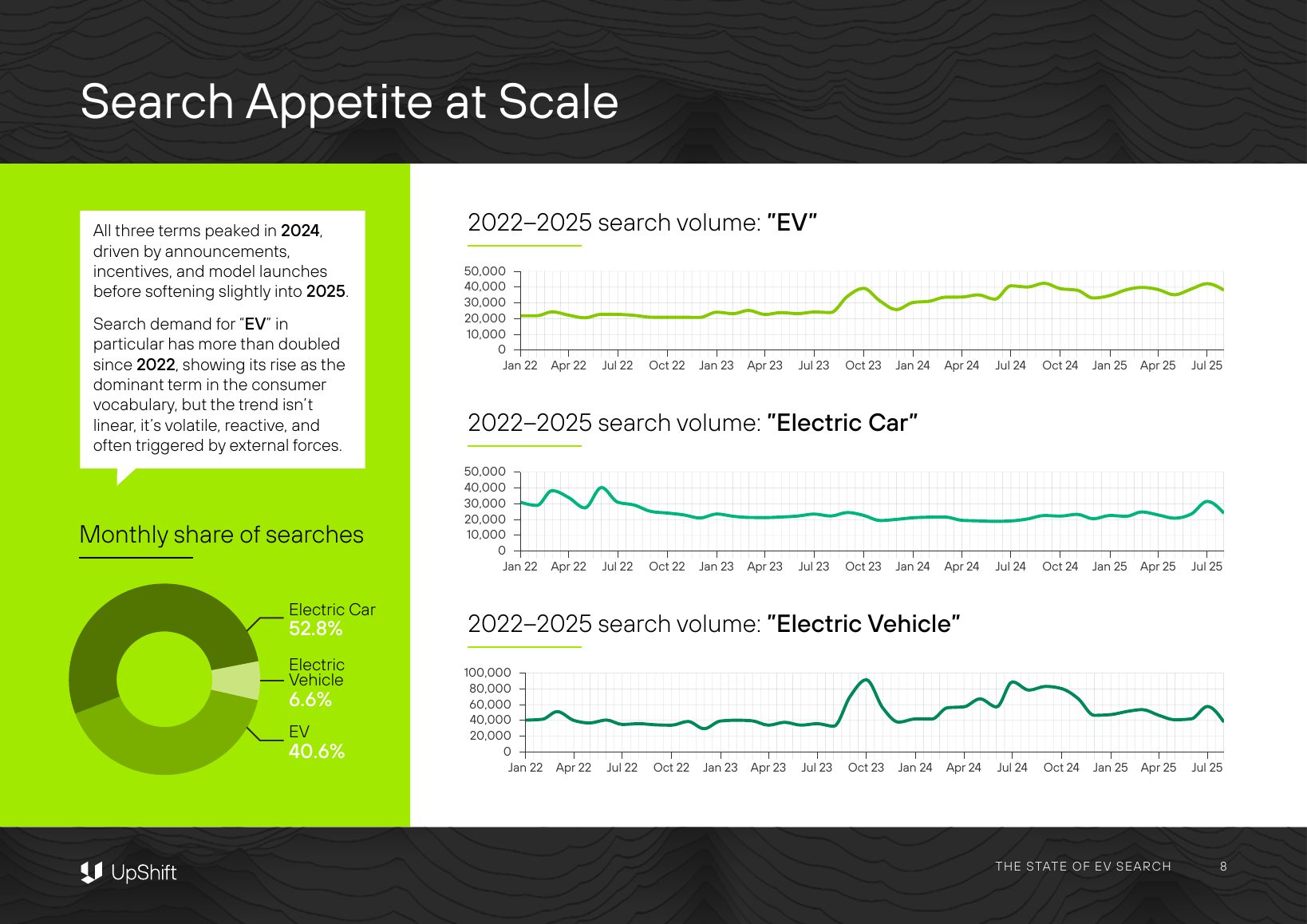
All three terms peaked in 2024, driven by announcements, incentives, and model launches before softening slightly into 2025.
Search demand for “EV” in particular has more than doubled since 2022, showing its rise as the dominant term in the consumer vocabulary, but the trend isn’t linear, it’s volatile, reactive, and often triggered by external forces.
Monthly share of searches across the three generic terms: Electric Car 52.8%, EV 40.6%, Electric Vehicle 6.6%. Source report, page 08.
Authoritative source visual · page 8
2022–2025 search volume: “EV”, “Electric Car” and “Electric Vehicle”
Analysing Search Clusters to Reveal Underlying Intent · page 09
While overall search volume shows the scale of interest, it doesn’t tell us what people are actually trying to understand or solve.
To build that layer of insight, we analysed UK search data across thousands of related keywords, not just the headline terms, but all their meaningful variations.
Rather than looking at these in isolation, we grouped them into clusters, families of queries that share a common underlying intent. This method helps surface broad behavioural themes and clarify what users are really looking for at different stages of the journey.
Why This Matters
These linguistic and behavioural differences reveal more than just semantics
They signal how different audiences approach electrification:
Car
Affordability and lifestyle
EV
Ownership and infrastructure
Vehicle
Policy and compliance
Analysing Search Clusters to Reveal Underlying Intent
10“EV”
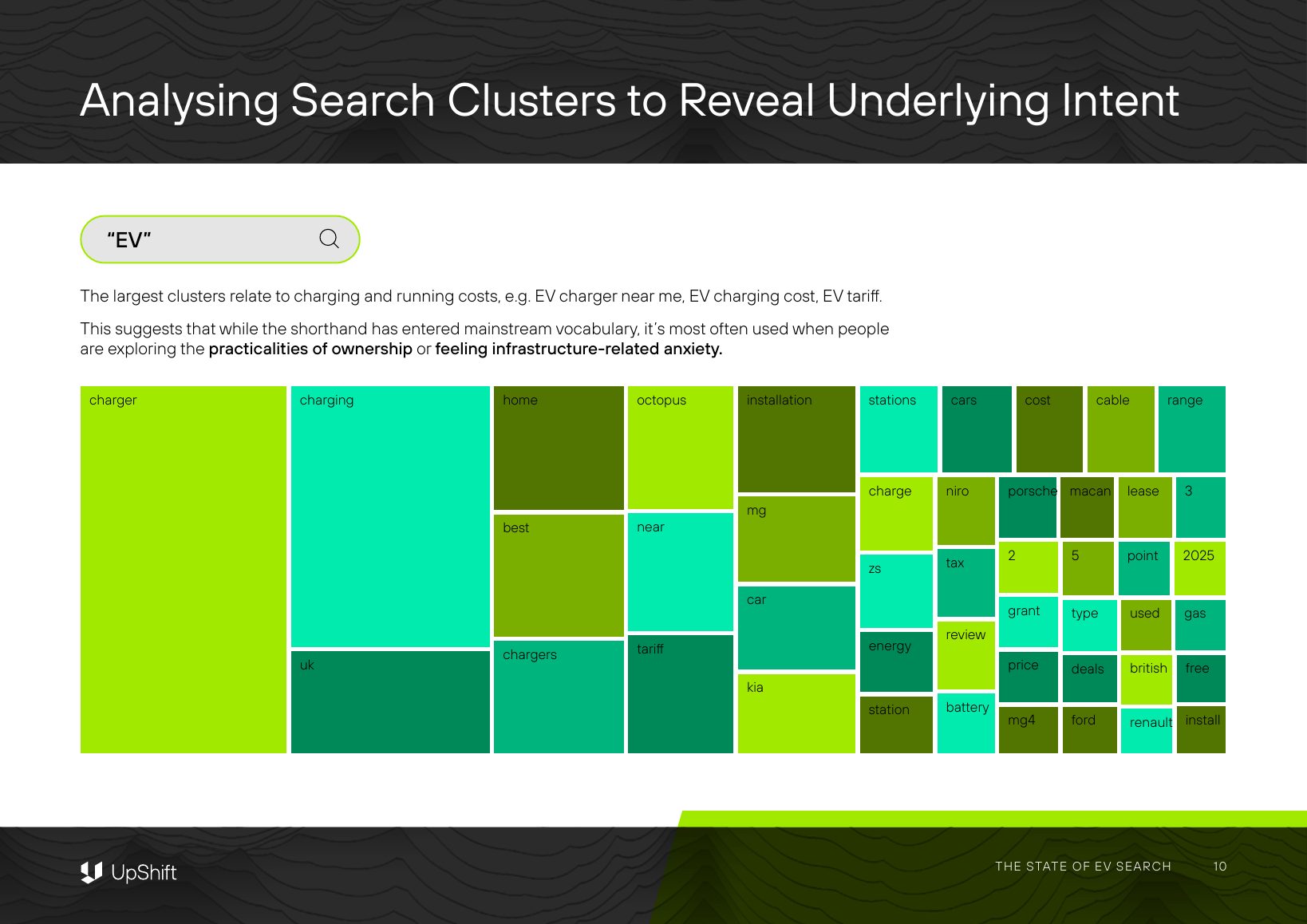
The largest clusters relate to charging and running costs, e.g. EV charger near me, EV charging cost, EV tariff.
This suggests that while the shorthand has entered mainstream vocabulary, it’s most often used when people are exploring the practicalities of ownership or feeling infrastructure-related anxiety.
Authoritative source visual · page 10
“EV” search cluster map
Analysing Search Clusters to Reveal Underlying Intent · page 11
“Electric Car”
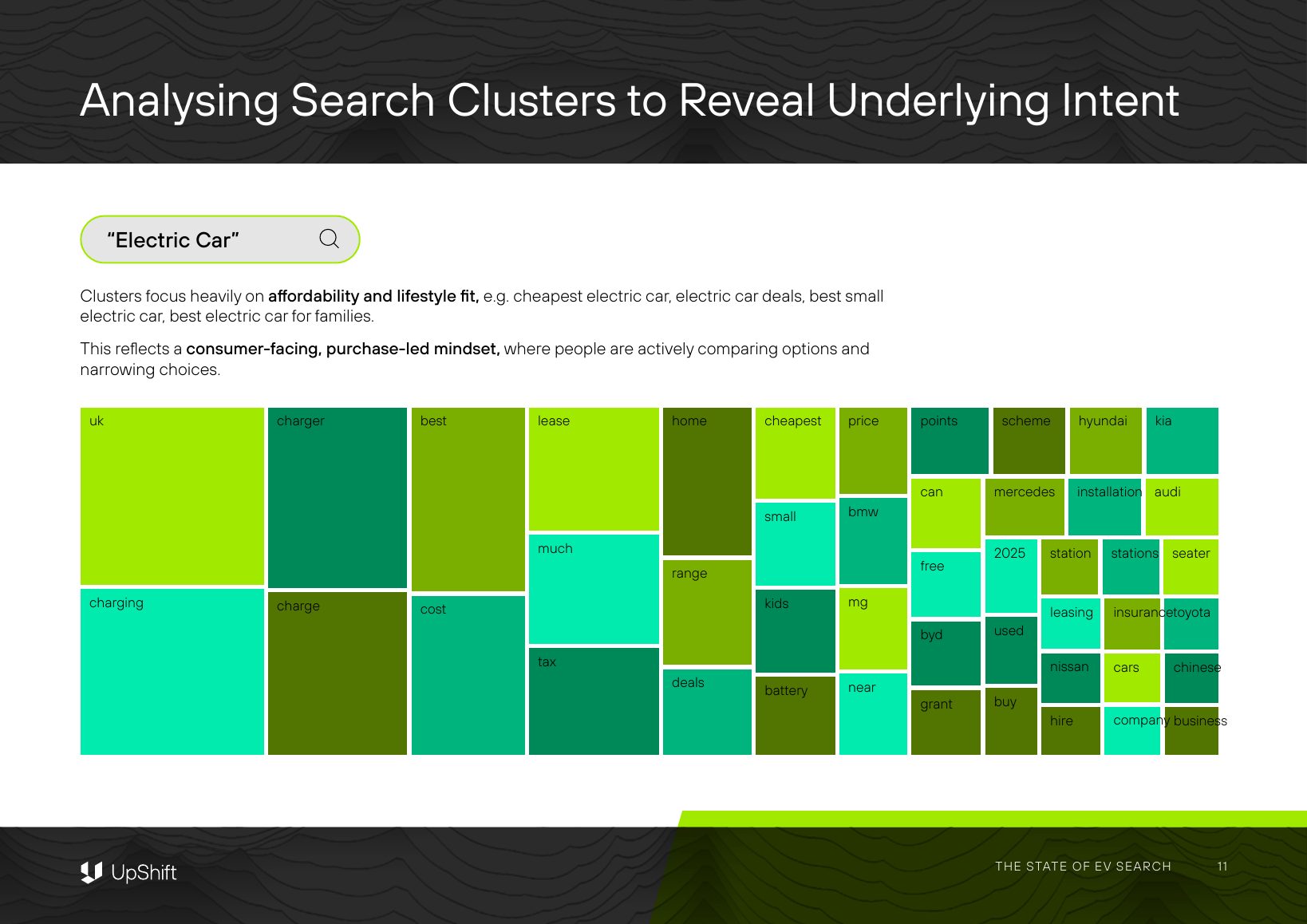
Clusters focus heavily on affordability and lifestyle fit, e.g. cheapest electric car, electric car deals, best small electric car, best electric car for families.
This reflects a consumer-facing, purchase-led mindset, where people are actively comparing options and narrowing choices.
Authoritative source visual · page 11
“Electric Car” search cluster map
Analysing Search Clusters to Reveal Underlying Intent
12“Electric Vehicle”
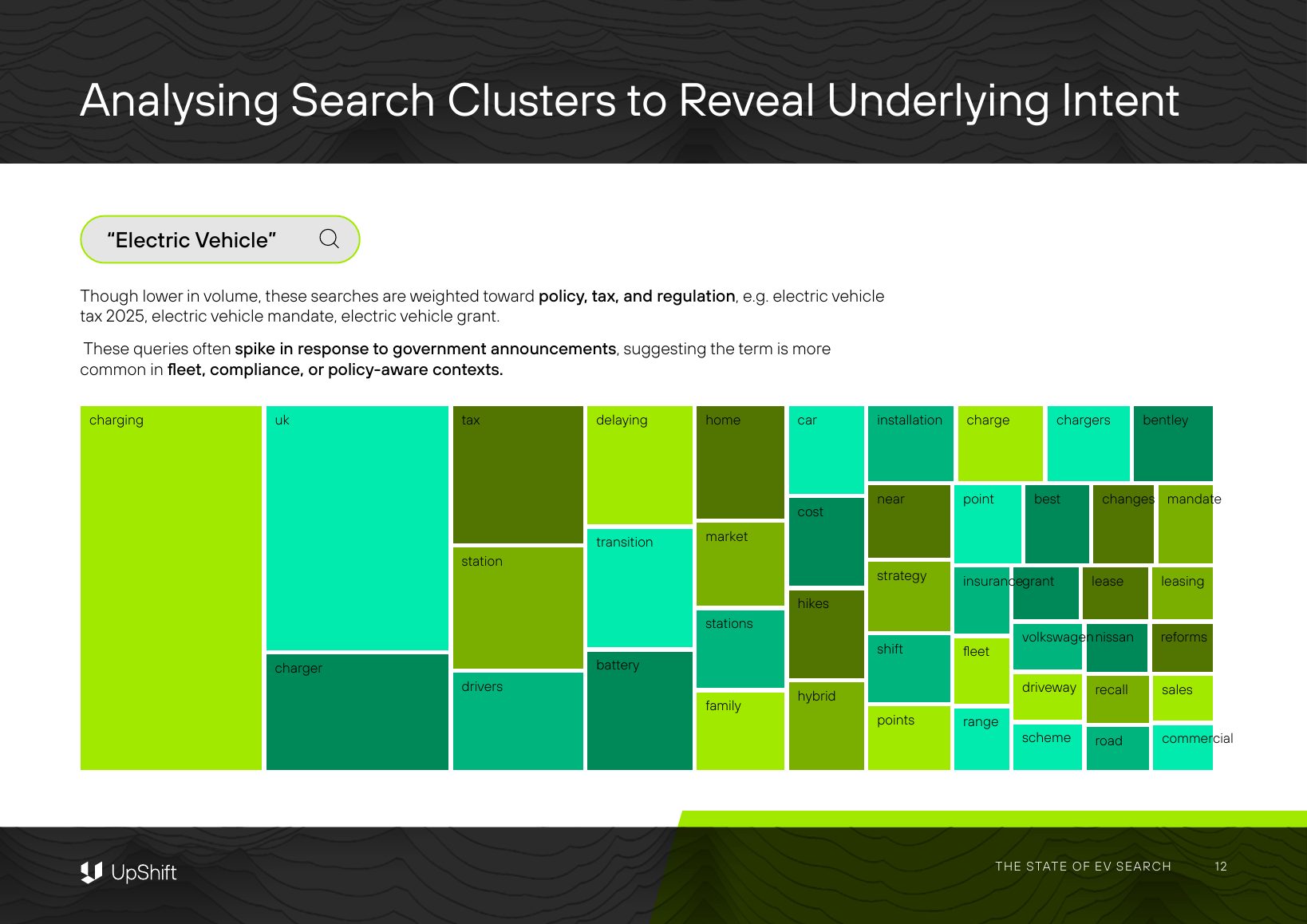
Though lower in volume, these searches are weighted toward policy, tax, and regulation, e.g. electric vehicle tax 2025, electric vehicle mandate, electric vehicle grant.
These queries often spike in response to government announcements, suggesting the term is more common in fleet, compliance, or policy-aware contexts.
Authoritative source visual · page 12
“Electric Vehicle” search cluster map
Most Searched EV Models
While generic search interest for EVs shows the scale of consumer engagement, looking at specific model-level demand helps us understand what’s actually driving consideration.
Most Searched EV Models · page 13
While generic search interest for EVs shows the scale of consumer engagement, looking at specific model-level demand helps us understand what’s actually driving consideration.
To uncover this, we analysed search volume for over 50 of the most prominent electric cars on sale in the UK, tracking both exact model keywords (e.g. “Tesla Model 3”) and their broader keyword variants (e.g. “Tesla Model 3 price”, “Model 3 range”, etc.). The data reflects average monthly UK search volumes across 2025, as well as year-on-year change compared to 2024.
Together, these numbers offer a snapshot of where the energy in the market really is, which brands are gaining traction, which models are fading, and how consumer attention is shifting as the EV landscape matures.
Model-Level Demand is Concentrated, But Shifting Fast
While consumer search interest spans dozens of EV models, demand is highly concentrated in a handful of clear frontrunners.
Even among these, the leaderboard is changing rapidly. The Tesla Model 3 still commands the highest total search volume at 250,000 monthly queries, but it now faces stiff competition from fast-rising challengers like the BYD Seal and Volvo EX30, both of which have posted YoY search growth over 30%.
SUVs continue to dominate the landscape, with models like the Tesla Model Y, Skoda Enyaq, and Hyundai Ioniq 5 all generating six-figure search volumes, reflecting the segment’s strong alignment with UK consumer preferences. However, some previously hyped models are seeing interest plateau or decline, Kia EV6 searches have dropped 15% YoY, while the Tesla Model X is down 6%.
This divergence in search performance reveals a market where brand momentum can shift quickly, often driven by pricing changes, new launches, or earned media buzz. The battleground is no longer just about range or badge; search data shows the winners are those matching consumer priorities on value, format, and visibility.
“Tesla Model 3” monthly queries
Source report, page 14“BYD Seal” & “Volvo EX30” YoY search growth
Source report, page 14Kia EV6 YoY search change
Source report, page 14The Top 20 Most Searched EV Models in the UK · page 15
This table ranks the top 20 EV models by total monthly search volume.
Combining exact keyword queries (e.g. “Tesla Model Y”) with long-tail variations such as “Tesla Model Y price”, “Model Y range”, or “Tesla Model Y lease deals.”
This gives us a clearer view of real-world interest not just brand awareness, but active consumer curiosity, often tied to decision-making moments.
Structured evidence
The Top 20 Most Searched EV Models in the UK
| Rank | Model | Exact keyword vol. | Total search vol. (incl. variations) | YoY change |
|---|---|---|---|---|
| 1 | TESLA MODEL 3 | 114,000 | 250,000 | +5% |
| 2 | TESLA MODEL Y | 100,000 | 213,000 | +5% |
| 3 | BYD SEAL | 71,000 | 167,000 | +45% |
| 4 | POLESTAR 2 | 62,000 | 133,000 | +4% |
| 5 | KIA EV9 | 51,000 | 110,000 | +34% |
| 6 | BMW I4 | 48,000 | 132,000 | +15% |
| 7 | SKODA ENYAQ | 47,000 | 126,000 | +14% |
| 8 | KIA EV6 | 45,000 | 103,000 | -15% |
| 9 | VOLVO EX30 | 41,000 | 94,000 | +34% |
| 10 | HYUNDAI IONIQ 5 | 38,000 | 118,000 | -2% |
| 11 | NISSAN LEAF | 36,000 | 130,000 | -3% |
| 12 | MG 4 | 30,000 | 87,000 | +16% |
| 13 | TESLA MODEL S | 22,000 | 53,000 | 0% |
| 14 | MERCEDES EQA | 21,000 | 72,000 | +17% |
| 15 | BMW IX3 | 20,000 | 47,000 | -5% |
| 16 | AUDI Q4 E-TRON | 15,000 | 54,000 | +15% |
| 17 | MERCEDES EQE | 12,000 | 54,000 | +22% |
| 18 | HYUNDAI KONA EV | 7,000 | 20,000 | -5% |
| 19 | LUCID AIR | 3,500 | 9,000 | 0% |
| 20 | PEUGEOT E-2008 | 1,400 | 10,000 | -10% |
Segment Breakdown: What Body Type Trends Reveal
To understand what’s driving EV search demand at a deeper level, we broke the data down by vehicle segment, grouping each model into logical consumer-facing categories like SUV, hatchback, saloon, or luxury flagship.
This allows us to go beyond the headline leaderboard and assess where demand is strongest, which types of models are gaining traction, and how consumer intent varies between form factors.
- City Cars / Superminis (A & B Segment)
- Family Hatchbacks (C-Segment)
- Compact SUVs / Crossovers (B & C-SUVs)
- Mid-size / Large SUVs (D & E-SUVs)
- Saloons / Coupes (D-Segment & Premium)
- Premium / Luxury Flagships
Structured evidence
City Cars / Superminis (A & B Segment)
| Rank | Model | Exact keyword search volume (avg monthly) | Total search vol. (incl. variations) | YoY change |
|---|---|---|---|---|
| 1 | BYD DOLPHIN | 27,000 | 62,000 | 37% |
| 2 | RENAULT ZOE | 14,000 | 46,000 | -3% |
| 3 | HONDA E | 17,000 | 34,000 | 8% |
| 4 | FIAT 500E | 7,800 | 19,000 | 15% |
| 5 | MINI ELECTRIC (MINI COOPER SE) | 2,800 | 14,000 | 9% |
| 6 | PEUGEOT E-208 | 2,700 | 10,000 | 10% |
| 7 | RENAULT 5 E-TECH | 2,600 | 6,600 | 53% |
City Cars / Superminis (A & B Segment)
Small, affordable, and built for the urban commuter, this category remains relevant, though total search volumes are lower than larger formats.
BYD Dolphin
The BYD Dolphin stands out with 62,000 total searches and +37% YoY growth, suggesting Chinese brands are gaining visibility.
Renault Zoe, Fiat 500e and Mini Electric
Models like the Renault Zoe, Fiat 500e, and Mini Electric still register demand, though not all are seeing growth.
Renault 5 E-Tech
The Renault 5 E-Tech, despite not yet launching, is already driving significant interest, up +53% YoY, thanks to nostalgic design and aggressive pre-launch comms.
This is the affordability battleground. Search intent here is practical and price-led, a mix of first-car buyers, city dwellers, and value hunters.
Structured evidence
Family Hatchbacks (C-Segment)
| Rank | Model | Exact keyword search volume (avg monthly) | Total search vol. (incl. variations) | YoY change |
|---|---|---|---|---|
| 1 | NISSAN LEAF | 36,000 | 130,000 | -3% |
| 2 | MG 4 | 20,000 | 87,000 | 16% |
| 3 | VW ID.3 | 23,000 | 78,000 | 2% |
| 4 | CUPRA BORN | 71,000 | 33,000 | 21% |
| 5 | VAUXHALL CORSA-E | 3,900 | 18,000 | 4% |
| 6 | KIA SOUL EV | 2,000 | 5,500 | -2% |
| 7 | VAUXHALL ASTRA ELECTRIC | 800 | 2,800 | 16% |
Family Hatchbacks (C-Segment)
Once the dominant car shape in the UK, hatchbacks now face pressure from SUVs and crossovers.
- The Nissan Leaf, an early leader, is showing signs of decline (–3% YoY) as newer rivals emerge.
- The Cupra Born and VW ID.3 perform well, but neither has broken into mass-market levels of interest.
Structured evidence
Compact SUVs / Crossovers (B & C-SUVs)
| Rank | Model | Exact keyword search volume (avg monthly) | Total search vol. (incl. variations) | YoY change |
|---|---|---|---|---|
| 1 | VOLVO EX30 | 41,000 | 94,000 | 34% |
| 2 | MERCEDES EQA | 21,000 | 72,000 | 17% |
| 3 | MG ZS EV | 11,000 | 26,000 | 6% |
| 4 | KIA NIRO EV | 11,000 | 22,000 | 14% |
| 5 | PEUGEOT E-2008 | 1,400 | 10,000 | 10% |
| 6 | HYUNDAI KONA EV | 900 | 3,700 | -14% |
| 7 | JEEP AVENGER EV | 600 | 880 | 40% |
Compact SUVs / Crossovers (B & C-SUVs) · page 19
Sitting between hatchbacks and larger SUVs, this segment is quietly gaining momentum.
Volvo EX30
The Volvo EX30 is the breakout model here, +34% YoY and over 90,000 total searches, showing that smart design and price positioning can win big.
Mercedes EQA, Kia Niro EV and MG ZS EV
Mercedes EQA, Kia Niro EV, and MG ZS EV all perform steadily, reflecting a growing appeal across different price points.
Company car meets family use
Several of these models are bridging company car and family use, a sweet spot for mass adoption.
This segment is versatile, with models balancing size, price, and badge appeal. It could be the next sweet spot for EV volume.
Structured evidence
Mid-size / Large SUVs (D & E-SUVs)
| Rank | Model | Exact keyword search volume (avg monthly) | Total search vol. (incl. variations) | YoY change |
|---|---|---|---|---|
| 1 | TESLA MODEL Y | 100,000 | 213,000 | 2% |
| 2 | SKODA ENYAQ | 47,000 | 126,000 | 14% |
| 3 | HYUNDAI IONIQ 5 | 38,000 | 118,000 | -2% |
| 4 | KIA EV9 | 51,000 | 110,000 | 34% |
| 5 | KIA EV6 | 45,000 | 103,000 | -15% |
| 6 | FORD MUSTANG MACH-E | 13,000 | 60,000 | -4% |
| 7 | VW ID.4 | 15,000 | 55,000 | 14% |
| 8 | AUDI Q4 E-TRON | 15,000 | 54,000 | 15% |
| 9 | BMW IX3 | 18,000 | 47,000 | 15% |
Mid-size / Large SUVs (D & E-SUVs)
This is the category with the highest total search volume by far.
- The Tesla Model Y is the undisputed king, 213,000 monthly searches, backed by brand familiarity and global visibility.
- Kia EV9, Skoda Enyaq, and Hyundai Ioniq 5 also show strength, with high combined volumes and strong YoY growth.
- Even more established models like the VW ID.4 and Audi Q4 e-tron post respectable numbers, suggesting this isn’t just hype, it’s long-term category strength.
Structured evidence
Saloons / Coupes (D-Segment & Premium)
| Rank | Model | Exact keyword search volume (avg monthly) | Total search vol. (incl. variations) | YoY change |
|---|---|---|---|---|
| 1 | TESLA MODEL 3 | 114,000 | 250,000 | 5% |
| 2 | BYD SEAL | 71,000 | 167,000 | 45% |
| 3 | POLESTAR 2 | 62,000 | 133,000 | 14% |
| 4 | BMW I4 | 48,000 | 132,000 | 15% |
| 5 | MERCEDES EQE | 12,000 | 54,000 | 22% |
| 6 | HYUNDAI IONIQ 6 | 13,000 | 34,000 | 20% |
| 7 | AUDI A6 E-TRON | 5,000 | 13,000 | 19% |
Saloons / Coupes (D-Segment & Premium)
Though narrower in variety, this category performs surprisingly well in search, driven by both innovation and executive appeal.
Tesla Model 3 and BYD Seal
Tesla Model 3 and BYD Seal both lead here, the latter showing massive momentum at +45% YoY.
BMW i4, Polestar 2 and Hyundai Ioniq 6
Strong volume across BMW i4, Polestar 2, and Hyundai Ioniq 6 shows this isn’t just a Tesla game anymore.
Fleet benefits, tax advantages and high-end tech
These models often feature in search queries around fleet benefits, tax advantages, and high-end tech.
This is where rational meets emotional. Sleek design, strong ranges, and tax-efficient leasing make this a powerful segment for business and premium private buyers.
Structured evidence
Premium / Luxury Flagships
| Rank | Model | Exact keyword search volume (avg monthly) | Total search vol. (incl. variations) | YoY change |
|---|---|---|---|---|
| 1 | PORSCHE TAYCAN | 24,000 | 151,000 | 8% |
| 2 | JAGUAR I-PACE | 24,000 | 88,000 | 4% |
| 3 | TESLA MODEL X | 25,000 | 54,000 | -6% |
| 4 | TESLA MODEL S | 22,000 | 53,000 | -10% |
| 5 | MERCEDES EQS | 8,200 | 42,000 | 3% |
| 6 | BMW I7 | 23,000 | 40,000 | 16% |
| 7 | LUCID AIR | 5,000 | 9,900 | 10% |
| 8 | AUDI E-TRON GT | 3,300 | 5,000 | 4% |
Premium / Luxury Flagships
Though lower in overall search volume, these models matter, especially for influencing brand perception and showcasing innovation.
- Porsche Taycan leads the charge with 151,000 total searches, followed by the Jaguar I-Pace, BMW i7, and Tesla Model S.
- While YoY growth is more modest, search interest in newer nameplates like Lucid Air suggests there’s room for innovation to cut through, if the price and press are right.
- These models may not convert as easily, but they often shape how the public (and press) perceive the pace of EV progress.
This segment isn’t about volume, it’s about brand halo. If you want to win hearts, not just wallets, this is where the drama lives.
TLDR
Key Takeaways: What Search Volumes Really Tell Us
- 01SUVs dominate
Bigger formats account for the lion’s share of EV search volume. They align with consumer priorities around range, safety, and confidence, making them the perceived “safe bet” while charging and battery-life anxieties remain.
- 02Saloons are surging
Models like the BYD Seal and Polestar 2 show saloons and coupes are no longer niche. Strong media coverage and striking design are helping them outpace traditional hatchbacks, even at similar price points.
- 03City cars and hatchbacks are steady, not growing
Practical options like the Nissan Leaf and MG4 continue to draw healthy search volumes, but growth is flat. Without innovation or fresh press, they feel dependable but less exciting.
- 04New entrants draw curiosity
BYD, Lucid and other challengers are making visible dents in search demand. Even if sales remain small, search activity shows consumers are open to exploring unfamiliar brands when they bring something different to the table.
- 05Legacy leaders lose momentum
Early pioneers such as the Nissan Leaf and Ford Mustang Mach-E are sliding down the search rankings. Familiarity is no longer enough to hold attention in a market that prizes novelty and perceived value.
- 06Premium drives aspiration
Flagships like the Porsche Taycan, BMW i7, and Lucid Air don’t dominate registrations, but they dominate attention. These “halo” models shape perceptions of EV innovation, even if uptake is limited.
Overall: What This Tells Us About the EV Market
Search data offers a window into momentum, perception, and shifting priorities.
The models generating the most interest are not always the ones topping sales charts, but they reveal the ideas and aspirations shaping the EV narrative, status, savings, curiosity, convenience, and a dose of uncertainty.
The direction of travel is clear: momentum is tilting toward newer entrants and bolder formats. Traditional players like Nissan, Vauxhall, and Ford remain part of the conversation, but they are losing ground in search to challenger brands that push harder on design, performance, or affordability. Consumers are no longer simply searching for “an EV”, they are searching for a better EV.
We also see how perception and reality diverge. City cars are affordable and available, yet generate little buzz. Premium flagships command headlines without commanding roads. SUVs sit between the two, converting both visibility and adoption. This divergence underscores the gap between mindshare and market share, a critical factor for brands planning their next moves.
Structured evidence
Search visibility versus sales volume
| Brand | Search visibility (UK) | Sales volume (UK) | Visibility > sales? |
|---|---|---|---|
| TESLA | Very High | Very High | No (Aligned) |
| BYD | High and Rising | Low | Yes |
| POLESTAR | High | Low to Moderate | Yes |
Overall: What This Tells Us About the EV Market (cont.)
24So in the next section, we’ll zoom in on these EV-first brands to explore how they’re outperforming legacy players in the digital battleground and what others can learn from the way they’ve engineered relevance.
Brand Spotlights
Who’s Really Leading the EV Conversation?
Brand Spotlights: Who’s Really Leading the EV Conversation?
In the UK EV market, visibility and influence don’t always match sales volumes. Some brands dominate registrations, but not attention.
Others, particularly EV-first players, are winning the conversation online, commanding outsized search interest compared to their actual market footprint.
This section explores three brands at the heart of that story: Tesla, BYD, and Polestar. Each represents a different angle on the EV transition, from Tesla’s cultural and sales dominance, to BYD’s affordability-driven surge, to Polestar’s design-led premium niche.
To set the scene, we compared them across key dimensions of performance and perception, from search visibility and sales volumes to consumer positioning and growth momentum.
Brand Positioning Matrix · page 26
This comparison makes it clear: Tesla remains the benchmark, but its dominance is being tested.
BYD is converting global momentum into rapid UK growth, and Polestar has carved out a distinct brand identity that far outweighs its registration numbers. Together, these brands highlight how attention is fragmenting in the EV space, and how digital visibility is becoming just as important as showroom performance.
From here, we’ll take a closer look at each brand in turn, unpacking what’s driving their search interest, how that compares with their UK market presence, and what other OEMs can learn from their positioning.
Structured evidence
Brand Positioning Matrix
| Dimension | Tesla | BYD | Polestar |
|---|---|---|---|
| Search visibility | Very high, Model Y & Model 3 dominate UK EV search volumes (200k+ monthly each). | Rapidly rising, Seal & Dolphin showing double-digit YoY growth, outpacing sales. | High relative to sales, Polestar 2 consistently strong in searches (133k monthly). |
| UK sales volumes | Market leader, Model Y was UK’s best-selling EV in 2024; thousands sold monthly. | Small but fast growth, ~20,000 units in 2025 so far (double 2024 full-year). | Niche, well below 10k units annually, but with strong brand recognition. |
| Growth momentum | Slowing in some months; signs of maturity. | Explosive growth (+100% YoY), still in early adoption phase. | Moderate, tied to premium niche; search growth > sales growth. |
| Brand positioning | Tech-led disruptor, mass-market + premium. Strong cultural relevance. | Value-led, diverse line-up (city cars to SUVs). Clear affordability pitch. | Design-led, premium-lite. Modern aesthetic and Scandinavian identity. |
| Consumer perception | Default EV brand; aspirational but increasingly “mainstream.” | Challenger, curiosity-driven. Affordable & new, curiosity outpaces ownership. | Stylish, aspirational, seen as “cool” alternative to Tesla. |
| Challenges | Competition from Chinese entrants; softening brand buzz in UK media. | Converting high visibility into sustained sales; building trust and infrastructure. | Limited range and volume; less competitive on price vs mass brands. |
Brand Spotlight
27Brand Spotlight: Tesla
Tesla remains in a league of its own when it comes to EV-related search visibility in the UK.
Across all queries containing the term “Tesla”, the brand attracts over 3.2 million searches per month, spanning everything from vehicle models to charging infrastructure, share price, and cultural moments.
This scale isn’t just impressive, it’s indicative of Tesla’s broader status. For many UK consumers, Tesla is EV. That default association gives the brand an ongoing advantage in search, particularly in a category where trust, range anxiety, and resale value are still barriers.
For many UK consumers, Tesla is EV.
Tesla · Search Performance
Cluster analysis
Cluster analysis of Tesla search queries shows how that visibility breaks down.
Model-Specific
~1.75m monthly searches
Terms like “Tesla Model 3”, “Tesla Model Y”, “Tesla Cybertruck.”
This is a brand where people know what they want, and they search accordingly.
Price, Leasing & Value
~230k monthly searches
Queries such as “Tesla Model 3 price UK”, “Tesla cheapest model”, or “Tesla PCP deals” show growing interest in affordability and financing options.
Reviews & Comparisons
~130k monthly searches
Terms like “Tesla Model Y review”, “Tesla vs Polestar”, or “Is Tesla worth it” reveal ongoing appetite for validation and reassurance.
Technology & Features
~80k monthly searches
Encompasses searches around “Tesla Autopilot”, “Tesla charging”, “Tesla Powerwall”, and other product adjacencies.
Dealers & Availability
~45k monthly searches
Including queries like “Tesla test drive UK”, “Tesla dealership near me”, or “Tesla delivery times.”
Generalised Searches
~970k monthly searches
Includes broad or non-specific terms like “Tesla”, “Tesla UK”, “Elon Musk Tesla”, and others with unclear transactional intent.
Brand Spotlight: Tesla
29Tesla: Search Performance
Tesla’s search profile is the most mature of any EV brand in the UK.
Nearly 55% of total search volume is model-specific, showing a high degree of product awareness and consideration-stage behaviour. The remaining volume is split across finance, tech, comparisons, and culture, reflecting a brand that lives well beyond the car lot.
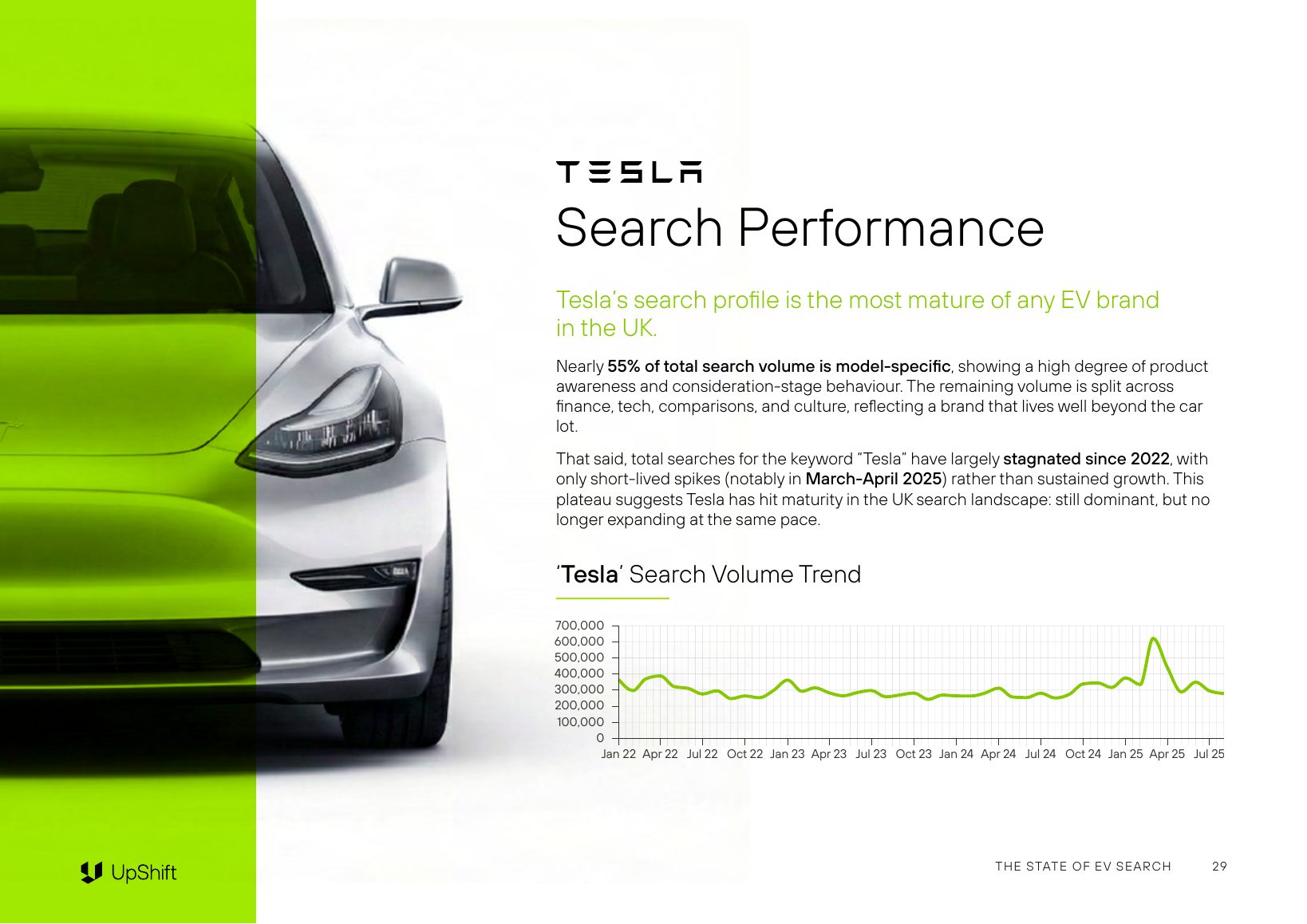
That said, total searches for the keyword “Tesla” have largely stagnated since 2022, with only short-lived spikes (notably in March-April 2025) rather than sustained growth. This plateau suggests Tesla has hit maturity in the UK search landscape: still dominant, but no longer expanding at the same pace.
Nearly 55% of total Tesla search volume is model-specific, showing a high degree of product awareness and consideration-stage behaviour. Source report, page 29.
Authoritative source visual · page 29
‘Tesla’ Search Volume Trend
Tesla Model 3 monthly searches in 2025
Source report, page 30Tesla Model Y monthly searches in 2025
Source report, page 30Tesla Model X monthly searches in 2025, down from 45k in 2022
Source report, page 31Tesla: Model Trends · pages 30–31
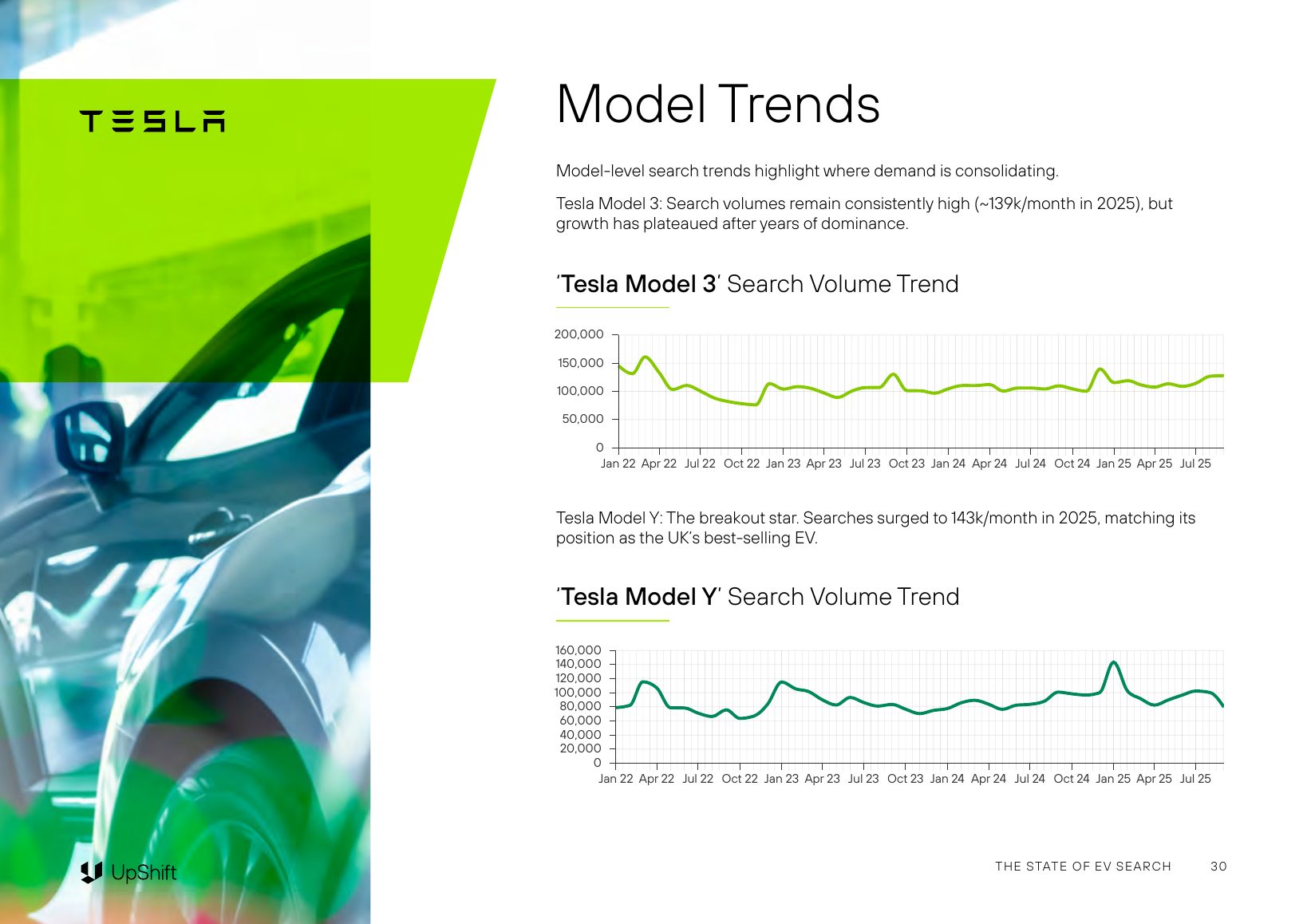
Model-level search trends highlight where demand is consolidating.
Tesla Model 3
Search volumes remain consistently high (~139k/month in 2025), but growth has plateaued after years of dominance.
Tesla Model Y
The breakout star. Searches surged to 143k/month in 2025, matching its position as the UK’s best-selling EV.
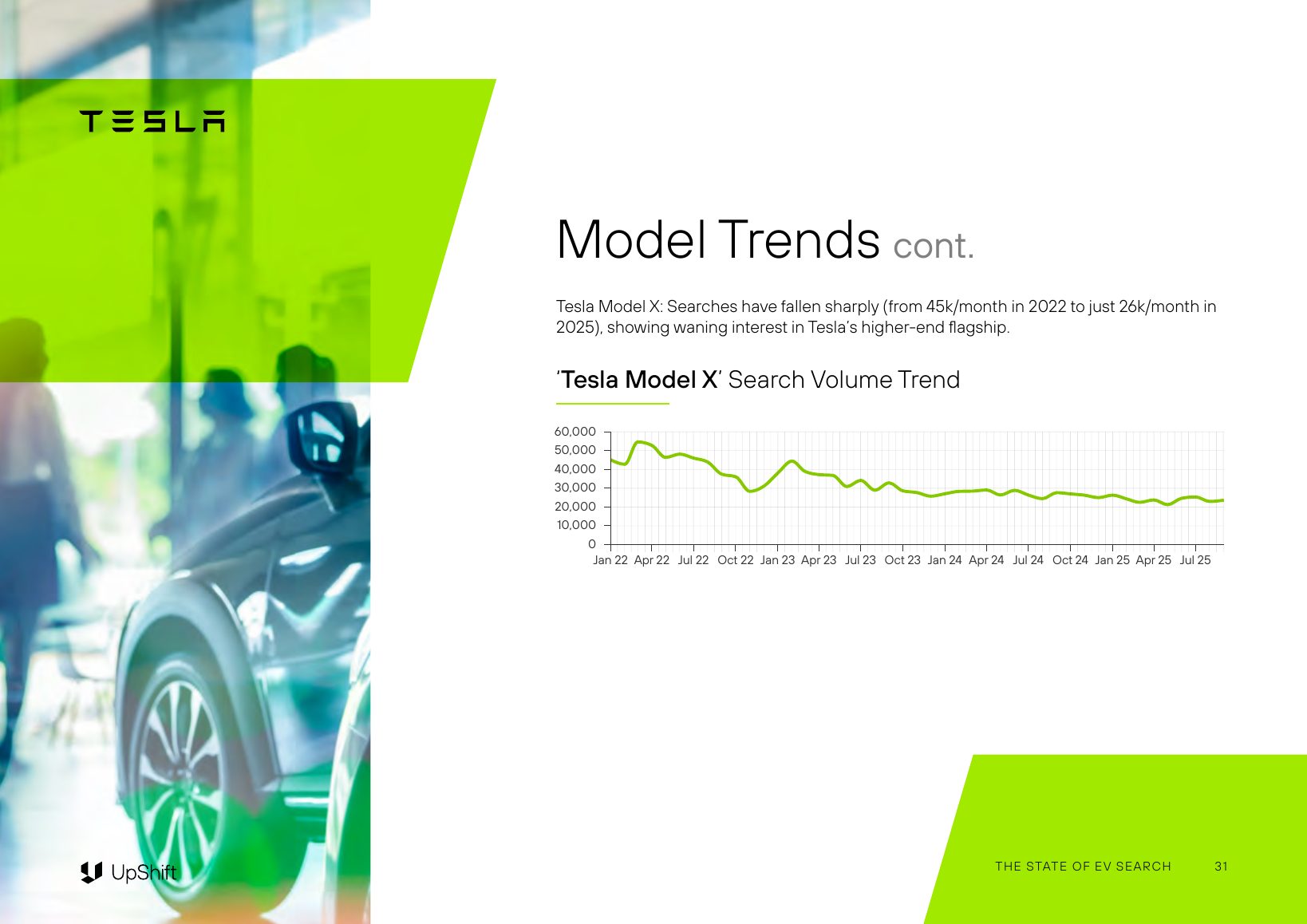
Tesla Model X
Searches have fallen sharply (from 45k/month in 2022 to just 26k/month in 2025), showing waning interest in Tesla’s higher-end flagship.
Authoritative source visual · page 30
‘Tesla Model 3’ and ‘Tesla Model Y’ Search Volume Trends
Authoritative source visual · page 31
‘Tesla Model X’ Search Volume Trend
Brand Spotlight: Tesla
32Tesla: Market Position
Tesla is one of the few EV brands where search demand and sales performance overlap. The Model Y was the UK’s best-selling EV in 2024, and Tesla consistently appears near the top of new registrations.
That said, momentum is uneven. Registrations surged through 2024 but dipped sharply in mid-2025: -36% year-on-year in May and -60% in July, before partially recovering in August. Analysts attribute this to a mix of factors, intensifying competition from Chinese brands like BYD, softer economic conditions, and increasing reputational risks tied to Elon Musk. His high-profile controversies, such as the January 2025 salute incident, generated widespread backlash. While it is difficult to prove causality, it’s generally accepted that sales declines in the following months coincided with periods of heightened media scrutiny.
Search data also shows these fluctuations aren’t just about cars, they reflect Tesla’s identity as a financial and cultural brand. For example, the sharp spike in Tesla searches earlier in 2025 aligns with the period when its share price plummeted, triggering a surge of financial-market interest. In fact, finance-related queries (e.g. Tesla share price, Tesla stock) account for over one million UK searches per month (around a third of all Tesla related search queries), more than the entire search demand for some established OEMs. This underlines how Tesla’s market position is sustained not just by car buyers, but by investors, the press, and public curiosity around Musk himself.
In short, Tesla’s market position in the UK remains powerful but volatile. It has succeeded in converting awareness into adoption, but its fortunes are now more tightly bound to cultural and financial narratives than any other automotive brand. This visibility is a double-edged sword: it fuels attention, but it also exposes Tesla to sharper swings in perception when sentiment turns.
Tesla UK registrations year-on-year, May 2025
Source report, page 32Tesla UK registrations year-on-year, July 2025
Source report, page 32Finance-related Tesla searches per month (around a third of all Tesla related queries)
Source report, page 32Tesla · page 33
What’s Driving Search Demand?
Cultural dominance
Tesla is shorthand for “EV” in UK consumer searches.
Ecosystem effect
Superchargers, Powerwall, and Autopilot extend visibility beyond cars.
Media buzz
Elon Musk is both a magnet for attention and a reputational risk.
Simplicity
A streamlined model line-up makes Tesla easy to search and compare.
Brand Spotlight: BYD · page 34
BYD’s surge in UK search visibility has been nothing short of remarkable.
In 2022, searches for the brand were negligible. By 2025, BYD now attracts ~882,000 searches per month across all keywords containing the brand name. That puts it in the same league as long-established OEMs, despite only entering the UK market in 2023.
The growth has been highly event-driven, with spikes in 2024–25 linked to new model launches (Dolphin, Seal, Sealion 7), attention-grabbing price announcements (like the Dolphin Surf at £18,650), and awareness campaigns such as UEFA EURO 2024 sponsorships and Octopus EV partnerships.
BYD · Search Performance
Cluster analysis
Cluster analysis of BYD search queries shows where consumer attention is focused.
Model-Specific
~278k monthly searches
Search terms such as ‘BYD seal’, ‘BYD Atto 3’ or ‘BYD Sealion 7’ for example.
Price, Leasing & Value
~130k monthly searches
Queries such as “BYD price UK”, “BYD Dolphin cost”, “BYD cheapest EV”. Affordability is the dominant lens through which BYD is being discovered.
Reviews & Comparisons
~56k monthly searches
Terms like “BYD Seal review”, “BYD vs Tesla”, “BYD reliability”. This reflects a brand still being assessed and benchmarked by a curious, but not yet convinced, audience.
Technology & Features
~20k monthly searches
Smaller but meaningful queries around “BYD battery”, “BYD bus”, and “BYD energy” underline BYD’s wider role as a diversified EV and energy company.
Dealers & Availability
~5k monthly searches
Including “BYD dealers UK” and “BYD cars for sale”, these signals show that buyers are actively exploring where to access the cars.
Generalised Searches
~392k monthly searches
The bulk of BYD’s volume still sits in broad brand searches without clear transactional intent. This highlights how BYD remains in a discovery and trust-building stage in the UK market.
Brand Spotlight: BYD
36BYD: Search Performance
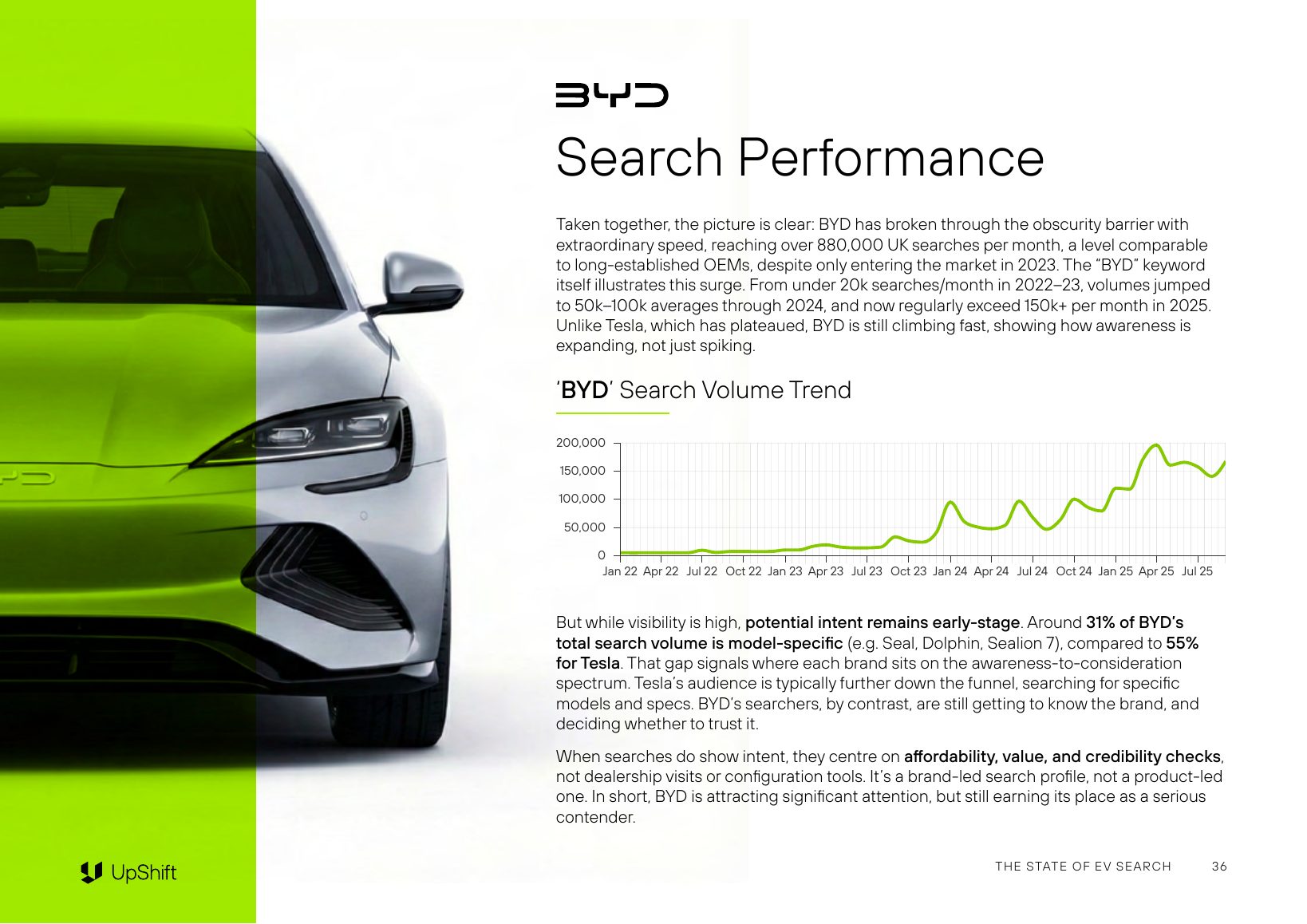
Taken together, the picture is clear: BYD has broken through the obscurity barrier with extraordinary speed, reaching over 880,000 UK searches per month, a level comparable to long-established OEMs, despite only entering the market in 2023. The “BYD” keyword itself illustrates this surge. From under 20k searches/month in 2022–23, volumes jumped to 50k–100k averages through 2024, and now regularly exceed 150k+ per month in 2025. Unlike Tesla, which has plateaued, BYD is still climbing fast, showing how awareness is expanding, not just spiking.
Authoritative source visual · page 36
‘BYD’ Search Volume Trend
Around 31% of BYD’s total search volume is model-specific (e.g. Seal, Dolphin, Sealion 7), compared to 55% for Tesla. Source report, page 36.
BYD: Search Performance (cont.)
36But while visibility is high, potential intent remains early-stage. Around 31% of BYD’s total search volume is model-specific (e.g. Seal, Dolphin, Sealion 7), compared to 55% for Tesla. That gap signals where each brand sits on the awareness-to-consideration spectrum. Tesla’s audience is typically further down the funnel, searching for specific models and specs. BYD’s searchers, by contrast, are still getting to know the brand, and deciding whether to trust it.
When searches do show intent, they centre on affordability, value, and credibility checks, not dealership visits or configuration tools. It’s a brand-led search profile, not a product-led one. In short, BYD is attracting significant attention, but still earning its place as a serious contender.
BYD: Model Trends · page 37
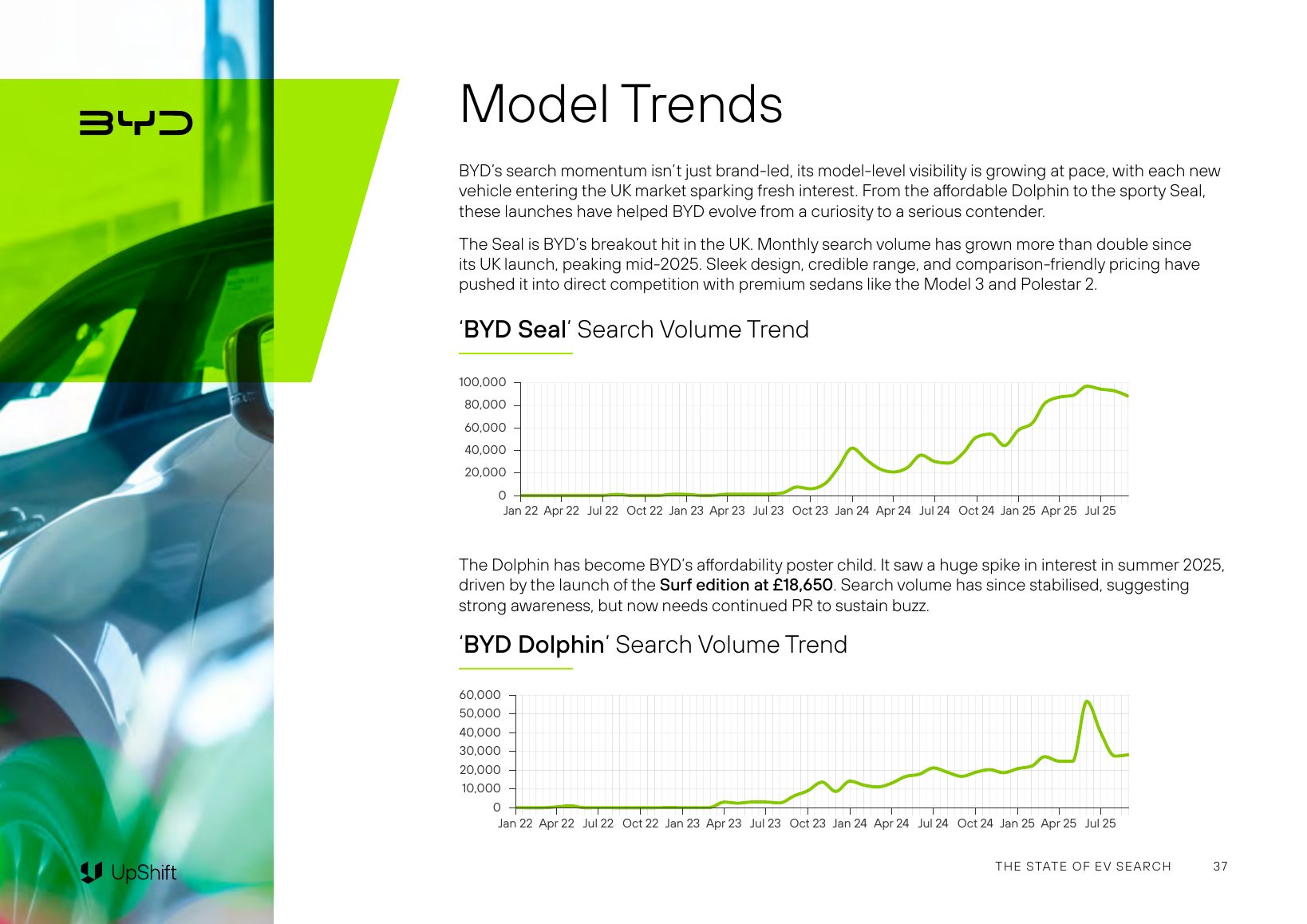
BYD’s search momentum isn’t just brand-led, its model-level visibility is growing at pace, with each new vehicle entering the UK market sparking fresh interest.
From the affordable Dolphin to the sporty Seal, these launches have helped BYD evolve from a curiosity to a serious contender.
The Seal is BYD’s breakout hit in the UK. Monthly search volume has grown more than double since its UK launch, peaking mid-2025. Sleek design, credible range, and comparison-friendly pricing have pushed it into direct competition with premium sedans like the Model 3 and Polestar 2.
The Dolphin has become BYD’s affordability poster child. It saw a huge spike in interest in summer 2025, driven by the launch of the Surf edition at £18,650. Search volume has since stabilised, suggesting strong awareness, but now needs continued PR to sustain buzz.
Authoritative source visual · page 37
‘BYD Seal’ and ‘BYD Dolphin’ Search Volume Trends
BYD: Model Trends (cont.) · page 38
Sealion 7 and Atto 3
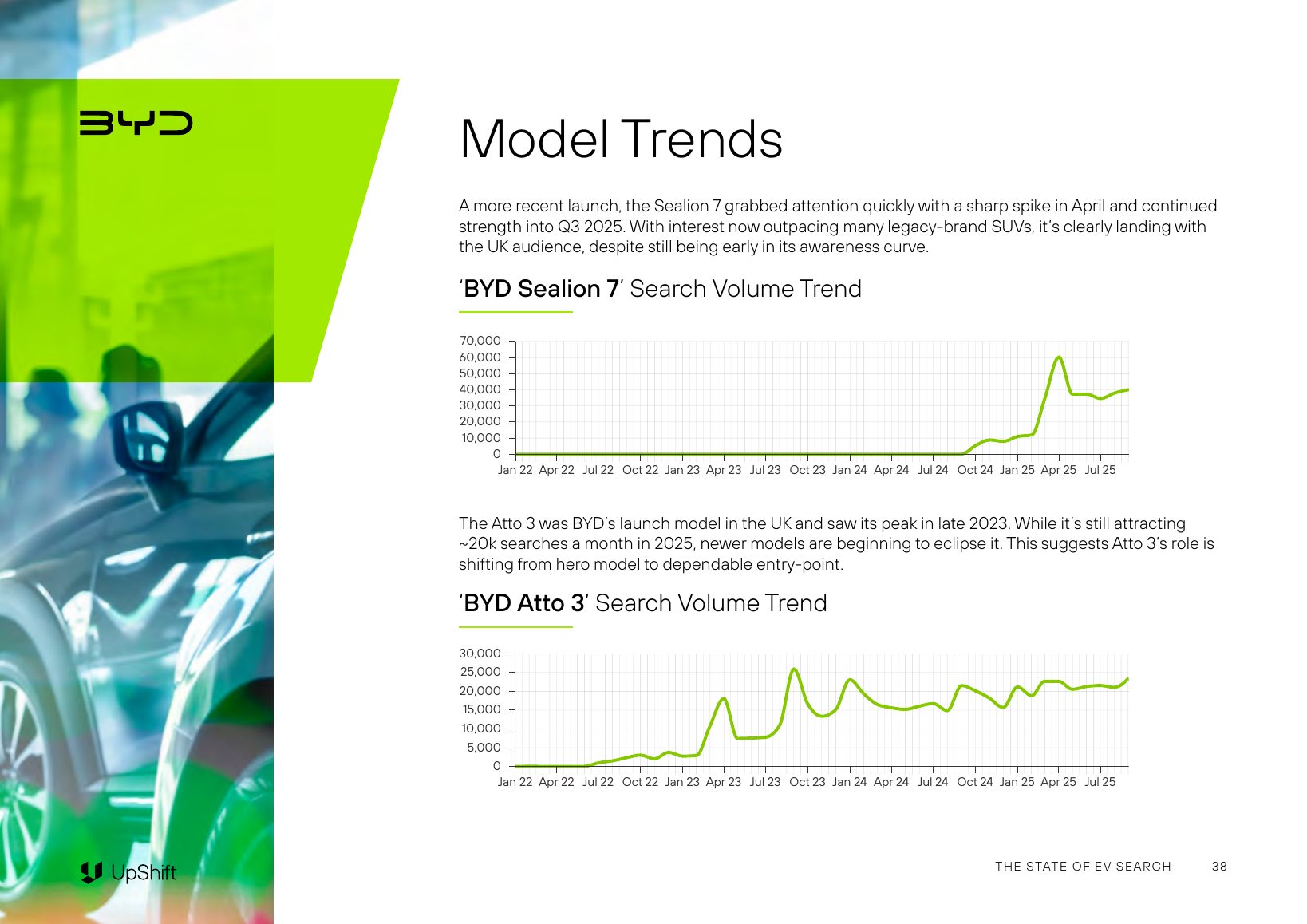
A more recent launch, the Sealion 7 grabbed attention quickly with a sharp spike in April and continued strength into Q3 2025. With interest now outpacing many legacy-brand SUVs, it’s clearly landing with the UK audience, despite still being early in its awareness curve.
The Atto 3 was BYD’s launch model in the UK and saw its peak in late 2023. While it’s still attracting ~20k searches a month in 2025, newer models are beginning to eclipse it. This suggests Atto 3’s role is shifting from hero model to dependable entry-point.
Authoritative source visual · page 38
‘BYD Sealion 7’ and ‘BYD Atto 3’ Search Volume Trends
Brand Spotlight: BYD
39BYD: Market Position
BYD may be a new name to many UK consumers, but behind the scenes it’s anything but a startup.
Already the world’s largest EV manufacturer by volume, its entry into the UK in early 2023 marked the beginning of a calculated push into one of Europe’s most competitive markets.
The approach? Aggressive pricing, rapid model rollout, and high-profile brand partnerships. The Atto 3 laid the groundwork, but momentum really took off in 2024 with the arrival of the Dolphin and Seal, and BYD’s visibility surged again in 2025 following its UEFA EURO 2024 sponsorship and partnerships with Octopus EV and others. The result: from obscurity to nearly 900k monthly searches, putting BYD on par with many legacy OEMs in just two years.
But while interest is surging, sales are still catching up. According to SMMT data, BYD sold just 3,621 vehicles in the UK in the first 8 months of 2025, compared to over 26,000 Teslas in the same period.
The Seal is leading BYD’s UK charge, but overall uptake remains modest. Some of this is structural, a relatively small dealership network and limited brand familiarity, but some of it reflects ongoing consumer hesitation. Search data still skews toward curiosity, not conversion.
Even so, BYD’s ascent feels inevitable. It’s not trying to play the legacy game, it’s outflanking it. With models undercutting rivals by thousands, specifications that often surprise, and a portfolio expanding into every major format (SUV, hatch, saloon), BYD is building something many Chinese challengers are still struggling to achieve: trust. And once that clicks, the sales curve may steepen just as fast as the search one did.
BYD monthly searches, from obscurity in just two years
Source report, page 39BYD vehicles sold in the UK in the first 8 months of 2025 (SMMT)
Source report, page 39Teslas sold in the UK in the same period
Source report, page 39BYD
What’s Driving Search Demand?
Launch momentum
Each new model (Seal, Dolphin, Sealion 7) triggers distinct spikes in search, with Seal alone up 20x YoY.
Affordability buzz
Price-led headlines (e.g. Dolphin Surf at £18,650) drive high-volume, value-focused discovery.
Review curiosity
“BYD vs Tesla” and “Is BYD any good?” style queries dominate, showing consumers are intrigued but still benchmarking.
Sponsorship reach
UEFA EURO 2024 partnership gave BYD broad brand exposure beyond the EV niche.
Fleet partnerships
Visibility boosted via salary sacrifice platforms like Octopus EV, especially among business users.
Brand-building stage
Searches are still top-of-funnel, focused on trust and value, not yet on dealers or ownership.
Brand Spotlight: Polestar · page 41
Polestar occupies a unique position in the UK EV search landscape, not yet a household name like Tesla, but clearly more mature and recognised than newer challengers like BYD.
With 547,000 average monthly searches across all UK terms containing the brand name, Polestar is now firmly within the upper tier of electric-first manufacturers in terms of online visibility.
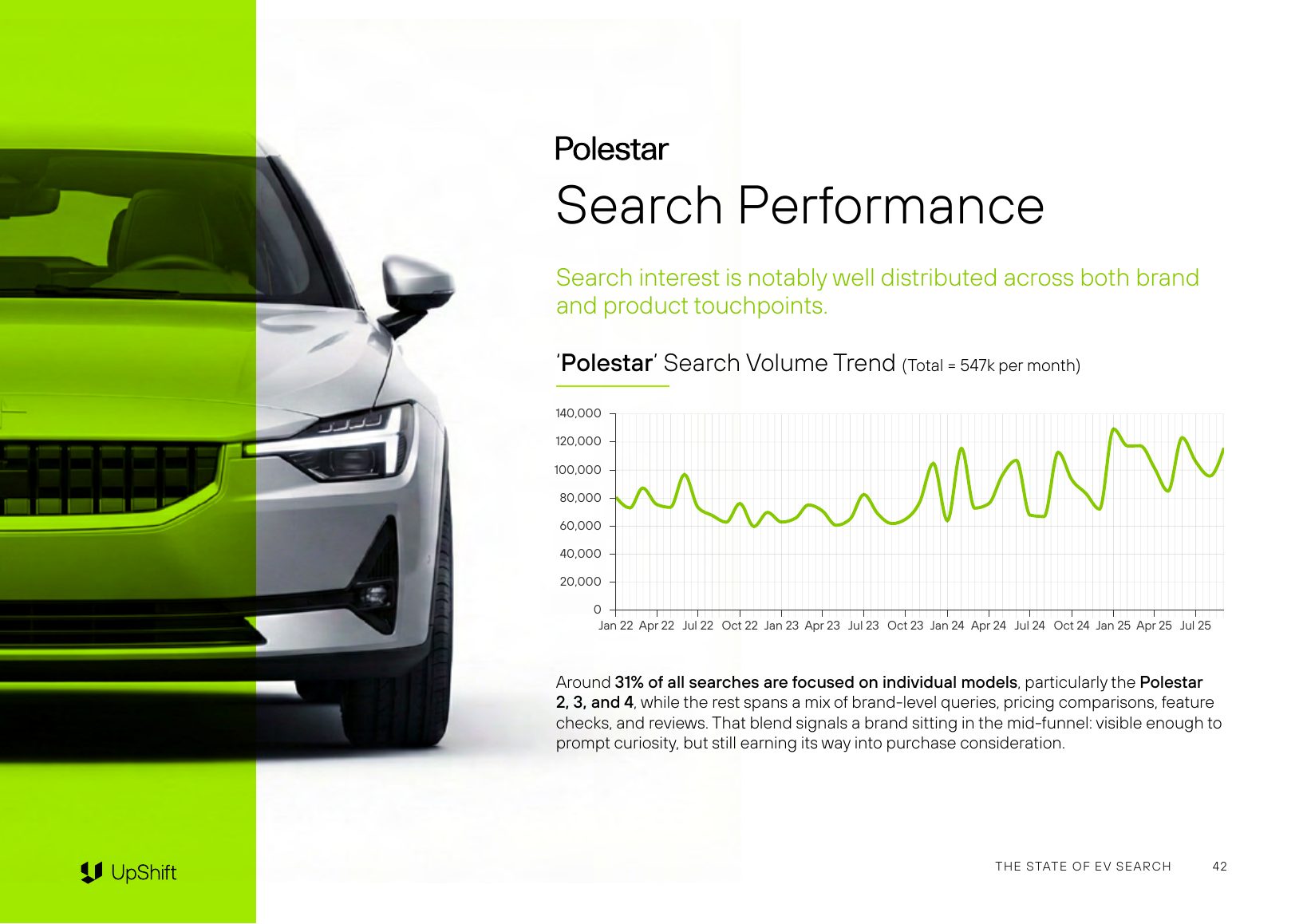
Search interest in “Polestar” itself has also shown renewed strength through 2025, peaking at over 129,000 monthly searches in January and maintaining consistently high volumes throughout the year. While this doesn’t always translate to direct purchase intent, it reinforces Polestar’s brand recognition and ongoing relevance in the EV conversation.
Brand Spotlight: Polestar
42Polestar: Search Performance
Search interest is notably well distributed across both brand and product touchpoints.
Authoritative source visual · page 42
‘Polestar’ Search Volume Trend (Total = 547k per month)
Polestar: Search Performance (cont.)
42Around 31% of all searches are focused on individual models, particularly the Polestar 2, 3, and 4, while the rest spans a mix of brand-level queries, pricing comparisons, feature checks, and reviews. That blend signals a brand sitting in the mid-funnel: visible enough to prompt curiosity, but still earning its way into purchase consideration.
Polestar · Search Performance
Cluster analysis
Cluster analysis of the Polestar search landscape reveals a market increasingly familiar with the brand’s line-up.
Model-Specific
~171,000 monthly searches
Terms such as “Polestar 2”, “Polestar 3”, and “Polestar 4”. These searches indicate growing recognition of the individual vehicles and interest in what sets them apart.
Price, Leasing & Value
~63,000 monthly searches
This includes terms like “Polestar price UK”, “Polestar 2 lease”, and “Polestar cost of ownership”. The volumes show that Polestar is being discovered as a considered purchase, often compared against more mainstream or affordable EVs.
Reviews & Comparisons
~43,000 monthly searches
Queries such as “Polestar 2 review”, “Polestar vs Tesla”, or “Polestar reliability” suggest that consumers are still working out whether this Scandinavian-backed brand can deliver on its promise.
Technology & Features
~18,000 monthly searches
Polestar’s Android Automotive OS and advanced driver-assistance features are drawing specific attention. Queries like “Polestar app” and “Polestar tech” highlight a tech-forward audience interested in more than just range and price.
Dealers & Availability
~10,000 monthly searches
Searches for “Polestar test drive”, “Polestar near me”, and “Polestar dealers UK” show early-stage exploration, but volumes remain relatively modest compared to intent-heavy brands like MG or Tesla.
Generalised Searches
~242,000 monthly searches
The largest cluster is still broad brand queries, things like “Polestar car”, “what is Polestar”, or “Polestar EV”. This reflects a brand still in the process of introducing itself to UK audiences, many of whom are encountering it for the first time.
Brand Spotlight: Polestar
44Polestar: Search Performance
Polestar’s UK search footprint totals around 547,000 searches per month, placing it behind Tesla and BYD in overall search volume, but ahead of many traditional OEMs.
However, volume alone doesn’t tell the full story. Polestar’s search profile reveals a brand with deeper trust, clearer positioning, and stronger mid-funnel signals than its newcomer rivals.
Around 31% of Polestar’s total search volume is model-specific, driven by the Polestar 2, 3 and 4, all of which show steady or rising interest. Meanwhile, a further 18% comes from review and comparison queries, such as “Polestar vs Tesla” or “Polestar reliability”, reflecting a user base that is actively assessing Polestar as a legitimate alternative to more established players. Even leasing-related searches are notably strong, indicating real-world consideration and financial planning, not just curiosity.
In contrast to BYD, which generates higher overall volume (~882k), Polestar’s searchers are less likely to be asking what the brand is and more likely to be asking whether it’s right for them. While BYD is still battling for recognition and trust, Polestar appears to have crossed that threshold, benefitting from strong brand cues (Volvo affiliation, Scandinavian design) and a more premium, design-led proposition.
Taken together, Polestar’s search profile suggests a brand still growing in size, but already mature in perception. It may not yet be driving mass-market scale, but in the battle for credibility and mid-funnel attention, it’s already a serious contender.
Polestar searches per month
Source report, page 44Model-specific search volume
Source report, page 44Review and comparison queries
Source report, page 44...growing in size, but mature in perception.
Brand Spotlight: Polestar
45Polestar: Model Trends
Model-level search trends highlight where demand is consolidating.
Tesla Model 3: Search volumes remain consistently high (~139k/month in 2025), but growth has plateaued after years of dominance.
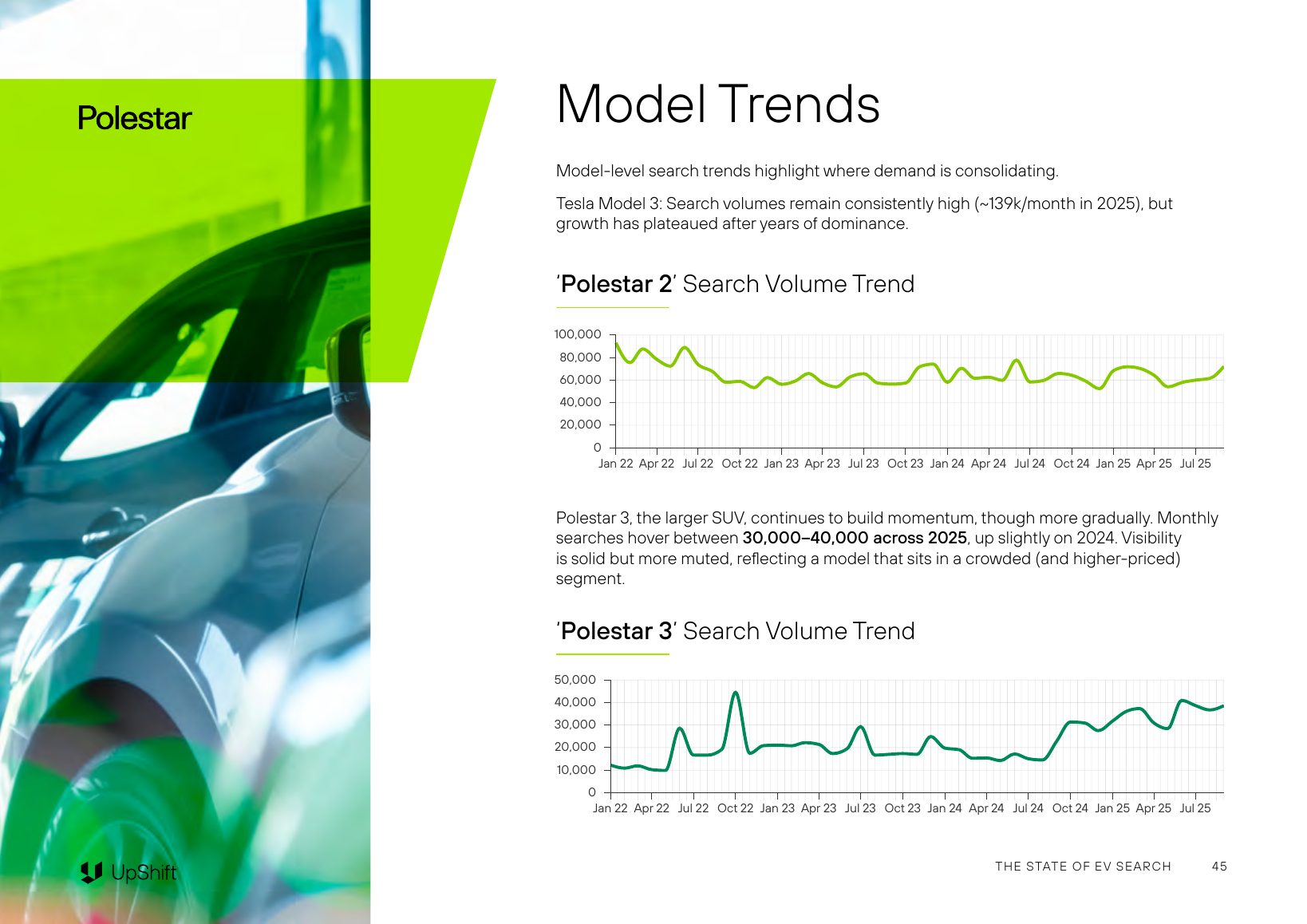
Polestar 3, the larger SUV, continues to build momentum, though more gradually. Monthly searches hover between 30,000–40,000 across 2025, up slightly on 2024. Visibility is solid but more muted, reflecting a model that sits in a crowded (and higher-priced) segment.
Authoritative source visual · page 45
‘Polestar 2’ and ‘Polestar 3’ Search Volume Trends
Polestar: Model Trends cont. · page 46
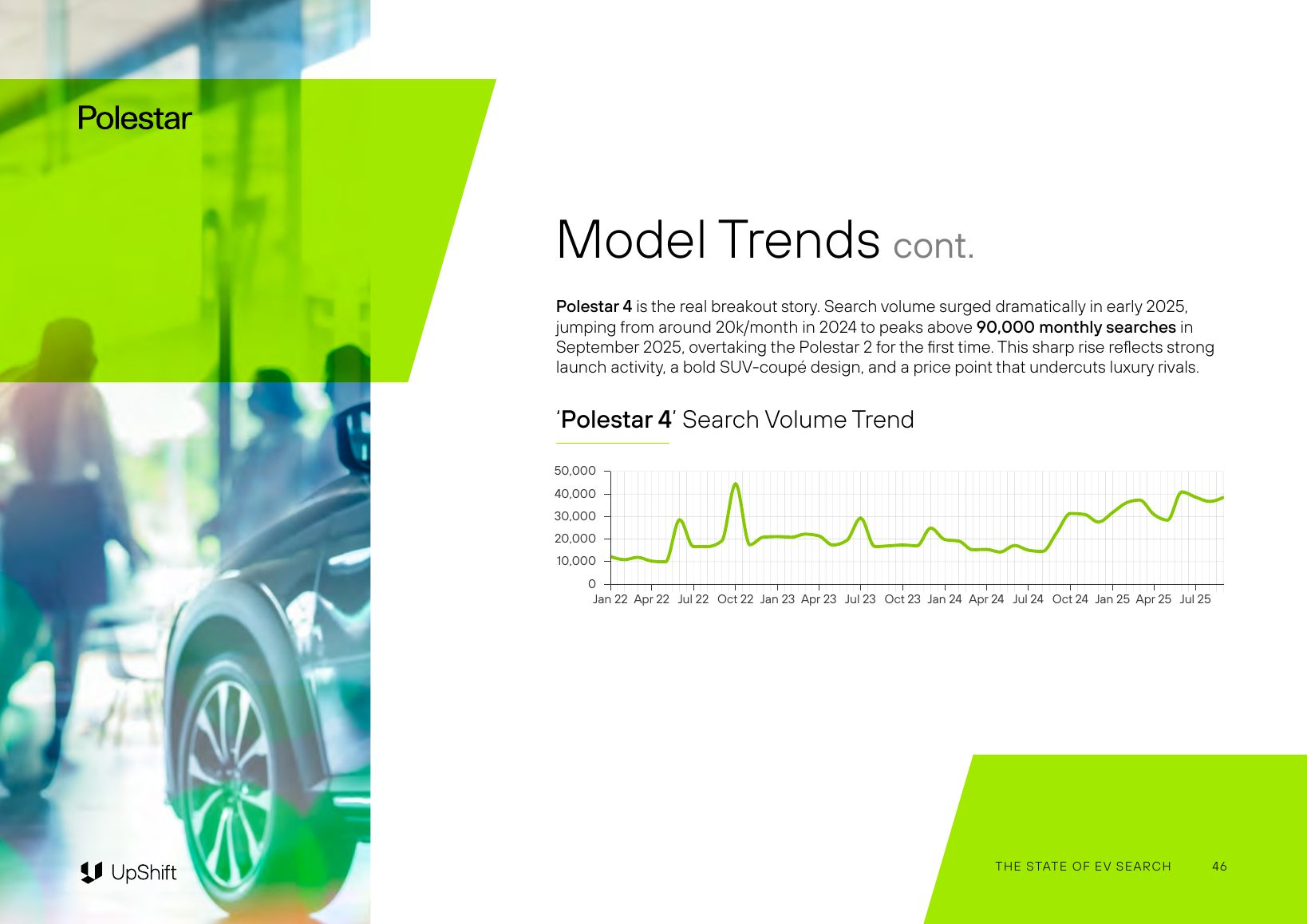
Polestar 4 is the real breakout story.
Search volume surged dramatically in early 2025, jumping from around 20k/month in 2024 to peaks above 90,000 monthly searches in September 2025, overtaking the Polestar 2 for the first time. This sharp rise reflects strong launch activity, a bold SUV-coupé design, and a price point that undercuts luxury rivals.
Polestar 3 monthly searches across 2025, up slightly on 2024
Source report, page 45Polestar 4 monthly searches in 2024
Source report, page 46Polestar 4 peak monthly searches, September 2025, overtaking the Polestar 2 for the first time
Source report, page 46Authoritative source visual · page 46
‘Polestar 4’ Search Volume Trend
Brand Spotlight: Polestar
47Polestar: Market Position
Polestar may not dominate the headlines like Tesla or boast the sheer scale of BYD, but in the UK market, it plays a different, and arguably more deliberate, game.
Originally launched as Volvo’s performance sub-brand, Polestar spun out as a standalone EV marque with a clean, design-led identity rooted in Scandinavian minimalism, safety credentials, and premium sustainability.
That Volvo heritage matters. It gives Polestar credibility with older, more brand-conscious audiences, especially those wary of Chinese newcomers or flashier EV disruptors. And while Polestar vehicles are manufactured in China, the brand distances itself through sleek European styling, recycled materials, and a quiet confidence in its tech stack and over-the-air capability, all traits that resonate with a growing segment of the UK EV buyer base.
2025 has seen Polestar increase its presence in both marketing and model availability. The Polestar 2 continues to do much of the heavy lifting in terms of awareness and sales, but the Polestar 3 and 4 are now landing in meaningful numbers, the latter enjoying a sharp spike in UK search interest since Q1.
Unlike many rivals, Polestar is not chasing mass-market attention through aggressive pricing or broad influencer campaigns. Instead, it’s leaning into quality, brand trust, and targeted digital retail partnerships, including its longstanding relationship with BVRLA-accredited leasing providers and premium EV specialists.
That strategy has helped it build one of the more stable EV audiences in the UK, even if not the largest. The brand consistently draws over 500,000 searches a month, comparable to BYD, but with a user base that’s further down the funnel. In a fragmented and noisy EV category, Polestar’s clarity, heritage and design restraint remain its biggest advantages. The challenge now is scale.
Polestar
What’s Driving Search Demand?
Design-led appeal
Polestar’s minimalist Scandinavian styling drives strong visual and brand recognition.
Volvo halo effect
The Volvo connection gives instant trust and familiarity, especially among older, premium buyers.
Leasing over retail
Many searches reflect a leasing-led route to ownership, especially for company car drivers.
Model curiosity
Interest in the 3 and 4 models is rising fast, boosted by recent launches and strong critical reception.
Subtle sustainability
Quiet emphasis on recycled interiors and ethical materials appeals to climate-conscious buyers.
Structured evidence
Summary: At A Glance
| Metric | Tesla | BYD | Polestar |
|---|---|---|---|
| Average monthly search volume (UK) | 3,200,000 | 882,000 | 547,000 |
| % model-specific queries | 55% | 31% | 31% |
| Top-searched model | Model Y | BYD Seal | Polestar 2 |
| Most common search theme | Ecosystem & Culture | Price & Affordability | Design & Leasing |
| Years active in UK market | Since 2014 | Since 2023 | Since 2020 |
| # of key models in UK line-up | 4 (Y, 3, S, X) | 4 (Seal, Dolphin, Atto 2, Atto 3, Sealion 7) | 3 (2, 3, 4) |
| Search intent profile | Consideration-stage | Discovery-stage | Mid-funnel Consideration |
| Primary growth driver | Cultural dominance & tech halo | Price-led disruption | Design & Volvo trust |
| YoY search trend (vs. 2024) | Flat-to-declining | Rapid growth | Gradual upward trend |
| EV brand perception | Benchmark brand | Challenger brand | Premium niche brand |
Legacy OEM EV Visibility
The Legacy OEM EV Visibility Index
Legacy OEM EV Visibility · page 50
While Tesla, BYD and Polestar dominate much of the EV conversation, the majority of UK car buyers still associate electrification with long-established manufacturers.
To understand how these legacy OEMs are performing in digital visibility, we built a simple benchmark: the Legacy OEM EV Visibility Index.
Using Ahrefs Keyword Explorer, we calculated the total monthly UK search volume for all keywords containing each brand name and the word “electric.” This approach provides a consistent baseline across brands, showing how strongly each is being explicitly connected with electrification in consumer search behaviour.
Structured evidence
Legacy OEM EV Visibility Index
| Brand | Avg. monthly search vol. | Number of keywords |
|---|---|---|
| RENAULT | 81,000 | 2,249 |
| BMW | 64,000 | 4,944 |
| FORD | 57,000 | 4,664 |
| HYUNDAI | 54,000 | 5,091 |
| VW, VOLKSWAGEN | 50,000 | 3,860 |
| AUDI | 48,000 | 2,732 |
| MERCEDES | 48,000 | 4,055 |
| KIA | 40,000 | 4,312 |
| MG | 31,000 | 1,609 |
| VAUXHALL | 29,000 | 1,064 |
| VOLVO | 25,000 | 2,302 |
| NISSAN | 24,000 | 1,660 |
| PEUGEOT | 23,000 | 1,413 |
| JAGUAR | 22,000 | 1,097 |
| TOYOTA | 22,000 | 2,691 |
| SKODA | 19,000 | 805 |
| HONDA | 15,000 | 2,426 |
| CITROEN | 11,000 | 831 |
| LAND ROVER | 7,100 | 455 |
| MAZDA | 4,700 | 554 |
EV Search Volume (monthly average)
The total demand for brand + electric queries in the UK.
Keyword Count
The number of unique search queries captured for each brand.
What the index does not capture
This methodology doesn’t capture every EV-related query (e.g. model-specific searches like “ID.3” or “Ioniq 5” without the word electric are not included). Instead, it isolates how directly consumers are associating each brand with “electric” at the point of search, a useful signal of top-level brand positioning in the EV landscape.
Legacy OEM EV Visibility
What the Data Reveals
Renault leads legacy visibility
With 81k monthly searches, Renault outperforms larger German rivals in the “brand + electric” space. This is almost entirely driven by the Zoe and upcoming Renault 5 storylines, evidence that a focused EV narrative can outweigh broader brand size.
German premium brands are strong but fragmented
BMW, Audi, Mercedes, and VW all cluster between 48k–64k monthly searches. Their high keyword counts (2.7k–5k) show broad coverage across many models, but none dominate consumer association with “electric” in the way Tesla or BYD do.
Korean OEMs punch above their weight
Hyundai (54k) and Kia (40k) are mid-pack in volume, but their strong keyword breadth (4–5k each) reflects a wide EV presence, Ioniq and EV families are cutting through.
Volume brands underperform
Ford (57k) shows decent visibility, but Nissan (24k), despite the Leaf being the world’s first mainstream EV, lags significantly. Similarly, Vauxhall (29k) and Peugeot (23k) are modest considering their UK market presence.
Lagging legacies
Land Rover (7.1k) and Mazda (4.7k) barely register. With no EVs (LR) or only token models (Mazda MX-30), searchers simply aren’t associating these brands with electrification yet.
Search breadth matters
Brands like BMW and Hyundai have nearly 5k “electric” keywords each, suggesting consumers explore them across many different EV angles. By contrast, Renault and Nissan have fewer keyword variants but higher average searches per keyword, showing attention is more concentrated on specific models.
Conclusion
Where Next for EV Search?
Conclusion: Where Next for EV Search?
The UK’s EV market is no longer in its infancy. Search behaviour shows a sector that is maturing, fragmenting, and increasingly defined by new entrants.
Tesla still dominates mindshare, but its visibility has plateaued. BYD’s ascent is rapid, driven by affordability headlines and model launches, while Polestar continues to build a credible premium niche. SUVs have emerged as the safe bet for buyers, city cars and hatchbacks are stagnating, and saloons are finding new momentum through design-led challengers.
For legacy OEMs, the challenge is clear. While many enjoy deep brand familiarity, consumers are not consistently associating them with “electric.” Renault and BMW show strength, but stalwarts like Nissan and Ford risk being eclipsed in the EV conversation. Search behaviour also makes clear that barriers remain: consumers are still preoccupied with charging, cost, and confidence.
Action Framework
Turning Search Insights into Growth
What search shows for each audience, and the recommended action.
OEMs
What search shows: Weak “electric” association vs Tesla & BYD.
Recommended action: Build brand-led EV campaigns; reinforce electrification as a core identity, not a side product.
Marketplaces
What search shows: Rising share of generic EV discovery.
Recommended action: Develop comparison tools, editorial content, and trust signals that capture early-stage interest.
Leasing firms
What search shows: Search dominated by cost, tax, and BIK queries.
Recommended action: Lead with affordability narratives, total-cost-of-ownership calculators, and simple leasing explainer content.
Policy/Industry
What search shows: Spikes linked to mandates, grants, VAT changes.
Recommended action: Prepare communications that translate policy into consumer language quickly.
The Upshift Perspective
Search is more than a mirror of demand
The Upshift Perspective · page 53
Search is more than a mirror of demand, it is a live signal of how consumers are connecting (or failing to connect) with the EV transition.
It shows the battlegrounds where brands must win attention, the anxieties that hold buyers back, and the models that capture imagination long before they reach showrooms.
At Upshift, we help OEMs, leasing platforms, and marketplaces turn search data into strategies that convert, whether that means shaping brand narratives, targeting content where anxieties peak, or positioning products at the point of decision.
The EV battleground isn’t just on the road, it’s in search. And in that space, attention is fragmenting fast.
The question is: who will capture it?
Want to dig deeper into your brand’s search performance?
We help automotive brands turn search data into commercial advantage, from strategy to execution. If you’d like tailored insight or support, just drop us a line.
enquiries@upshift.co.uk