

Car finance marketing often starts with the obvious hook: the interest rate.
A low Annual Percentage Rate (APR) is easy to advertise, easy to compare and easy to justify because it feels rational. It gives customers a number that they can understand and gives marketers a clear proposition.
But unfortunately, when customers make decisions about car finance, it’s not as simple as that.
Customers sit at a crossroads of money, mobility, risk, lifestyle and trust. They’re not simply asking, ‘What’s the cheapest monthly payment?’ They’re also asking, ‘Can I trust this provider? Is the process clear? Am I making a safe decision? Will I get any nasty surprises?’
That’s why reassurance is not a nice-to-have in car finance marketing – it’s essential to success.
Interest rates matter, but they are not the whole decision
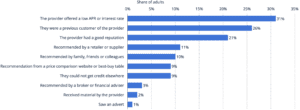
The data confirms that price is important. In the UK, the leading reason adults chose one motor finance provider over another is a low APR or interest rate (31% of adults, according to a 2022 study). That makes interest rates a powerful USP for marketing.
While rates might be the top reason, almost as many people were influenced by familiarity and confidence. The data shows that 26% of adults choose a provider because they were a previous customer, while 21% choose because the provider has a good reputation.
This means the car finance market isn’t split between customers who want a good rate and those who’re influenced by trust. In fact, many customers are both – they want a competitive deal, but they also want to feel that the provider is credible and transparent.
A low interest rate may get someone’s attention, but reassurance helps them continue.
Main reasons for choosing motor finance provider in the UK 2022:
Car finance is a high-consideration decision
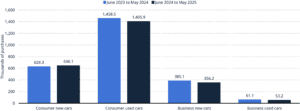
Car finance isn’t an impulse purchase. The market scale alone shows how common and how consequential these decisions are. In the twelve months to May 2025, more than two million cars were bought using finance by UK consumers, with used cars making up the majority of those purchases.
The wider car market also creates a large audience of potential finance customers. The UK passenger car market recorded 1.812 million vehicle sales in 2024. What’s more, 70% of UK consumers said they already owned a car and 25% said they intended to purchase one in 2025.
This is a category where people are actively researching, comparing and narrowing down vehicle options. According to the UK car buyer data, 55% used search engines for online product research between Q1 2024 and Q3 2025, while 39% used search engines for discovery. Brand also plays a major role, with 64% of car buyers visiting a brand’s website when choosing a vehicle.
That means the customer journey is full of moments where reassurance can either make or break a purchase – these moments that would either continue the momentum or let doubt creep in.
For example, a landing page that leads with ‘from £X per month’ but then buries strict eligibility criteria creates doubt. A provider page with no explanation of the process, support, regulations or next steps creates doubt.
This is an expensive lesson for those in the car finance industry.
Cars bought on finance by consumers and businesses in the UK 2023–2025:
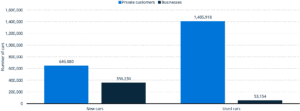
Cars financed in the UK by consumer and vehicle type 2024-2025:
Trust signals are the key to converting
You can’t just tell customers you’re a trusted brand – you have to show it. Luckily, there are plenty of ways that car finance sites can show trust to customers – reviews, FCA compliance, information about regulated lenders, FAQs, eligibility explanations, complaints processes and plain-English finance guides.
The consumer behaviour data makes it clear how important it is to show trust. Reputation and previous experience aren’t marginal factors in the decision-making process. In fact, these are more influential than recommendations from retailers, family and friends, price comparison websites, brokers, advertising or direct provider materials.
That should change how car finance marketers think about the purpose of a page, advert or email. The purpose isn’t only to create demand, but to make the customer feel safe enough to act.
Main reasons for choosing motor finance provider in the UK 2022:
The comparison journey is also a reassurance journey
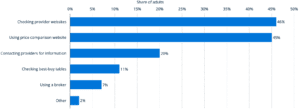
Customers do compare. Nearly half of adults who shopped around before taking a motor finance product checked provider websites, while 45% used price comparison websites. Another 20% contacted providers for information.
This suggests that customers are not simply looking for the lowest figure on a table. They are looking for enough information to make a safe decision. That has practical implications for marketing.
A provider website shouldn’t just display interest rates. It should explain what affects the rate, what the customer may be eligible for, what happens after applying, whether a soft search is used, how long approval takes, what documents may be needed and what support is available if circumstances change.
Methods to compare motor finance providers in the UK 2022:
Reassurance is especially important in used car finance
The finance market is heavily weighted toward used cars. In the twelve months to May 2025, UK consumers financed around 1.4 million used cars, compared with around 646k new cars.
That matters because used car finance can carry more uncertainty for buyers. The customer may be weighing the condition of the vehicle, the credibility of the dealer, the reliability of the lender, the fairness of the monthly cost and the long-term suitability of the agreement all at once.
In that context, the winning message may not be ‘cheap finance’ alone. It may be ‘clear, trusted finance, explained properly’, with ‘support from application to approval’.
The more complex the decision feels, the more valuable reassurance becomes.
Cars financed in the UK by consumer and vehicle type 2024-2025:
Six proven ways to build trust in car finance marketing
The best car finance marketing still needs competitive offers. But it should not rely on interest rates alone. A stronger approach makes trust visible at every stage.
- Use reputation clearly. Show reviews, ratings, established partnerships, lender credibility and outcomes where you can, like how many customers you’ve successfully helped finance a car.
- Make the process feel simple. Explain the application journey step by step, including eligibility checks, approvals, documents, timelines and what happens next.
- Reduce fear around finance language. Terms like APR, representative APR, HP, PCP, balloon payment, deposit and total amount payable should be explained in plain English.
- Be upfront about conditions. Customers are more likely to trust a provider that explains what could affect the final offer than one that appears to promise certainty too early.
- Reinforce support. Prompts such as ‘speak to a finance specialist’, ‘get help understanding your options’ or ‘check what works for your budget’ can be more reassuring than aggressive urgency.
- Use search and website content as trust-building media. Since search engines and brand websites are major touchpoints for UK car buyers, SEO and landing pages should answer confidence-building questions, not just rank for finance terms.
The takeaway
Rates win attention, but reassurance wins confidence – you need both for conversion.
In car finance, customers are making a decision that affects their monthly budget, their mobility and their sense of financial control. A low APR can put a provider on the shortlist, but trust, reputation, previous experience and clarity help turn interest into action.
The strongest car finance marketing doesn’t choose between price and reassurance. It uses price to open the conversation, then uses credibility, transparency and support to help the customer feel ready to convert.
Talk To Our Experts
Please submit your details and as much information as you can on what you would like to discuss:
required information