

One pattern appears in almost every dealership account we manage: paid traffic doesn’t stop when the showroom closes.
In many cases, the opposite is true. Evenings are when prospective buyers finally have the time to sit down and properly research their next vehicle. They’re comparing finance offers, browsing stock, reading reviews and deciding which dealerships are worth contacting.
Unfortunately, that’s also when many dealerships are least equipped to respond.
For dealerships investing thousands of pounds every month into paid media, it’s a gap that’s surprisingly easy to overlook. A significant proportion of your marketing budget is spent attracting high-intent visitors, only for those prospective customers to submit an enquiry outside trading hours and wait until the following morning for a response.
By then, they may already have booked a test drive elsewhere.
The Hidden Cost of Waiting Until Morning
As paid marketers, we spend a huge amount of time improving campaign performance. We optimise bidding strategies, refine audiences, test creatives, improve landing pages and work relentlessly to reduce cost per acquisition and return on investment.
Yet one of the biggest factors influencing whether that investment ultimately turns into a sale often sits completely outside the ad account: response time.
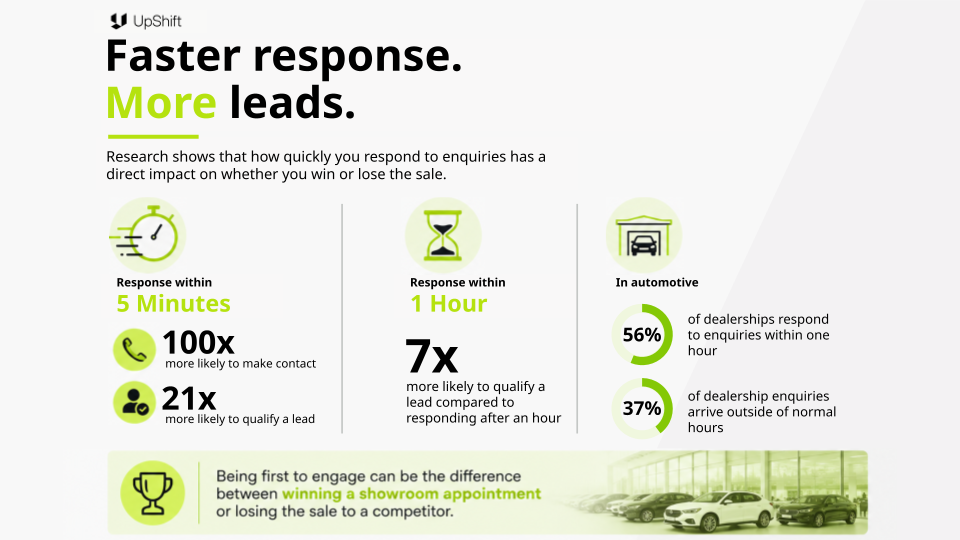
Research has consistently shown that businesses that respond to new enquiries quickly are significantly more likely to connect with and qualify prospective customers than those that wait. A landmark study by researchers from MIT and InsideSales found that responding within five minutes made businesses up to 100 times more likely to make contact with a lead and 21 times more likely to qualify them than waiting 30 minutes. Harvard Business Review later reinforced the importance of rapid lead response, finding that companies responding within an hour were around seven times more likely to qualify a lead than those that delayed their follow-up.
The same principle applies in automotive. McKinsey research found that more than half of dealership enquiries arrive outside normal business hours, yet fewer than four in ten dealerships respond within an hour. In a market where prospective buyers frequently compare vehicles, finance offers and retailers before deciding who to visit, being the first dealership to engage can make the difference between securing a showroom appointment and losing the opportunity to a competitor.
This is where many dealerships unknowingly lose value. We’ve also seen businesses respond by reducing bids or switching campaigns off during the evening because conversions appear too expensive. In reality, the issue is rarely the quality of the traffic. It’s what happens after somebody enquires.
The campaign has already done its job. It has found somebody ready to engage. But from that point onwards, momentum slows. The customer submits an enquiry knowing they probably won’t hear back until the following morning, and in the meantime they’re still browsing competing dealerships.
A Typical Evening Enquiry
Imagine a customer clicks one of your Google Ads at 9:47 pm after searching for “used Kia Sportage finance”.
They’ve already compared a handful of dealerships and narrowed it down to two or three. Yours is one of them.
Traditionally, they’d complete an enquiry form, receive an automated confirmation email and wait until the following morning for a call.
With a conversational AI agent, the experience is very different. The customer is immediately asked which vehicle they’re interested in, whether they have a part exchange, what deposit they’re considering and when they’d like to visit the showroom. If they’re ready, they can even book a test drive there and then.
By the time the sales team arrives the next morning, they aren’t chasing a cold lead. They’re following up with someone who has already engaged, shared useful buying information and, ideally, booked an appointment.
The Problem Isn’t Marketing. It’s Availability.
It isn’t realistic to expect a sales team to work around the clock.
Instead, dealerships should be asking a different question:
How do we make sure every genuine enquiry receives an immediate response, regardless of the time of day?
The answer isn’t extending showroom opening hours. It’s making sure your digital sales process isn’t tied to them.
This is where conversational AI begins to solve a genuine commercial problem. Not because it replaces your sales team, but because it removes unnecessary waiting from the buying journey.
Beyond the Chatbots of the Past
Mention chatbots to most dealer leaders and they’ll probably remember the frustrating versions from a decade ago with rigid decision trees, scripted responses and endless loops that left customers more frustrated than when they started.
Instead of creating another lead for somebody to work through the following morning, AI agents can continue the conversation immediately using information from your CRM, vehicle stock and dealership systems.
That means they can answer many of the questions buyers actually ask before speaking to a salesperson.
- Is this vehicle still available?
- What specification does it have?
- Can I part exchange my current car?
- What could monthly finance payments look like with a particular deposit?
- Can I book a test drive this Saturday?
Instead of asking a customer to leave their details and wait until tomorrow, the conversation continues immediately.
Where appropriate, the agent can collect qualification information, capture part-exchange details, suggest suitable vehicles and even schedule appointments directly into the sales team’s diary.
Just as importantly, it helps sales teams spend less time chasing people who were simply browsing and more time speaking to buyers who have already demonstrated genuine purchase intent.
Better Conversations. Better Data. Better Campaigns.
The benefits extend beyond responding faster. Every conversation generates valuable information about what a buyer is actually looking for, information that traditional lead forms rarely capture.
A conversational journey can capture much richer information, including:
- Vehicle of interest
- Part exchange requirements
- Preferred finance option
- Budget expectations
- Purchase timeframe
- Whether an appointment has already been booked
As privacy continues to reshape digital advertising, richer first-party data is becoming increasingly valuable.
More importantly, those conversations become measurable. When they’re connected back to your CRM and offline conversion tracking, platforms such as Google Ads can begin optimising towards the enquiries that actually become showroom appointments and vehicle sales, not simply the people who completed a form.
The more accurately your campaigns can distinguish genuine buying intent from casual browsing, the more effectively your advertising budget can be invested.
Protecting Your Paid Media Investment
This is why we increasingly see conversational AI as an extension of paid media strategy rather than simply another customer service tool.
Generating clicks has never been the difficult part. Turning those clicks into qualified opportunities is where dealerships create a competitive advantage.
By the time somebody submits an enquiry, you’ve already paid to earn their attention. The commercial question is whether your sales process makes the most of that opportunity. If a meaningful proportion of your enquiries arrive outside trading hours but receive no meaningful engagement until the following morning, you’re introducing unnecessary friction into a journey you’ve already paid to create.
Removing that friction doesn’t suddenly make your campaigns better. It simply gives more of the demand you’re already generating the opportunity to convert.
The Next Competitive Advantage Isn’t More Traffic
Most dealerships are still focused on generating more leads.
The more interesting question is whether they’re making the most of the leads they already have.
AI won’t fix poor campaigns. It won’t compensate for weak offers or inaccurate vehicle feeds, and it certainly won’t replace knowledgeable sales professionals.
What it can do is remove one of the biggest operational gaps in modern automotive marketing: the time between a prospective customer deciding to engage and somebody being available to continue the conversation.
The dealerships that gain an advantage over the next few years won’t necessarily be those spending the most on advertising. They’ll be the ones removing friction from every stage of the buying journey, using better data to optimise their campaigns and ensuring every genuine opportunity receives the attention it deserves, even when the showroom is closed.
The dealerships that win won’t always be the ones generating the most leads. They’ll be the ones responding to them first.
Interested in exploring how conversational AI could strengthen your dealership’s paid media strategy?
We’re working with dealerships to understand where conversational AI genuinely adds value, and where it doesn’t. If you’d like to discuss how it could support your existing paid media activity, we’d be happy to share what we’re seeing across the sector.
References
McKinsey & Company (2025) Boosting auto sales productivity: A playbook for excellence. Available at: https://www.mckinsey.com/industries/automotive-and-assembly/our-insights/boosting-auto-sales-productivity-a-playbook-for-excellence (Accessed: 15 July 2026).
Oldroyd, J.B., McElheran, K. and Elkington, D. (2011) The short life of online sales leads. Harvard Business Review, 4 March. Available at: https://hbr.org/2011/03/the-short-life-of-online-sales-leads (Accessed: 15 July 2026).
Oldroyd, J.B., McElheran, K. and Elkington, D. (2007) Lead Response Management Study. Cambridge, MA: Massachusetts Institute of Technology in collaboration with InsideSales.com.