

Dealerships have been trying to connect paid media activity to actual vehicle sales for years, and that is where measurement should be heading. Knowing a campaign generated 80 enquiries tells you something, but knowing how many of those people actually became customers gives you a much better basis for judging performance.
The problem starts when the full selling price of the vehicle becomes the headline measure of return. If a dealership spends £10,000 on advertising and attributes £150,000 of vehicle sales back to it, the report shows 1,500% ROAS. The calculation is correct, but what it really tells us is that £150,000 of vehicle turnover was attributed to £10,000 of media spend. It does not mean the advertising made the dealership £150,000.
That distinction matters because these numbers are not just used for reporting. Paid teams use them to decide where budget should move, which campaigns deserve more investment and, increasingly, what outcomes Google’s bidding systems should prioritise. If the value being fed into those decisions only reflects part of the commercial picture, it becomes very easy to make sensible optimisation choices based on incomplete information.
What the ROAS figure is actually telling us
Revenue ROAS still has a purpose, and I wouldn’t remove it from dealership reporting. If £30,000 of media spend is associated with £500,000 of vehicle sales, that is useful information because it tells us how much vehicle turnover has been attributed to the advertising. The problem is when that figure starts being treated as a proxy for profitability, because two campaigns can look very different once you bring the economics of the sales into the picture.
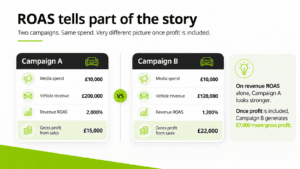
On revenue ROAS alone, Campaign A appears to be the stronger performer. It has generated £80,000 more vehicle turnover from the same level of media spend. Once gross profit is included, though, Campaign B starts to look very different, generating £7,000 more gross despite the lower reported ROAS.
That doesn’t automatically mean Campaign B deserves more budget. There may be perfectly valid reasons why the dealership places greater value on the sales coming through Campaign A. What it does show is that the judgement changes as soon as information from outside the ad account is brought into the conversation.
This becomes even more important when those same conversion values are being used for value-based bidding. If a £40,000 vehicle is returned to Google as £40,000 of conversion value and a £20,000 vehicle as £20,000, the bidding system has every reason to treat the first transaction as twice as valuable. That logic starts to break down if the £40,000 vehicle produces £1,000 gross while the £20,000 vehicle produces £2,000.
Google hasn’t misunderstood the data. We have simply given it a definition of value that doesn’t fully reflect the commercial outcome we care about.
Where reliable transaction-level profit data is available, using gross profit rather than the full selling price can improve that signal considerably. Profit-based bidding, often referred to as POAS, gives the bidding system a better indication of the relative value of individual sales and reduces the tendency for higher-priced vehicles to look automatically more important.
I still wouldn’t treat gross profit as a complete answer because dealerships make decisions around more than margin. Stock position, manufacturer commitments and changing commercial priorities all affect what the business needs paid media to support at any given time. A vehicle moving into overage stock may become more important to sell than a fresh unit carrying a slightly stronger margin, particularly if the business is starting to build a concentration of 90+ day stock.
That is where the paid media data needs commercial context. Google Ads can tell us which campaigns are generating revenue, enquiries and sales. It cannot tell us, without input from the dealership, which of those sales the business most needed to make.
The dashboard is only half the picture
The relationship between the paid team and the people inside the dealership is one of the most important parts of campaign strategy, because both sides see a different part of the customer journey. The paid team can see search demand, spend, enquiry volume, CPL, conversion rates, model interest and how individual campaigns are behaving. The dealership sees what happens once those leads leave the platform.
That internal view matters. Sales teams know whether enquiries are serious, whether a campaign is producing a lot of activity without many worthwhile conversations, and whether a more expensive campaign is actually sending through customers who are much closer to buying. The wider business also has context around stock, overage inventory, OEM targets and changing commercial priorities that simply isn’t visible in Google Ads.
That information should affect how the account is managed. I’ve seen plenty of situations where the platform data and the client’s view of performance don’t line up at first. A campaign can have an excellent CPL while the sales team is telling us the leads are poor. Another can look expensive on paper but consistently produce stronger opportunities. In those situations, pointing back at the dashboard and insisting the numbers say otherwise is the wrong response. The sales feedback is part of the performance picture as well.
If lead quality from a particular campaign starts to fall, I want to understand why before continuing to scale it. If the dealership tells us overage stock is building, I want to know whether paid media can help support it. If an OEM target suddenly changes what the business needs to sell this month, that should be part of the conversation before we decide where the next chunk of budget goes.
The same works in the other direction. Paid media can show the dealership where search demand is changing, which models are attracting more interest, how customers are responding to different offers and where acquisition costs are becoming harder to maintain. The best working relationships are the ones where both sides bring information the other doesn’t have, then use that combined view to make better decisions.
That is very different from an agency turning up once a month with a ROAS figure and a traffic-light report.
What I would actually change
I wouldn’t start by replacing every dealership KPI with a complicated profit model. The first priority is getting a better view of what happens after the lead. Google’s Enhanced Conversions for Leads can help connect offline outcomes back to the advertising activity that generated the original enquiry, using identifiers such as GCLID alongside first-party customer information. For a dealership, that means following the customer further through the journey: the advert generates the enquiry, the lead enters the CRM, and the eventual outcome is fed back so the paid team can see whether that enquiry became qualified and, ultimately, whether it became a sale.
Once that feedback loop exists, the conversation about value becomes much more useful because every form submission is no longer being treated as though it carries the same commercial weight. If the dealership can reliably provide transaction-level gross profit, I would test using that as the conversion value for completed sales rather than the vehicle selling price. Google supports profit-based values as well as revenue, so Smart Bidding does not have to work from turnover alone.
I would still keep the setup fairly simple. The paid team should not be trying to invent its own version of the dealership’s accounts. If the business has a trusted figure that reflects the relative profitability of different sales, use it. If it doesn’t, feeding completed sales and better lead-quality information back into the account is still a substantial improvement on optimising towards raw enquiry volume.
Stock requires a slightly different approach because it reflects a changing business priority rather than simply another financial value. Vehicle feeds can help paid teams group and manage inventory around priorities such as overage stock, giving us a practical way to respond when the dealership tells us certain vehicles need more support. That might influence campaign structure, budget allocation or efficiency targets, but the setup still needs to make sense for the size of the account and the amount of conversion data available.
I don’t think the answer is to find another single metric and put that at the top of the report instead. Revenue, gross profit, lead quality and stock position each tell us something different about performance. The useful part is understanding where those signals agree, where they don’t, and what the dealership actually needs paid media to support.
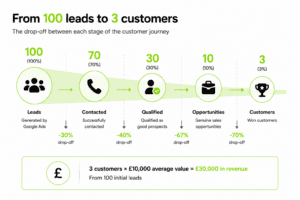
Better offline conversion tracking also gives us stronger attribution. If we can connect an enquiry back to the original advertising interaction and later feed the completed sale into Google Ads, we have a much clearer picture of which campaigns are associated with genuine outcomes. That still doesn’t prove the advertising caused the sale. Attribution and incrementality are different questions, and I wouldn’t pretend a better ROAS setup solves both.
For day-to-day campaign management, there is a much more practical opportunity. Keep revenue ROAS, but give it context. Feed as much genuine sales information back into the account as the dealership can reliably provide, use better value signals where the data supports them, and make sure lead quality and stock priorities form part of the conversation around campaign performance.
That last part matters more than any individual Google Ads feature. The paid team knows what is happening inside the account; the dealership knows what happens once those leads reach the business. You need both views before deciding what to scale, what to cut and what you want Google to find more of.