

- Up to 30 Chinese-owned marques could be in the UK by the end of 2027, but most sit in one quadrant: ecosystem-led and mid to premium.
- UK buyers can now choose from more than 160 EV models, so being electric has become a basic requirement of the category.
- OEMs are discounting EVs by an average of £11,000 per unit, because once brands sound the same, price is the only lever left.
- Very few entrants sit in the engineering-led premium quadrant, the least contested position on the map.
- Chinese OEMs hold 5.1% of UK automotive brand search against 94.9% for legacy brands, and every new arrival has to win its share from that same pool.
What happens when up to 30 Chinese-owned brands chase UK buyers with the same pitch? And how does a buyer tell them apart once the badge is the only real difference?
The biggest risk facing Chinese car brands in the UK is how many of them are arriving with the same story.
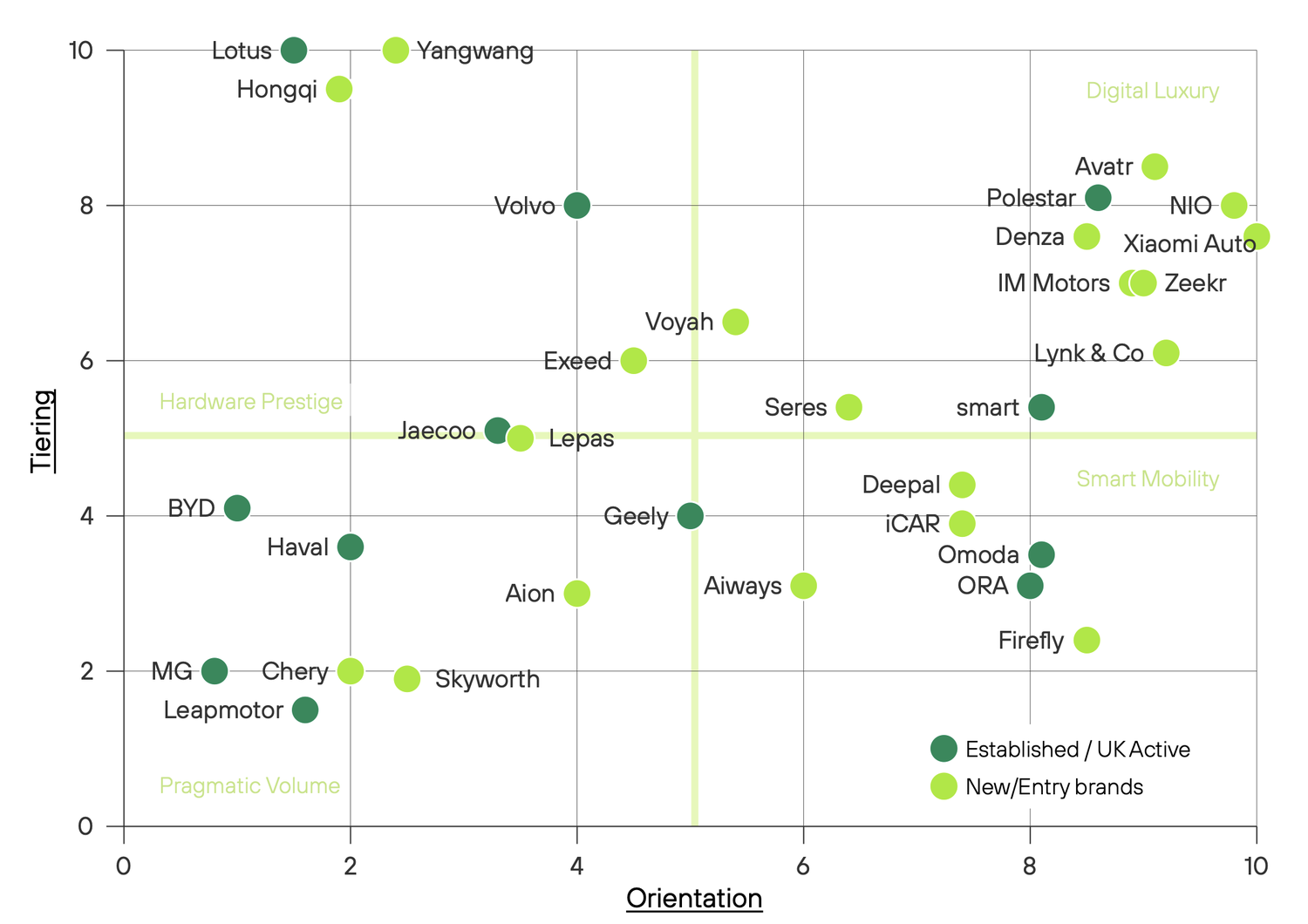
Most Chinese car brands are arriving into one position
Our research maps up to 30 Chinese-owned marques reaching the UK by the end of 2027.
The more useful finding sits underneath that number, because most of those brands cluster in one quadrant: ecosystem-led and mid to premium.
Read the launch material and the same pitch keeps coming up with a different badge on it. It’s tech-forward and premium at an attainable price, with a generous warranty and a well-equipped SUV somewhere in the middle of the range.
A crowded position works differently from a crowded market. In a crowded market, buyers choose between real alternatives, but in a crowded position, they pick the cheapest version of the same thing.
So marketing directors need one sentence on what their brand is that no rival could use.
Being electric has stopped setting brands apart
UK buyers can now choose from more than 160 EV models.
With that much choice, being electric is just a line on the spec sheet, and any rival can match it.
Plan for every spec-led claim to be matched, and build a position that survives it.
Sameness forces discounting, and discounting eats margin
OEMs are discounting EVs by an average of £11,000 per unit.
When several brands hold the same position with similar products, cost is the only argument left, and the discount comes out of margin instead of a marketing budget.
The trap is that discounting works. It shifts cars this quarter while teaching the market what the brand is worth.
Brands should treat sustained discounting as a positioning failure showing up in the P&L, and fix the position rather than the price.
The leasing market applies a second discount
Lease prices have fallen 6 to 8% on high supply.
In that market, leasing houses take a risk buffer off the future value of any car they can’t model with confidence, which pushes its monthly payment up. So a weak brand gets discounted twice, once by its own pricing and again by the leasing house.
In practice, residual value confidence is now a marketing problem as much as a finance one. Brands should know what the leasing house’s view of their residual value does to the customer’s monthly payment.
Fleet punishes sameness
Fleet accounts for 61.2% of UK new car registrations. The total car lease fleet is above 1.5 million vehicles, and salary sacrifice leases grew 118% year on year.
In other words, most new cars are bought by people comparing whole-life cost and tax bands on a spreadsheet.
There, an undifferentiated brand can only compete on cost. A fleet buyer comparing four similar SUVs with similar equipment will pick the cheapest every time.
The question for each brand is whether it’s built to win a spreadsheet comparison or to be the car a fleet manager asks for by name. Each needs a different product and a different story.
Attention is scarce, and it’s already picking winners
Chinese OEMs hold 5.1% of UK automotive brand search, against 94.9% for legacy brands.
And that 5.1% is spread unevenly. BYD draws around 1.1 million average monthly UK brand searches, 26th of 51 brands, while Aion draws about 3,000.
Jaecoo, on just over 620,000, already outdraws Bentley on just over 610,000 and Polestar on almost 590,000.
Attention gets reallocated when new brands arrive, rather than growing to fit them.
Every brand that sounds like the one next to it competes for a slice of a fixed pool, with nothing to help a buyer remember which is which. Share of category attention is the number to track alongside impressions, and it needs to be growing.
Engineering-led premium is the open lane
We found very few entrants in the engineering-led premium quadrant, where brands sell on how the car is built and how it drives.
What’s interesting is that it sits in the same premium tier as the most crowded quadrant on the map.
Few brands move in because it’s hard. Engineering-led premium needs a coherent product story and the patience to build credibility slowly, and neither shows up in a quarterly sales number.
If your brand has real engineering depth, ask whether you’re underselling it to fight over ecosystem features anyone can copy.
Distinctiveness is what the market pays for in the end
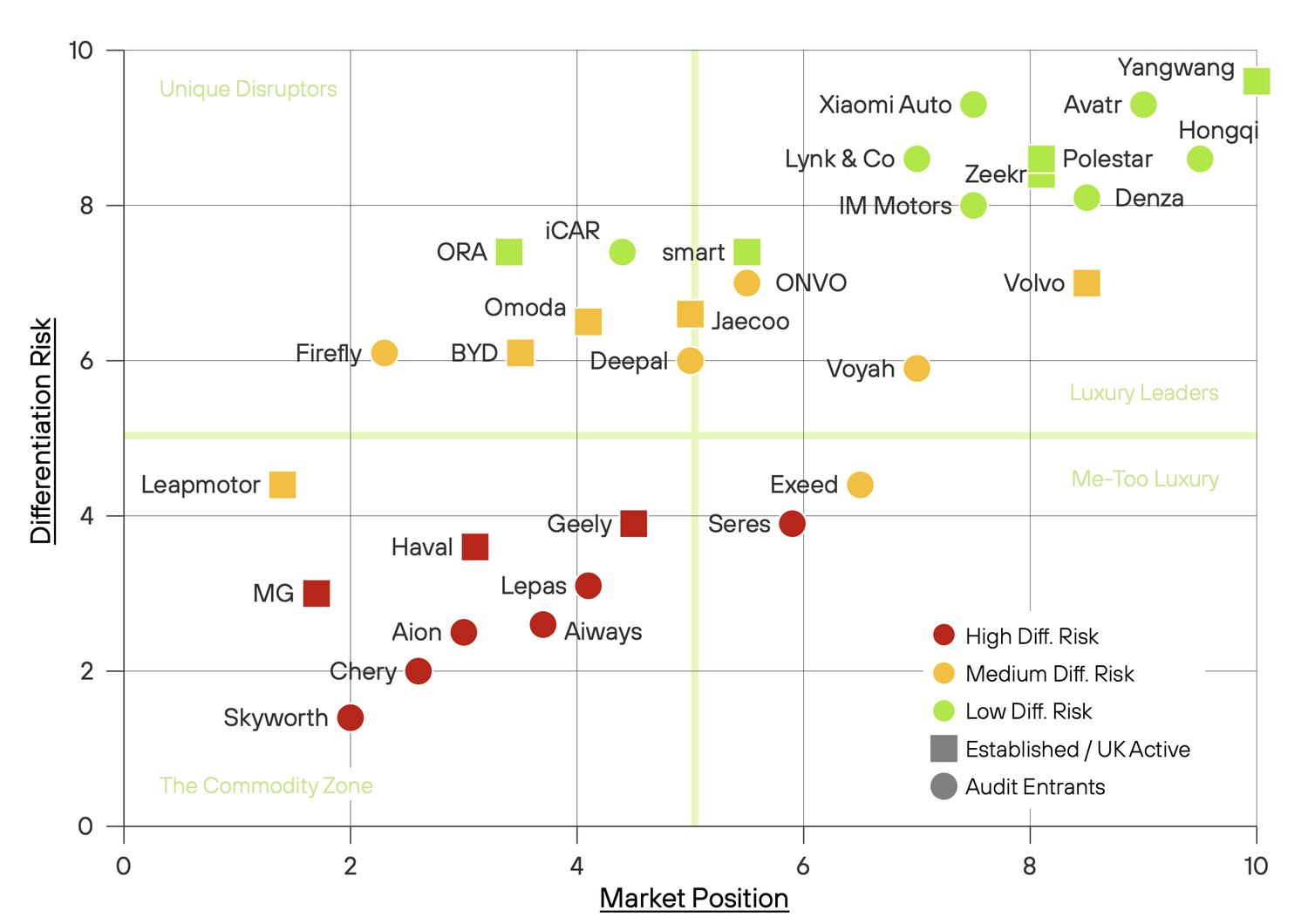
Execution advantages are real and temporary. A better infotainment system, a sharper price, a longer warranty or a faster dealer rollout can each be matched, and in this category each usually is.
Positioning builds over time, because a rival can’t copy what buyers already associate with a brand.
Our research puts it bluntly: the indistinct middle is a graveyard. Make sure a buyer can describe your brand in one sentence without mentioning the price, and get there before the next model launch.