

- Registration data confirms yesterday’s result. Search behaviour forms tomorrow’s shortlist, and the two rarely move in step. BYD sat near-invisible in UK search before 2022 and now pulls over 150,000 core brand searches a month, a shift that showed up in demand long before it showed up in the sales charts.
- Chinese OEMs hold only 5.1% of total UK automotive search attention against 94.9% for legacy brands, yet Chinese-owned registrations already hit nearly 25% of the market in December 2025. The sales share is running ahead of the search share, which tells you where the fragility is.
- 73% of EV buyers enter the market undecided on brand and one in four EV searches carry no brand at all, meaning most of the shortlist is still being built on screen rather than defended in the showroom.
- Between 2016 and 2025, Vauxhall core brand search fell around 25%, Fiat 26% and Citroën 27%, while Tesla grew 168% and Polestar over 1,000%. The reallocation of attention led the reallocation of registrations by years.
- The winners among the incoming Chinese brands are already visible in search demand. The registrations will simply confirm what the search curves are pricing in now.
The car-buying journey now starts on a screen months before it reaches a forecourt.
Buyers compare specs, monthly payments and reviews long before they speak to a dealer. By the time a registration is recorded, the decision was made much earlier, in a search bar. That is why registration data is a lagging indicator and search demand is a leading one.
For a market absorbing up to 30 Chinese marques by the end of 2027, that gap is the most useful signal available.
Registration data only tells you who already won
Registrations are a settlement, not a forecast. They record a decision that a buyer reached weeks or months earlier.
BYD closed 2025 as the sixth best-selling brand in the UK with a 2.55% share, and outsold Tesla across the year. Impressive, and entirely backward-looking. The demand that produced those numbers formed much earlier, when BYD moved from 1% brand recognition in 2023 to 31% by late 2024.
Recognition is a search-adjacent metric. It moves first.
By the time a brand tops a registration league table, the commercial window to notice it early has already closed. This matters commercially because budget set against last year’s registration data is budget aimed at a market that has already moved.
Search demand is where the shortlist actually forms
The shortlist is built before the buyer ever contacts a dealer. It is built in queries.
Our research shows 73% of EV buyers enter the market undecided on brand. One in four EV searches are unbranded. That leaves 86% of EV new-car sales still to capture, and most of that capture happens during research, not at the point of sale.
The buyer searching “EV charging cost” this week is the same buyer searching “best electric car deals” next month. The brand that answers both questions enters the shortlist. The brand that answers neither never does.
Automotive businesses should treat branded and unbranded search demand as the earliest reading of who is entering consideration. The registration follows the consideration, not the other way round.
The search share and the sales share are out of sync
Chinese OEMs hold 5.1% of total UK automotive search attention. Legacy brands hold 94.9%.
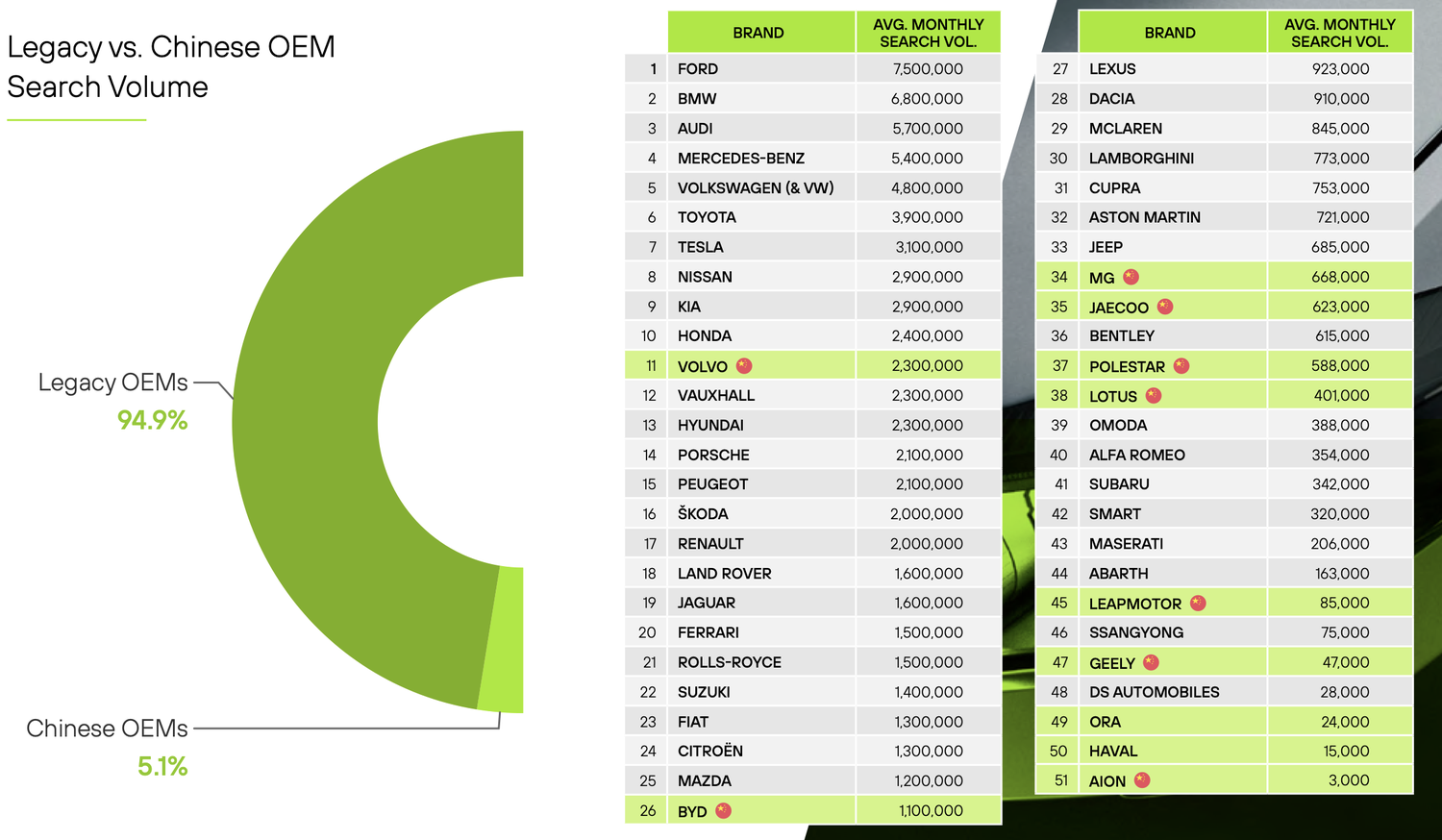
Set that against registrations and the tension is obvious. Chinese-owned share rose from under 9% to 13% in twelve months and peaked near 25% of new registrations in December 2025. The sales share is running well ahead of the search share.
That gap is where the exposure sits.
Registrations pulled forward by heavy discounting, with SMMT data showing EVs discounted by an average of £11,000 per unit in 2025, and by fleet volume can outrun genuine brand demand. When the incentive stops, the registration stops with it, unless search demand has caught up to hold the volume in place. This matters commercially because a brand with high registrations and low search attention is renting its market position, not owning it.
The decade of search history already named the losers
Attention reallocated long before registrations did, and the record is unambiguous.
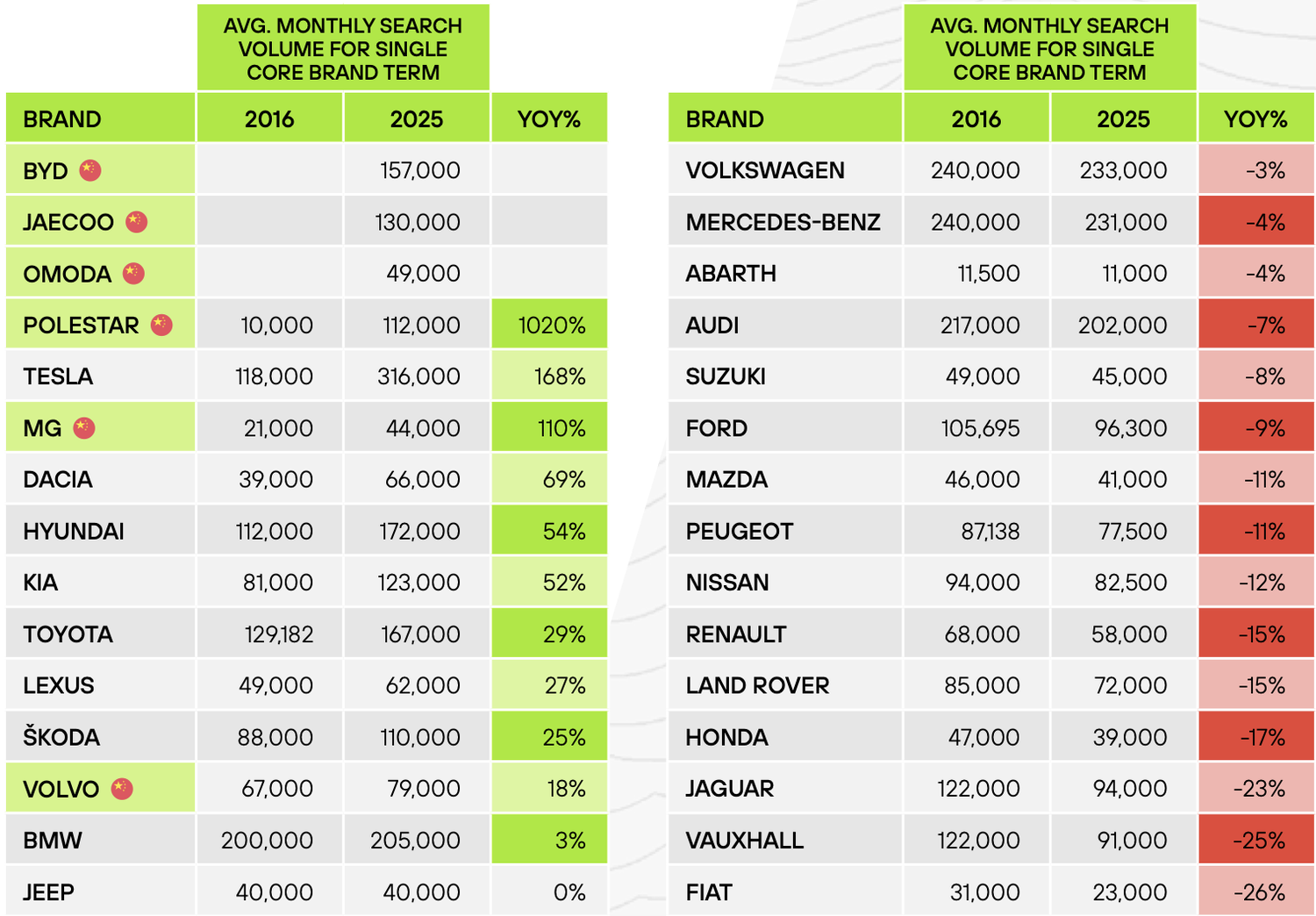
Between 2016 and 2025, Vauxhall core brand search fell around 25%, Fiat 26% and Citroën 27%. Over the same period Tesla grew 168%, Polestar over 1,000% and MG more than doubled. The brands losing search were losing relevance years before the sales decline was fully visible on the road.
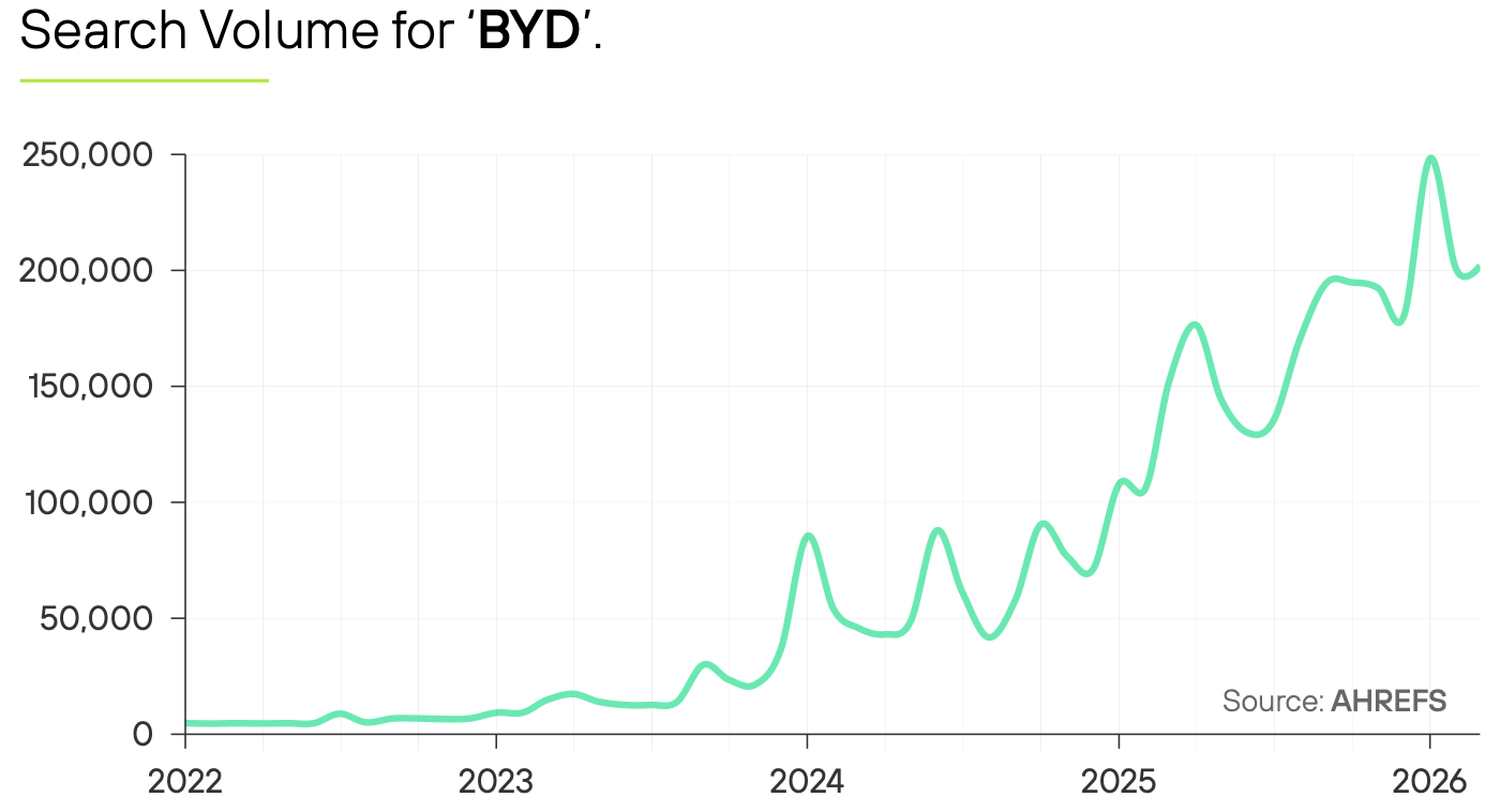
BYD was effectively absent from UK search before 2022. It now attracts over 150,000 core brand searches a month.
The commercial implication is straightforward. If search demand had been read as the leading indicator it is, the incumbents shedding attention had years of warning. Most treated flat brand search as background noise. It was the forecast.
Search flags the Chinese winners before the sales figures confirm them
The same signal that named the incumbent losers is now naming the incoming winners.
Jaecoo went from 0 to 28,232 registrations in a single year and secured 70-plus dealers before selling a car, taking the Jaecoo 7 to the second most popular model in the UK by January 2026.
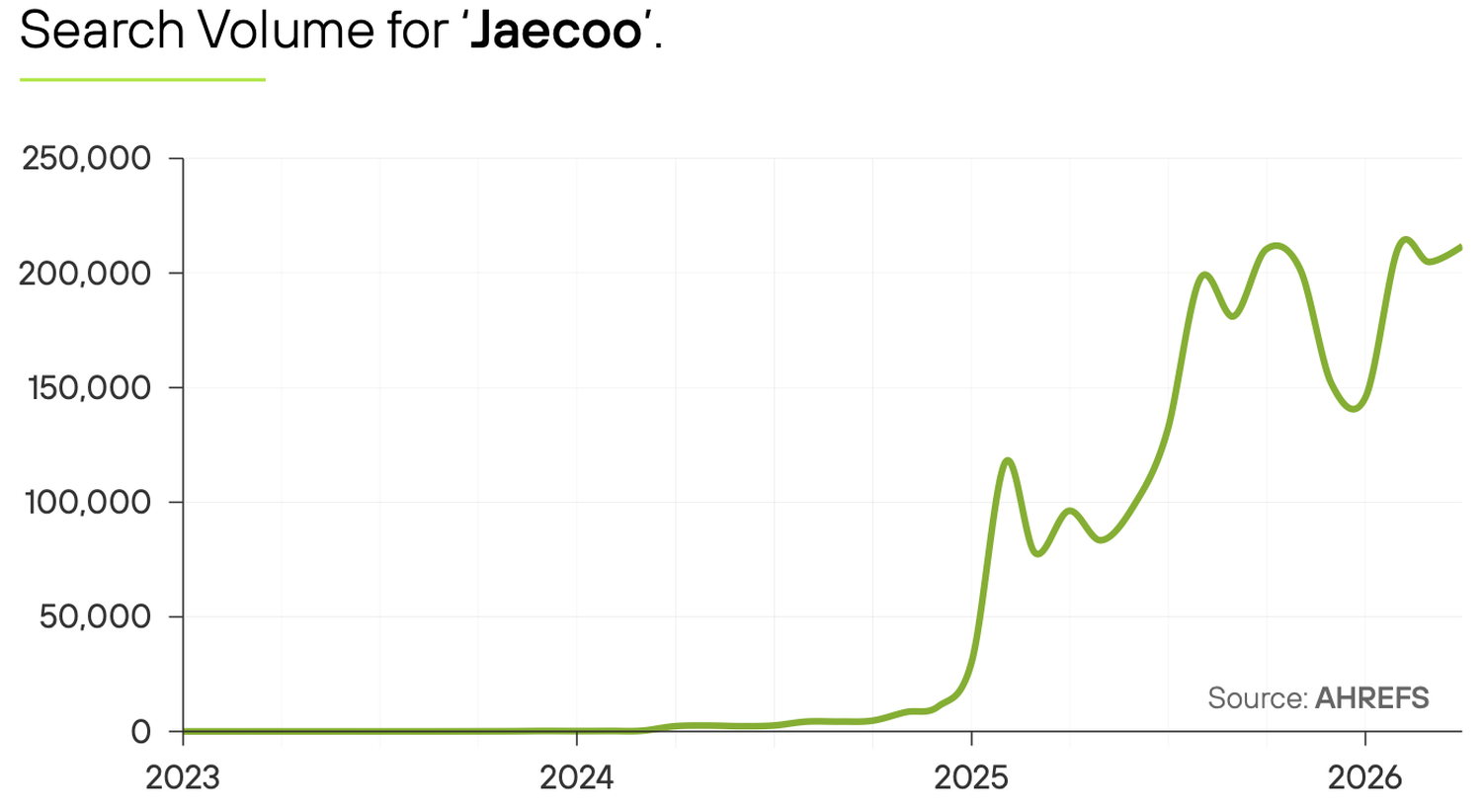
That did not come from nowhere. It came from engineered demand and search visibility built ahead of the sales curve.
On our six survival filters, brands with genuine moats, Zeekr, Lynk & Co, Denza, Hongqi and NIO among them, occupy defensible territory. Commodity-exposed brands like Skyworth, Aiways, Aion and Seres do not.
The brands building distinct, defensible search demand now are the ones whose registrations will hold once the discounting normalises. The ones buying registrations without building attention are the ones to watch fall.
Fleet volume hides the search signal, then exposes it
Fleet and salary sacrifice drive more than half of UK registrations, which means a large share of the sales chart reflects procurement decisions, not consumer demand.
That masks the real search signal. A brand can post strong fleet registrations while its consumer search demand stays thin. The numbers look healthy right up until the retail market has to carry weight the fleet channel used to absorb.
With Benefit-in-Kind rising to 4% in April 2026, the ZEV mandate tightening to 33%, and used EV residuals under pressure, fleet appetite will not stay uniformly generous. When it tightens, brands with genuine consumer search demand hold their volume. Brands leaning entirely on fleet do not. Search demand is the reading that tells you which is which before the fleet cycle turns.
What to read, and what to act on
For marketing directors, the practical shift is where you look first. Registration league tables describe the market you were competing in last quarter. Branded and unbranded search demand describes the one forming now.
For OEMs entering the UK, the discipline is to build search attention alongside registrations, not behind them. Volume without demand is a position that has to be re-bought every quarter.
For dealer groups, the same logic decides which brands to back. A partner with rising search demand is compounding equity. A partner with rising registrations and flat search is a volume spike waiting to correct.
The winners in this market are already visible. They are the brands whose search curves are climbing before the registrations catch up.
If your planning still starts with last year’s registration data, it is worth reviewing whether you are reading the market as it was or as it is becoming. The search curve moves first. The registration is just the receipt.