

- Up to 30 Chinese marques are due by 2027, so the first arrivals’ novelty edge shrinks with every launch.
- Chinese-owned brands rose from under 9% to 13% of registrations in a year, peaking at nearly 25% in December 2025. Yet they hold just 5.1% of UK automotive brand search.
- BYD went from 1% brand recognition in 2023 to 31% by late 2024, on the back of five model launches in two years and almost a decade of groundwork.
- Most of the second wave shares one pitch: mid-premium and tech-forward, hybrid or EV, priced aggressively.
- The brands that outlast the novelty phase will be the hardest to swap for another, whatever their launch date or price.
What happens to a launch plan built on being new when up to 30 Chinese-owned brands are chasing the same UK buyers? And how long can novelty keep selling cars once buyers have already watched the first wave arrive?
The first Chinese brands to reach the UK were the fresh alternative, and being new helped them get noticed.
By the end of 2027, the newcomers will be telling much the same “new challenger” story.
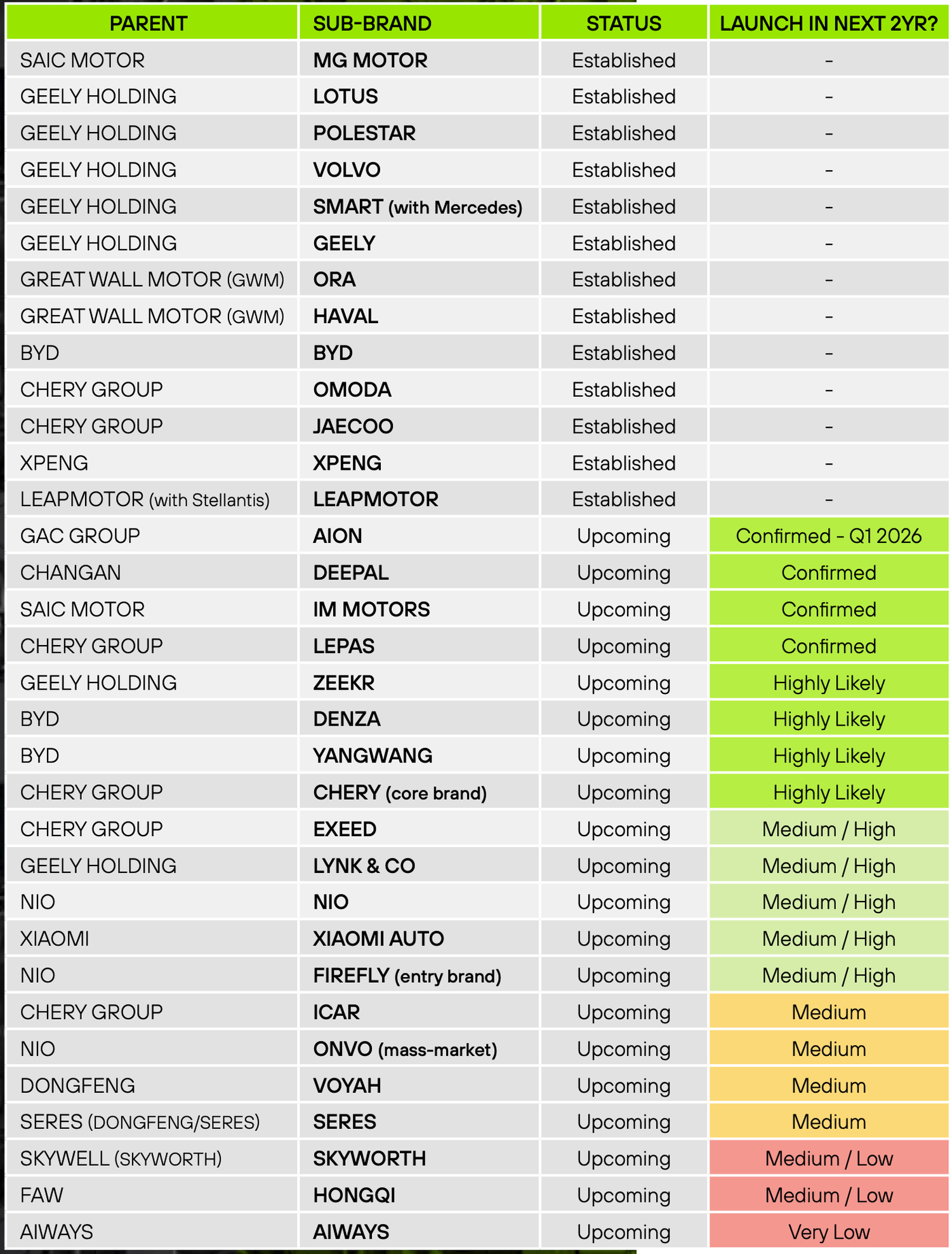
Planned launches carried the first wave of Chinese brands
BYD outsold Tesla across 2025. Its brand recognition went from 1% in 2023 to 31% by late 2024, after five model launches in two years.
The push sat on almost a decade of groundwork. Since 2014, BYD has supplied UK cities with more than 2,000 electric buses.
Jaecoo moved even faster, with more than 70 dealers signed up before it sold a single car. The brand went from zero to just over 28,000 registrations in a year, and the Jaecoo 7 was the UK’s second most popular model by January 2026.
Both won on planning as much as novelty. Being new got them a first look, and fast launches, long warranties and big dealer partners turned that look into sales.
But novelty fades with repetition. The tenth Chinese EV a buyer sees surprises them far less than the first one did.
So the brands arriving now inherit the category awareness the pioneers built, and they’re walking into a room that’s already full of similar names.
A fixed market leaves less room for each new arrival
The UK market stays roughly the same size, however many brands turn up.
Chinese-owned brands went from under 9% to 13% of registrations in twelve months and reached nearly 25% in December 2025.
On the face of it, there’s room for everyone. But our report expects the next round of pressure to come from fellow Chinese brands chasing the same buyers, rather than the legacy incumbents they’ve been winning share from.
Dealer capacity and fleet budgets stay fixed too. Every marque that sells itself as the new option is chasing the same buyers, the ones who want something new. This group stops growing once being new is normal.
Search shows how far brand attention lags behind sales
Chinese OEMs hold just 5.1% of UK automotive brand search, against 94.9% for legacy brands.
Put simply, their share of sales is more than double their share of search.
Ford alone draws 7.5 million UK brand searches a month, while BYD draws 1.1 million.
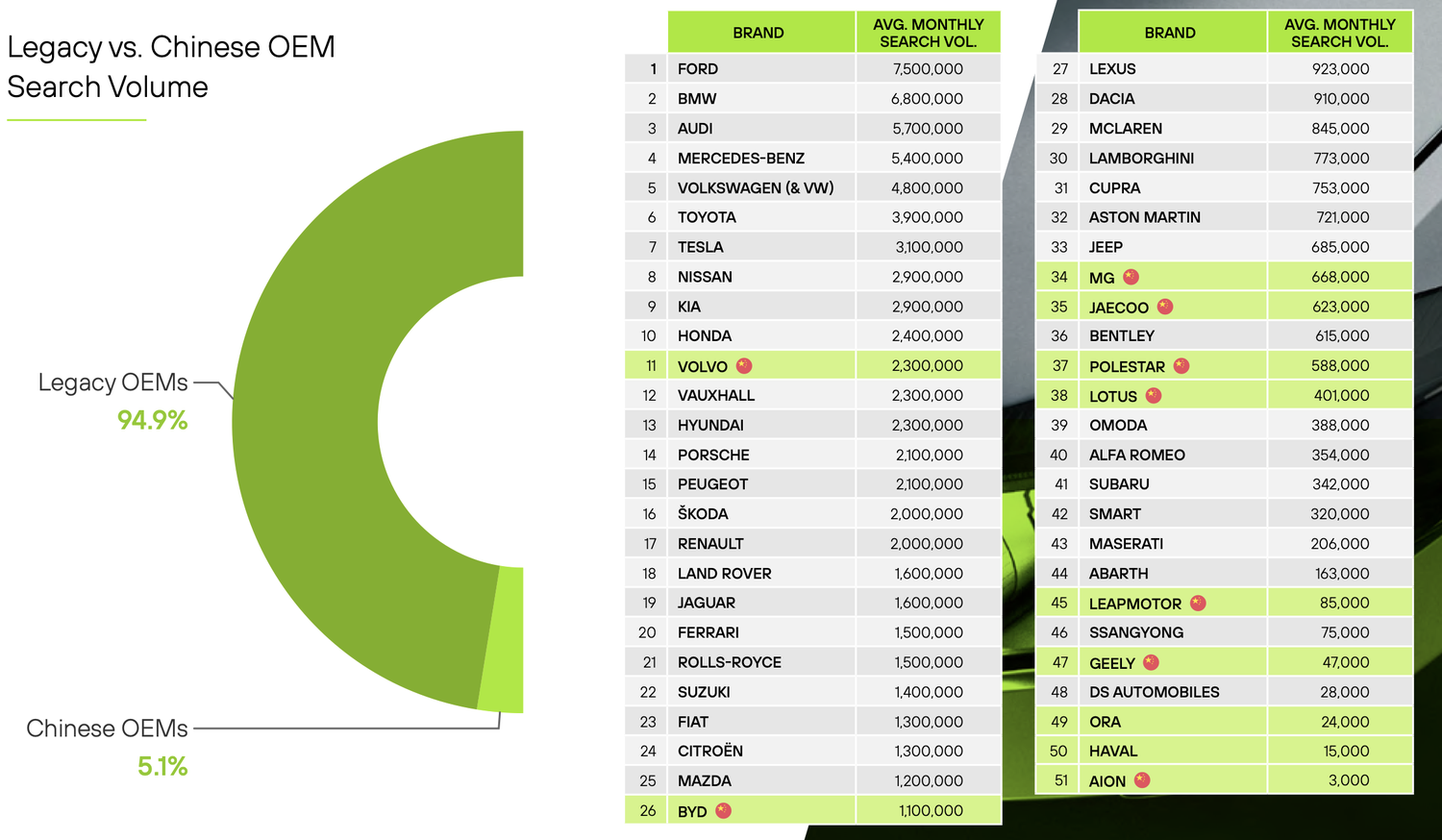
And search is the leading indicator. Once the novelty fades, the brands with thin search demand have little to fall back on.
The new challenger story is now the most crowded in the market
A position only works if it separates you from the brand parked next to you.
Our report mapped the second wave across six structural filters and found the field clustering in the same territory. Most entrants share one script: mid-premium and tech-forward, hybrid or EV, at an aggressive price.
That script makes sense on paper, but the trouble is that up to 15 more brands could arrive reading from it.
Defensible identities outlast the novelty premium
Some brands own territory a newer rival can’t take from them.
On our structural scoring, Zeekr, Lynk & Co, Denza, Hongqi and NIO sit on less crowded, more defensible ground. Each competes on something rivals can’t copy quickly, such as Hongqi’s heritage or NIO’s battery swapping.
At the other end, Skyworth, Aiways, Aion, Seres and Chery’s own brand sit in commodity space, where price is the only lever left.
And OEMs are already discounting EVs by an average of £11,000 per unit.
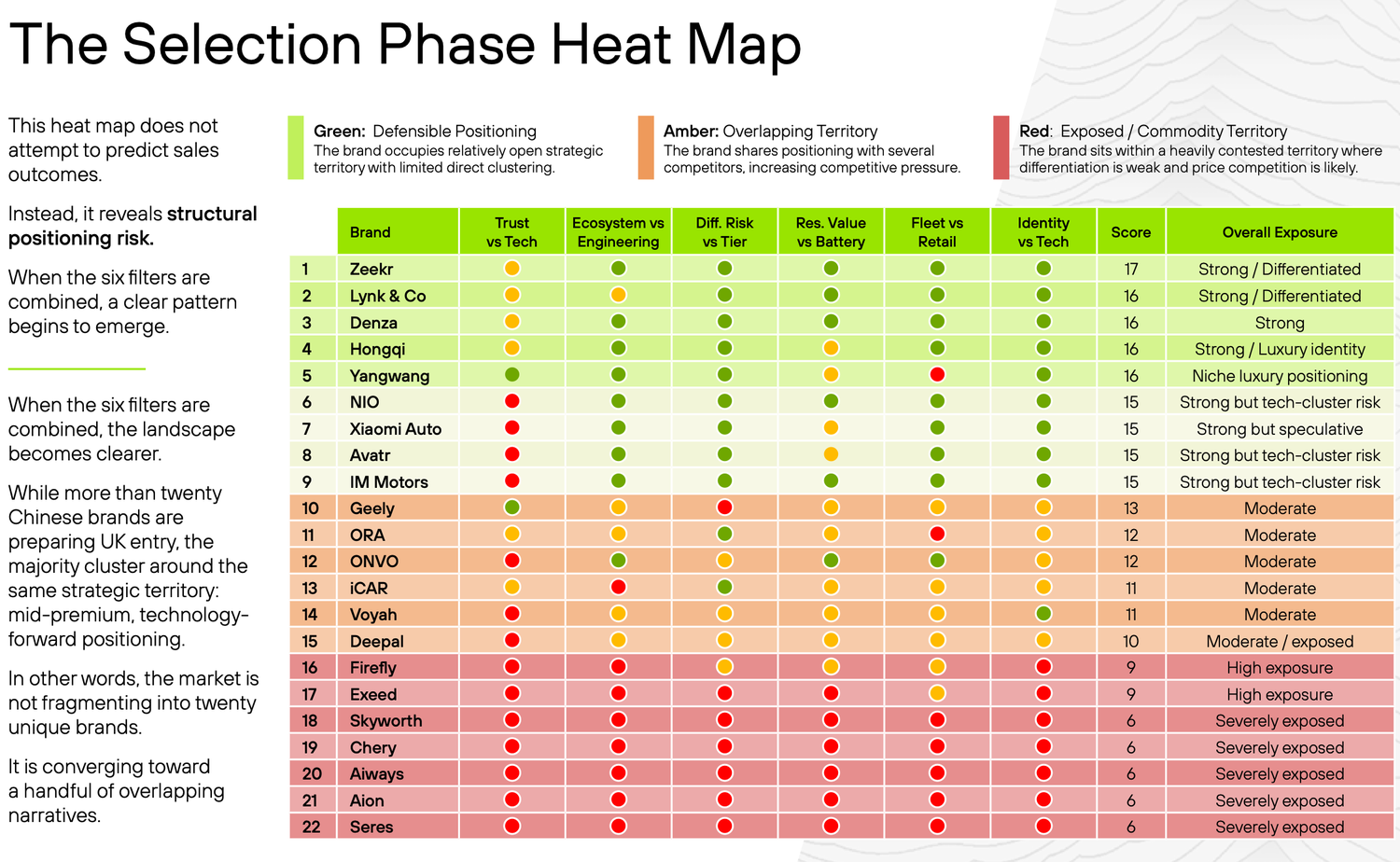
What separates the two groups is a clear audience, a distinct identity, residual value confidence and trust. All four survive the day a brand stops being the newest name on the forecourt.
Japan built defence before it built volume
Japanese manufacturers spent decades in the UK building a reputation for reliability, a dealer network and confidence in their residual values. Those foundations let them scale and stay.
The Chinese entrants are compressing that timeline into years, and the ones that pull it off will have used the novelty window to build defence.
Take “new” out of the pitch and see what’s left
For dealer groups and leasing partners, the choice is between brands with a durable identity and brands still trading on novelty. Backing the second group buys volume now and exposure later, when residuals soften.
OEMs and marketing directors have a simple test. Take “new” and “affordable” out of the proposition and see if a distinct audience and a reason to be remembered are still standing.
If your growth has run on being the fresh option, check whether your position is distinct or simply early.