

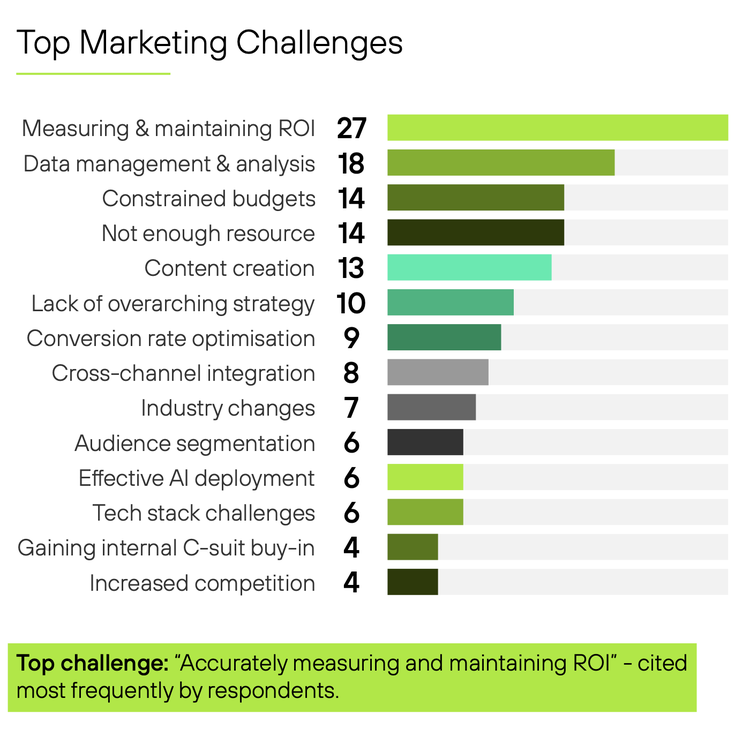
- Measuring and maintaining ROI is the number one challenge in automotive marketing, cited 27 times in our survey, ahead of data management on 18 and constrained budgets on 14.
- Average confidence in quantifying ROI sits at 6 out of 10, while the top objective for the year ahead is higher lead and sale volumes, cited 41 times. Growth targets are being set on a measurement foundation nobody fully trusts.
- Two of the three biggest obstacles to adopting new marketing technology are organisational rather than financial: resistance to change on 21 mentions and wider business buy-in on 18, either side of limited budget on 23.
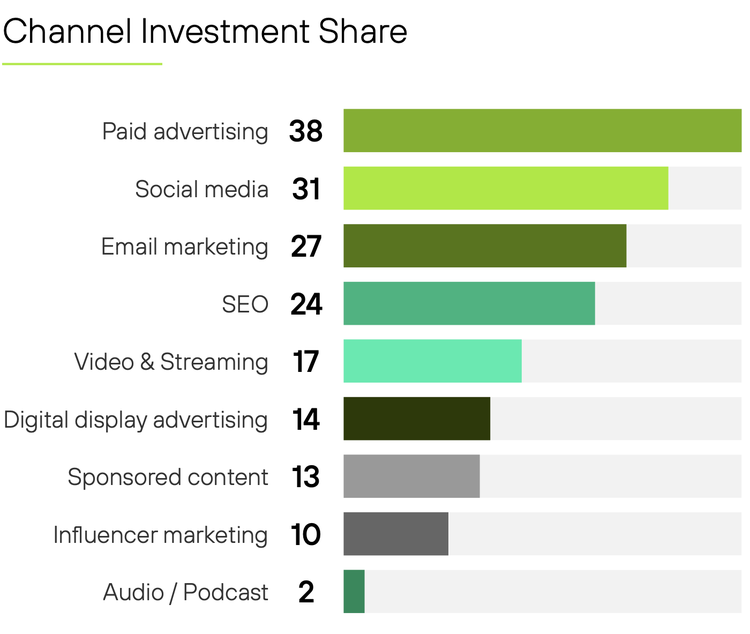
- Paid advertising takes 22% of investment share, ahead of social on 18%, email on 15% and SEO on 14%, and Google Ads is the most-cited priority for the next 12 months. Spend is concentrated exactly where attribution is easiest to claim.
- Only 48% of in-house marketing strategies currently include AI, yet AI and machine learning is the most-wanted area to explore, cited 36 times. Interest is running well ahead of application.
We surveyed 50 in-house automotive marketers about what is actually blocking them, and the answer was not money.
Measurement outranks budget as the biggest challenge
Measuring and maintaining ROI was cited 27 times as a top challenge. Data management followed on 18. Constrained budgets came third on 14.
That ordering is worth sitting with, because most planning conversations in this sector start from the assumption that the constraint is spend.
This matters commercially because a budget problem and a measurement problem need opposite responses. More money poured into a channel nobody can evaluate compounds the original issue. Automotive businesses should establish what they can actually prove before they argue for a larger budget, because the second conversation is much easier once the first is settled.
A 6 out of 10 confidence score is a budgeting problem
Average confidence in quantifying return on marketing investment came in at 6 out of 10.
Set that against the top objective for the year ahead, higher lead and sale volumes, cited 41 times, well clear of brand awareness on 26 and lead-to-sale conversion on 23.
Growth-led targets are sitting on a measurement base that the people running it rate as barely adequate. The commercial implication is straightforward: allocation decisions are being made on partial evidence, and the gap between what gets credited and what actually worked is where budget quietly disappears. Marketing directors should treat a confidence score below 8 as a live risk to the plan rather than a reporting inconvenience.
The obstacles to new technology sit inside the business
Limited budget led the obstacles to adopting new marketing technology on 23 mentions. Resistance to change followed on 21. Wider business buy-in came third on 18.
Two of those three are internal politics rather than finance.
This changes what a technology case needs to contain. A proposal built entirely around cost and capability is answering one objection out of three. In practice, teams should build the internal argument first, name who has to agree, and bring them in before the tooling decision rather than after it.
Spend concentrates where attribution is easiest to claim
Paid advertising takes 22% of investment share. Social follows on 18%, email on 15% and SEO on 14%.
Looking forward, Google Ads is the most-cited investment priority for the next 12 months on 28 mentions, then SEO on 25 and paid social on 20. The stated plan is more of what already dominates.
There is a pattern here that connects directly to the measurement finding. The channels attracting the most spend are the ones that report most cleanly, which is not the same as the ones creating the most value. When confidence in attribution is 6 out of 10, money drifts towards whatever produces a legible number. Automotive businesses should check whether their channel mix reflects commercial contribution or reporting convenience.
Channel reliance is almost certainly understated
Seven in ten marketers said they are not overly reliant on any single channel. The remaining 30% admitted they are, most commonly on Google Ads.
Our read is that the 70% is optimistic. Weak attribution hides reliance rather than removing it, and a business that cannot measure channel contribution confidently is not well placed to judge its own concentration risk.
The commercial exposure here is real. A brand that discovers its dependency during an algorithm update or a CPC rise is discovering it far too late. Teams should model what happens to pipeline if their largest channel drops 30% in a quarter, and treat that number as a planning input.
Brand investment is being cut while acquisition gets more expensive
Brand building came through as undervalued, with cuts landing on TV and display.
This is the predictable consequence of the measurement gap. Upper-funnel activity is the hardest thing to attribute cleanly, so it loses the internal argument first, even though weak brand demand is what makes performance media expensive in the first place.
The result is a slow squeeze. Less brand investment, higher acquisition costs, more pressure on the channels that already carry the spend. Marketing directors should be able to state what their brand investment is buying in demand terms, because the alternative is defending it on faith every planning cycle.
Interest in AI is running ahead of application
Only 48% of in-house marketing strategies currently include AI. Another 48% do not, and 4% do not know.
At the same time, AI and machine learning is the most-wanted area to explore on 36 mentions, ahead of generative AI on 21 and video streaming on 20.
The split matters because the advantage does not go to whoever adopts first. It goes to whoever applies the tools to a problem worth solving, and in this sector the obvious candidate is the measurement gap that came top of the list. Teams should point AI at attribution and data management before they point it at content production.
Sector expertise has become a filter rather than a differentiator
Every marketer surveyed said industry expertise matters when selecting an agency, and 60% called it imperative. Meanwhile 62% currently work with agencies.
For anyone selling into this market, automotive knowledge is now the entry requirement rather than the pitch. It gets you considered and nothing more.
What separates suppliers at that point is whether they can close the gap the survey identified. An agency that can raise a client’s ROI confidence from 6 to 8 is solving the problem the market says it has.
The gap is between ambition and alignment
The survey describes a sector with clear commercial goals, real budget and genuine appetite for new capability, held back by an inability to prove what is working.
Ambition is not the constraint here. The report puts it plainly: this is not a sector that lacks drive, it lacks direction.
If confidence in your own attribution sits anywhere near 6 out of 10, it is worth reviewing whether your next budget increase would actually be measurable, because a bigger number spent through the same reporting gap will not tell you any more than the last one did.