

- More than half of UK registrations now run through fleet and salary sacrifice, so most buyers see a monthly payment first. That payment is set by what the car is forecast to be worth at 36 months.
- When an underwriter can’t model that value with confidence, it adds a risk buffer and the rental goes up, which wipes out the list price advantage.
- SMMT data shows EVs were discounted by an average of £11,000 per unit in 2025, and each discount lowers the forecast for the next round of leases.
- Up to 30 Chinese-owned brands could be on sale here by the end of 2027, in a market of roughly 2 million cars a year.
- The brands that scale will be the ones leasing houses trust enough to write volume against.
What actually decides whether a Chinese car brand makes it in the UK? And what if the answer has very little to do with the car itself?
For most buyers, the number that matters comes from a leasing house. It’s the forecast of what the car will be worth in three years, and it settles which brands scale and which ones stall.
Most UK buyers now see the monthly payment first
More than half of UK registrations now run through fleet and salary sacrifice. The total car lease fleet has passed 1.5 million vehicles, and business contract hire is growing at 8% a year. So most buyers see a monthly figure first.
The rental is built on a residual value forecast
A lease rental comes from the gap between the list price and the predicted value at contract end. Underwriters like CAP HPI and Autovista make that prediction.
Put simply, the bigger and less certain the expected depreciation, the more the customer pays each month.
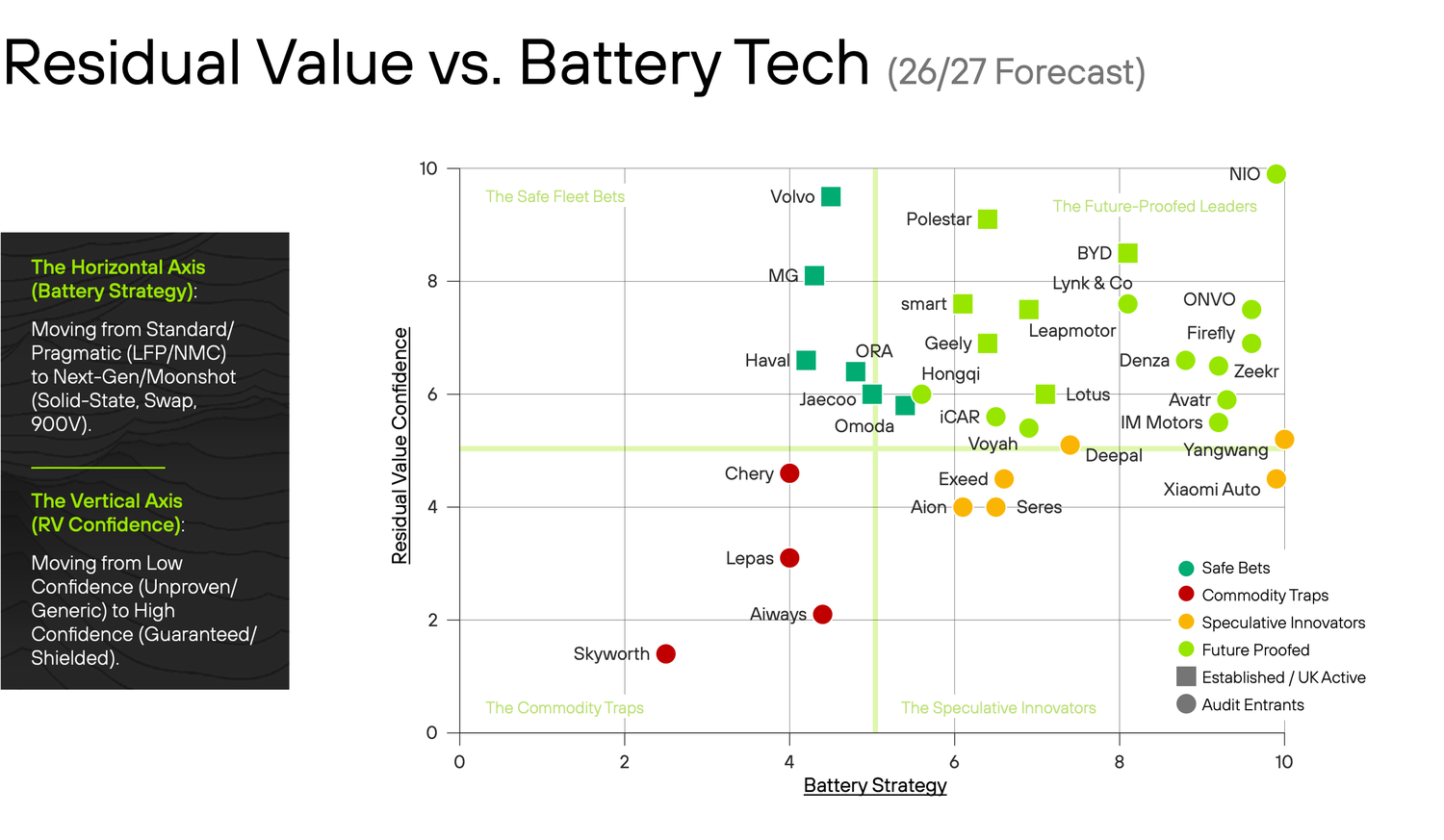
The strongest spot on that map pairs next-generation battery tech with high residual confidence, and very few brands sit there.
Residual value is a test every Chinese brand arriving now has to pass. A brand can launch with a sharp list price and still look expensive on a broker’s screen, because an uncertain residual forecast comes with a wide risk buffer.
A soft residual wipes out the price advantage
Most second-wave Chinese brands pitch on value, with more car and more technology for less money, and that draws plenty of retail interest. But it struggles to get past a cautious residual forecast.
If an underwriter can’t model a car’s worth at 36 months with confidence, it adds a buffer. That buffer pushes up the rental, so the challenger that was meant to be cheaper can end up quoting more each month than an established brand with strong residuals.
Discounting today drags down the next residual forecast
EV residual values are already under pressure from oversupply and heavy discounting.
SMMT data shows EVs were discounted by an average of £11,000 per unit in 2025. Hardly reassuring.
Every heavy discount on a car in the showroom lowers the reference point for forecasting the next one. So a Chinese brand that discounts its EVs to hit this quarter’s registration target is likely to face higher lease rates later.
Policy is pushing fleets towards the cars that are hardest to forecast
The fleet channel is getting harder for a new brand to break into.
Benefit in Kind on EVs went up to 4% in April 2026, and the ZEV mandate has tightened to 33%. Both push fleets further towards electric ranges, which is where residual uncertainty is highest.
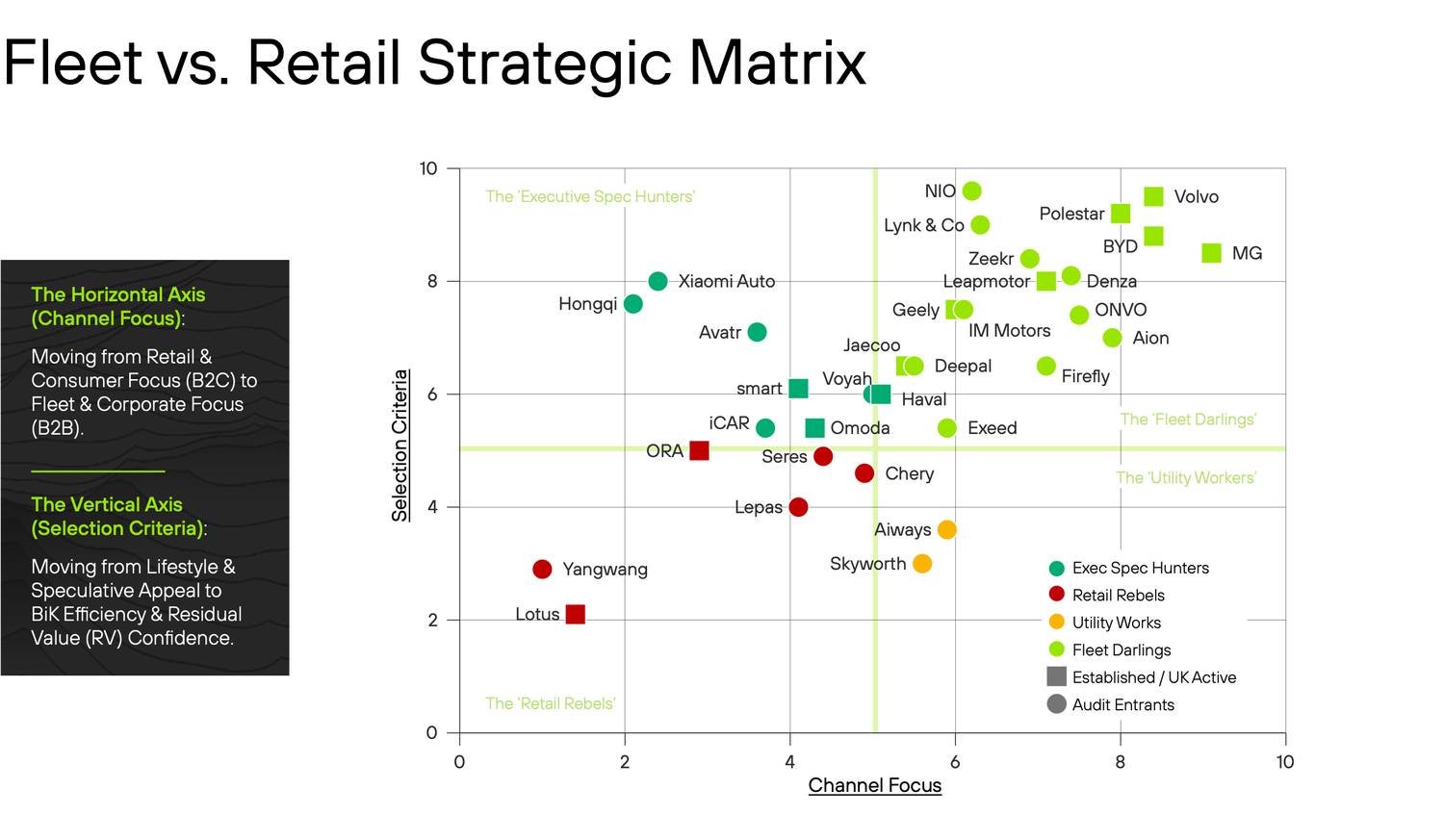
The brands that win fleet volume will be the ones that give underwriters a reason to forecast with confidence.
Leasing houses decide which brands reach scale
Enthusiasm gets a brand noticed, but it scales in the UK when leasing houses like Lex, Arval and Zenith are willing to write large volumes of business against it.
Retail demand is real. BYD outsold Tesla in 2025, and the Jaecoo 7 was the UK’s second most popular model by January 2026.
But headline demand and financed volume work differently. Lasting volume comes from fleet integration, and that depends on a residual forecast that a broker and an underwriter will both stand behind. Once a brand is built into company car replacement cycles, its volume keeps compounding.
A good car can still be capped by its residual
Chinese-owned brands went from under 9% to 13% of registrations in a year, peaking near 25% in December 2025. The market itself stays at roughly 2 million cars a year. Up to 30 Chinese marques could be on sale by the end of 2027.
Most of them pitch the same value story, and only a small cluster is set up for fleet.
Our report scores 22 Chinese brands on six structural filters, residual value among them.
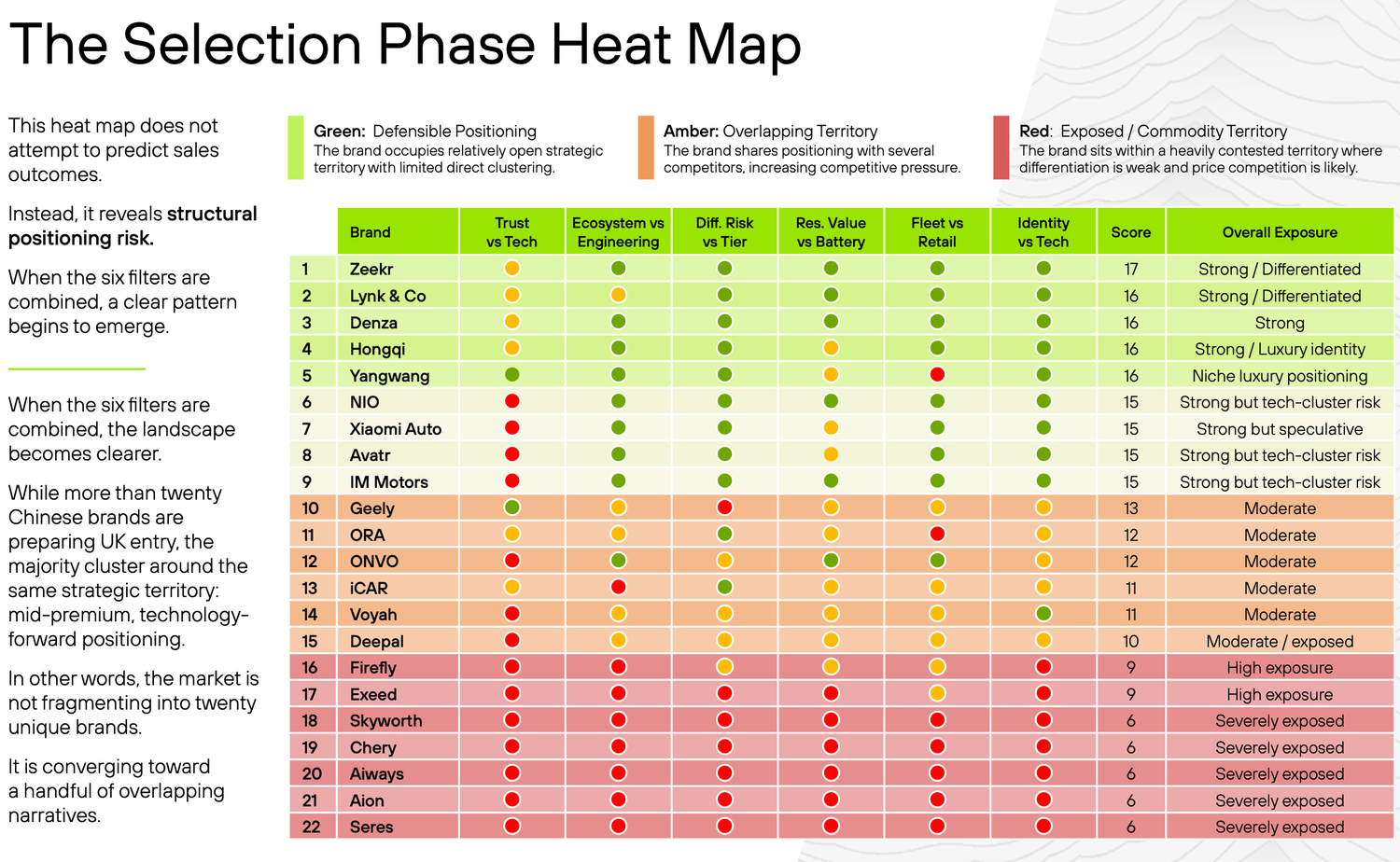
A brand can build a genuinely good car and still be capped, because its residual forecast prices its leases above the incumbents it set out to undercut.
Our report expects the first exits to come from brands that pair a standard battery with weak residual confidence. For those brands, heavy discounting becomes the normal way to shift stock.
Screen Chinese brands on residual value before you back them
Residual value belongs in commercial due diligence. Without residual confidence, a brand’s monthly rentals become uncompetitive, whatever its list price.
When you decide which Chinese brands to take on and promote, use battery strategy, warranty terms and used market performance as your early indicators. They shape the residual before the registration data catches up.
And back the entrants whose economics hold up in a downturn. A brand offering quick volume on a weak residual buys registrations now and margin erosion later.
If your pipeline is built around launch pricing and retail momentum, check whether the residual forecasts underneath those brands can carry the volume you’re planning to write.