

Most leasing brokers focus heavily on traffic acquisition because clicks are easy to measure.
Search visibility, CPCs, impression share and lead volume dominate reporting conversations across the industry. The problem is that strong traffic numbers often hide weak conversion performance once the user lands on site.
As competition increases, that gap is more important.
The UK vehicle leasing and finance market continues to grow, with turnover in the rental and leasing sector reaching £21.46 billion in 2023. At the same time, the number of vehicle leasing companies has expanded significantly over the last decade, creating a more crowded acquisition environment.
That means brokers are paying more to attract visitors into a market where users have more choice and less patience.
The commercial pressure is no longer just about generating traffic. It is about converting attention into enquiry volume efficiently.
Most brokers optimise for the first part of the journey then fall at the final hurdle
Search still plays a major role in automotive discovery.
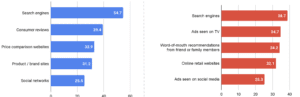
According to the GWI data, 55% of car buyers used search engines for online product research between Q1 2024 and Q3 2025, while 39% used search engines for brand discovery.
Online Product Research in %: Brand Discovery in %:
This creates a predictable behaviour pattern.
Users search for a specific model, monthly price, fuel type or lease structure. They compare multiple brokers quickly, open several tabs, then start filtering providers based on trust, clarity and ease of action.
Most brokers still optimise only for the first part of that journey.
They win the click-through pricing pages, paid search campaigns and vehicle listings, then send users into generic landing experiences with weak reassurance and poor navigation structure.
That creates an unnecessary drop-off at the highest-intent stage of the funnel.
Generic leasing pages… Everywhere!
Many leasing pages still look interchangeable.
The same stock imagery, the same manufacturer logos and the same finance terminology appear across most broker sites. Users struggle to understand why they should trust one provider over another.
This becomes more important because leasing is a high-consideration purchase.
Consumers are committing to multi-year contracts with significant monthly costs. FCA data shows that provider reputation and existing customer familiarity remain major decision drivers in motor finance selection.
That means users need reassurance before they enquire.
The strongest-performing broker pages usually explain:
- Who the broker works with
- How the process works
- What happens after enquiry
- Whether the deal is genuinely available
- What support exists during the agreement
Weak pages force the user to work those answers out themselves.
That uncertainty lowers enquiry intent even when traffic quality is strong.
Trust signals are often placed too late
Many leasing sites treat trust as a secondary design element.
Review scores, funder relationships, delivery processes, customer service information and regulatory reassurance are frequently buried deep into the page or hidden entirely.
Users decide quickly whether a leasing business feels credible.
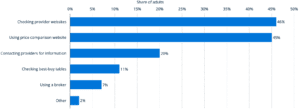
That matters because comparison behaviour is extremely high in automotive finance. FCA research shows consumers actively compare providers through websites and price comparison platforms before committing.
The implication for brokers is simple – every landing page needs to establish trust within seconds.
That includes:
- Clear FCA positioning
- Visible review validation
- Named finance partners
- Transparent pricing language
- Clear contact methods
- Real delivery expectations
Most brokers already have these assets internally, but the issue is placement and visibility.
Methods to compare motor finance providers in the UK 2022:
Too many journeys rely on “Request a Quote” – the same message on every leasing site
A large percentage of leasing websites still rely on generic lead forms as the main conversion action.
That creates friction because users are rarely ready to submit a blind enquiry immediately after landing.
High-performing journeys reduce uncertainty before asking for commitment.
That usually means giving users:
- Delivery expectations
- Eligibility guidance
- Vehicle availability context
- Estimated response times
- Leasing process clarity
- Early pricing transparency
The objective is to move the user forward confidently instead of forcing a premature lead action.
This becomes commercially important because acquisition costs continue rising across automotive search.
If post-click conversion remains weak, scaling traffic simply increases wasted spend.
Brokers underestimate how much users evaluate the business itself
Many brokers believe users only compare deals.
In practice, users also compare operational confidence.
The market has become crowded, with more than 3,400 vehicle renting and leasing enterprises operating in the UK in 2023. That creates very little perceived differentiation across search results.
Users increasingly evaluate:
- Site quality
- Communication clarity
- Brand familiarity
- Customer reassurance
- Process simplicity
- Transparency
The businesses that scale efficiently usually make the experience feel lower risk.
That affects paid search efficiency directly because stronger conversion rates improve how aggressively brokers can compete on acquisition channels.
The rise of EVs makes bespoke landing pages even more important
The growth of EV leasing adds another conversion challenge.
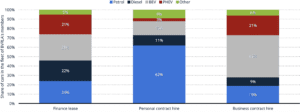
BVRLA data shows battery electric vehicles represented 38% of new fleet additions by Q4 2024, up from just 1% in Q4 2019.
EV leasing users often need more reassurance before enquiring because the research process is more complex.
They want clarity around:
- Charging
- Range
- Tax treatment
- Running costs
- Delivery timing
- Suitability for personal or business use
Many brokers still send EV traffic into standard leasing templates with limited educational support.
That weakens conversion efficiency because the landing experience does not match the intent behind the search.
Distribution of the car fleet of BVRLA’s members in the UK 2024, by fuel type:
Better conversion performance changes your budget strategy
The commercial impact of post-click optimisation is usually underestimated.
Most leasing businesses attempt to scale by increasing traffic acquisition budgets first.
The stronger opportunity is often improving conversion efficiency before increasing spend.
If landing pages convert more users into qualified enquiries:
- Paid search becomes more profitable
- Organic traffic generates higher value
- Brand campaigns produce stronger return
- Cost per lead falls
- Sales teams receive better intent traffic
That creates a more stable growth model than relying entirely on acquisition expansion.
This matters particularly in a market where search competition continues to increase across high-intent leasing terms.
What leasing brokers should do right now
Most brokers already generate enough traffic to identify conversion weaknesses.
The issue is usually post-click execution rather than acquisition visibility.
We would review:
- Landing page clarity
- Trust placement
- Form friction
- Mobile usability
- CTA sequencing
- Vehicle page structure
- Response expectations
- EV education content
- Brand differentiation
- Page intent matching
The brokers that improve these areas tend to scale more efficiently because they convert existing demand more effectively.
That creates better commercial performance without relying entirely on larger media budgets.
Talk To Our Experts
Please submit your details and as much information as you can on what you would like to discuss:
required information