

Leasing has moved from a financing option to a primary access point for electric vehicles across the UK market.
The shift is visible in fleet composition, funding structures, and how consumers manage risk around new technology.
EV adoption is being driven through leasing fleets
The share of battery electric vehicles entering leasing fleets has increased rapidly over a short period.
Distribution of new cars added to the BVRLA fleet in the UK 2019-2024, by fuel type:
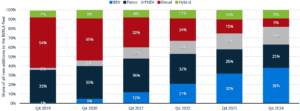
This shows BEVs moving from 1% of new fleet additions in Q4 2019 to 38% in Q4 2024 .
This means that leasing channels are where EV adoption is actually happening at scale.
OEMs are placing volume into leasing fleets because it provides a controlled route to market and supports residual value management.
Leasing brokers should prioritise EV visibility and stock availability because demand is already flowing through this channel.
Leasing concentrates EV exposure in business and salary sacrifice channels
Fleet data shows that EV penetration is highest in structured leasing products.
Distribution of the car fleet of BVRLA’s members in the UK 2024, by fuel type:
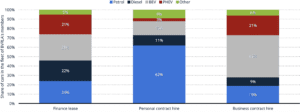
The chart above shows BEVs accounting for 45% of business contract hire fleets in 2024 .
This shows that company-funded and salary sacrifice schemes are the core drivers of EV uptake.The tax efficiency and predictable cost structure make these routes commercially viable for higher value vehicles.
Fleet operators should continue shifting procurement toward EVs because demand is already aligned with these funding structures.
OEMs should focus incentive spend on business leasing channels where conversion is already proven.
Leasing reduces technology and residual value risk for consumers
EV adoption is shaped by uncertainty around battery performance, depreciation, and long-term ownership costs.
Leasing removes this exposure by fixing the cost over a defined period and transferring residual risk to the funder. This makes newer and more expensive EV models accessible without requiring long-term commitment.
Brokers should position leasing as a risk management tool because this aligns with how consumers evaluate EVs.
Dealers should prioritise monthly cost messaging over total price because this reflects how EV decisions are being made.
Monthly affordability is unlocking access to higher-priced EVs
EVs typically sit at a higher upfront price point than internal combustion vehicles.
Leasing spreads this cost into predictable monthly payments, making higher-value vehicles accessible to a broader audience.
Cars bought on finance by consumers and businesses in the UK 2023-2025:
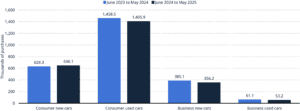
The finance data above shows over two million vehicles were acquired through finance by consumers in the latest 12-month period. This confirms that access to vehicles is already structured around financing rather than outright purchase.
Leasing brokers should optimise offers around monthly price competitiveness because this is where conversion happens.
OEMs should align pricing strategy with lease rate support to maintain competitiveness in EV segments.
Leasing aligns with how consumers research and evaluate vehicles
Search behaviour shows that car buyers are actively comparing options before committing.
The automotive market data shows 54.7% of buyers use search engines for product research and 38.7% use search for brand discovery .
This creates a research-heavy journey where flexibility becomes a priority.
Leasing fits this behaviour because it allows consumers to act without long-term commitment.
Automotive businesses should ensure EV leasing offers are visible across search because this is where demand forms.
Marketing teams should prioritise high-intent queries around monthly cost, lease deals, and EV comparisons.
The leasing market structure supports continued EV growth
The leasing sector continues to scale in both revenue and fleet size.
Vehicle renting and leasing turnover in the UK 2008-2023, by segment:
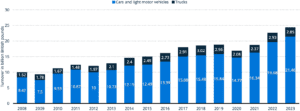
This chart shows total leasing and rental turnover increasing to over £21 billion in 2023, showing the infrastructure required to support EV adoption is already in place.
Large leasing fleets provide a route to cycle vehicles back into the used market, which will support broader EV adoption over time.
Fleet operators should plan for higher EV volumes entering secondary markets.
OEMs should align production and remarketing strategies with leasing cycles to manage supply and pricing.
What this means in practice
Leasing currently sits at the centre of EV adoption across the UK market.
It provides a scalable route for OEMs, a commercial opportunity for brokers, and a lower-risk entry point for consumers.
If this pattern is visible in your demand data, review how EV budget, inventory, and media spend are aligned with leasing-led journeys.
Talk To Our Experts
Please submit your details and as much information as you can on what you would like to discuss:
required information