

Used car demand dwarfs almost every other automotive search category.
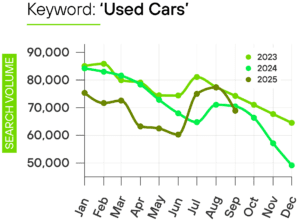
In 2025, UK consumers made an average of 2.3 million monthly searches explicitly containing “used cars”, with total intent significantly higher once broader terms like “cars for sale” and model-level queries are included.
This is the centre of gravity for automotive demand, where buyers are most active, most price-sensitive, and most ready to act.
Used car search operates at unmatched scale
The used car category captures the highest volume of intent across the entire automotive market.
The 2.3 million monthly searches only reflect keywords that explicitly include “used”, which excludes a large share of high-intent behaviour such as “cars for sale”, location queries, and model-specific searches.
This means the real scale of used car demand is materially larger than the headline figure suggests.
This is where demand is most consistent and least dependent on brand awareness.
Dealers are operating in the most active part of the market, where buyers are continuously entering and re-entering the journey.
Used car search should be treated as a primary acquisition channel across dealer groups and marketplaces.
Demand is driven by affordability and access
Used car search demand increased by around 30% year-on-year in August 2025 following a subdued period.
This rebound aligns with improving affordability conditions, including interest rate cuts and stabilising vehicle prices.
Consumers are using search to solve a financial constraint, focusing on vehicles they can afford now with lower upfront costs and manageable monthly payments.
This shifts demand towards value, availability and certainty.
Dealers should align messaging to reflect this mindset, focusing on price brackets, monthly affordability and clear ownership costs.
The search journey is shorter and more decisive
Search behaviour in used cars shows compressed journeys, where users move quickly from exploration to local intent.
Users often transition from general browsing to “cars for sale near me” within the same session.
This indicates stronger purchase intent earlier in the journey.
Dealers are engaging buyers who are ready to act.
This changes how presence should be structured.
Dealers need to capture demand at both ends of the journey, with comparison and guidance for early-stage queries and inventory, location relevance and immediacy for late-stage queries.
Limiting visibility to bottom-of-funnel activity reduces access to high-intent users earlier in the journey.
Marketplaces are shaping how demand is captured
The used car search landscape is heavily influenced by large marketplaces and aggregators.
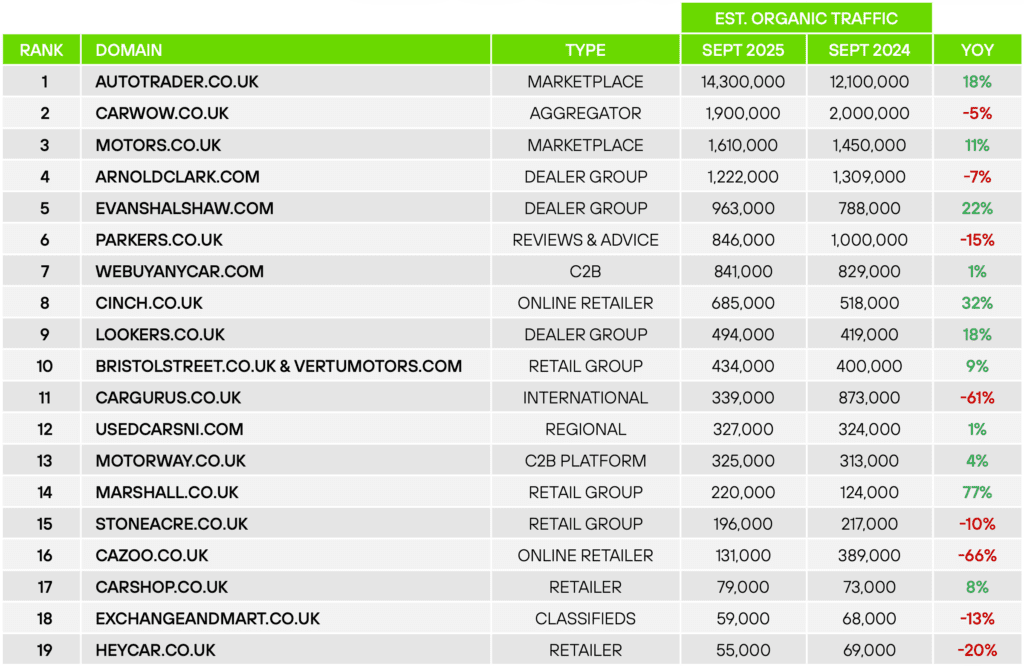
Platforms such as Auto Trader attract over 14 million monthly organic visits, far exceeding individual dealer sites.
These platforms set expectations around filtering, pricing visibility and comparison.
For many users, the marketplace is the starting point of the journey.
A significant portion of search traffic is captured before it reaches dealer websites.
Dealers should assume competition exists both within search results and inside aggregator ecosystems.
A balanced strategy is required between marketplace participation and building direct visibility.
Visibility is increasingly driven by structure and inventory
Used car search performance is closely tied to how well inventory is structured and surfaced.
Visibility is driven by structured data, localised pages and inventory freshness.
Search engines prioritise listings that are clear, up to date and locally relevant.
This is an operational requirement as much as a marketing one.
Dealers should ensure stock is properly indexed, consistently updated and aligned to search demand.
Inventory should be treated as a core search asset across dealer groups.
Growth is uneven and rewards focused execution
The recovery in used car search has not been evenly distributed.
Some platforms have grown significantly, while others have lost visibility or failed to recover.
Brands such as Cinch increased organic traffic by 32% year-on-year, while others saw sharp declines.
This indicates that execution determines who captures demand.
Performance gaps between competitors are widening as demand returns.
Dealers and marketplaces should focus on positioning, content and technical execution to compete effectively.
What this means for dealers and marketplaces
Used car search is the most commercially important demand source in automotive.
It is where buyers are most active, where intent is clearest, and where competition is most intense.
For dealers, this means prioritising inventory visibility, local search presence, price-led and value-led landing pages, and fast, frictionless user journeys.
For marketplaces, this means continuing to dominate comparison and discovery, investing in UX and filtering, and expanding content that supports decision-making.
Across both, the opportunity is to align strategy with how demand forms in search.
Used car search provides a clear signal of how the market is moving and how buyers are making decisions.
If this pattern is visible in search data, dealers and marketplaces should review how effectively demand is being captured and where it is being lost.
Want to see all insights on current automotive search trends?
👇
Talk To Our Experts
Please submit your details and as much information as you can on what you would like to discuss:
required information