

Millions of searches happen every month before anyone walks into a dealership.
This is where demand actually forms.
The UK automotive market is often measured through registrations, sales data, and finance volumes. Search shows something earlier and more reliable. It captures intent before it converts.
This analysis is based on UpShift’s Automotive Search: The 2025 Market Intelligence Report and focuses on four core areas: used cars, new cars, leasing, and finance.
Search Is the Market’s Leading Indicator
Search demand is growing across automotive, with total activity up 11% year-on-year in the UK.
This reflects sustained consumer interest despite economic pressure.
What this means commercially:
Search volume shows where demand is forming before it appears in sales data.
Automotive businesses that rely on registrations or platform performance are reacting late.
What to do:
We should treat search as a forward demand signal and use it to guide budget allocation, stock strategy, and messaging.
Used Cars: The Largest Pool of Active Demand
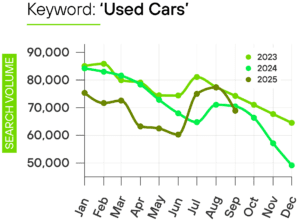
Used car search demand averages 2.3 million monthly queries for terms explicitly containing “used cars” alone.
This excludes high-intent searches like “cars for sale” and model-level queries, which significantly increase the total.
What this means commercially:
Used cars represent the single largest pool of active, intent-led demand in the market.
Demand is highly price-sensitive and reacts quickly to macroeconomic changes such as interest rates and affordability.
The rebound in mid-2025 shows demand returns quickly when conditions improve.
What to do:
Dealer groups should prioritise organic visibility across generic and local inventory searches.
Budget should shift toward capturing high-volume, mid-funnel queries like “cars for sale” and “used cars near me”.
Stock pages, structured data, and local SEO directly influence visibility in this category.
New Cars: Demand Is Brand-Led and Fragmented
New car search behaviour is driven primarily by brand and model queries rather than generic terms.
Brands like Tesla generate over 350,000 monthly searches, while emerging OEMs are rapidly increasing share.
What this means commercially:
Demand exists, but it is fragmented across brands rather than concentrated in generic discovery.
Brand visibility determines whether demand is captured or lost to competitors, aggregators, or paid placements.
Rising zero-click behaviour reduces the volume of traffic reaching brand sites.
What to do:
OEMs should prioritise owning branded search results through both organic and paid channels.
Content should focus on clarity around pricing, specifications, and comparisons to retain visibility within AI-driven search results.
Measurement frameworks need to account for reduced click-through and increased on-SERP engagement.
Car Finance: A High-Intent, High-Volume Layer of Demand
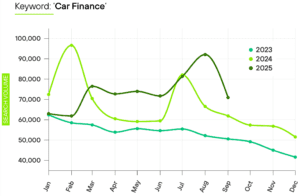
Car finance generates approximately 1.1 million monthly searches across related keywords.
Core terms like “car finance” have grown from around 54,000 monthly searches in 2023 to peaks near 90,000 in 2025.
What this means commercially:
Finance is embedded in the majority of purchase decisions, with over 80% of new cars bought using finance.
Search demand reflects increasing reliance on finance due to affordability constraints.
Zero-click behaviour and comparison journeys reduce direct traffic capture.
What to do:
Finance providers and dealers should invest in content that explains options clearly and supports comparison behaviour.
Eligibility tools, calculators, and structured content improve both conversion and visibility.
Paid search remains necessary for high-intent terms, but organic visibility reduces acquisition cost over time.
Leasing: A Smaller but Strategically Important Segment
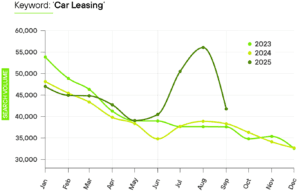
“Car leasing” acts as a proxy for broader leasing demand and shows volumes between 30,000 and 60,000 monthly searches.
The category experienced decline through 2023–2024, followed by a sharp recovery in mid-2025.
What this means commercially:
Leasing demand is more volatile and closely tied to economic confidence and interest rates.
Growth is being driven by EV adoption, salary sacrifice schemes, and OEM-led offers.
Organic search plays a dominant role, with many leasing brands generating 45–65% of traffic from SEO.
What to do:
Leasing brokers should prioritise organic acquisition to offset rising paid media costs.
Content should align to EV leasing, salary sacrifice, and affordability-led messaging.
Channel mix should balance paid growth with long-term organic investment to protect margins.
The Combined Search Economy
Across these four areas, monthly search demand in the UK automotive market runs into multiple millions of queries:
- Used cars: 2.3M+ monthly searches
- Car finance: ~1.1M monthly searches
- Leasing: tens of thousands monthly, with wider category impact
- New cars: fragmented across hundreds of thousands of brand searches
This creates a search economy that significantly exceeds visible transaction volumes.
What this means commercially:
Search represents the full addressable demand pool, including buyers who have not yet chosen a brand, channel, or product.
Most automotive businesses only capture a fraction of this demand.
What to do:
We should map total search demand against current visibility to identify gaps.
Budget allocation should reflect where demand is highest, not where performance is easiest to measure.
Search Is Where Decisions Start
51% of new car buyers identify their desired model online before visiting a dealership.
Search now sits across the entire journey, from discovery to comparison to local intent.
What this means commercially:
Demand is shaped digitally long before physical interaction.
Brands that are absent in early-stage search lose influence over the final decision.
What to do:
Automotive businesses should build full-funnel search strategies that cover discovery, comparison, and conversion.
Investment should extend beyond bottom-of-funnel keywords into earlier, research-led queries.
What This Means for Automotive Growth
The UK automotive market has a visible sales economy and a larger, earlier search economy.
Search shows where demand is forming, how it is shifting, and which brands are capturing it.
If this pattern is visible in your category, review how your visibility aligns with real demand across search.
Want to see all insights on current automotive search trends?
👇
Talk To Our Experts
Please submit your details and as much information as you can on what you would like to discuss:
required information