

AI is becoming the first touchpoint in the buying journey
Consumer behaviour is shifting toward conversational discovery, where buyers ask questions and receive synthesised answers before they ever search.
This changes where decisions are formed.
Search data already shows that users explore broad questions around cost, charging, and suitability early in the journey.
AI interfaces now sit directly on top of this behaviour, compressing multiple searches into a single interaction.
For suppliers, this means fewer opportunities to influence early-stage consideration through traditional search visibility.
We need to treat AI platforms as a new entry point for demand and ensure our data, content, and positioning are accessible to them.

Decision-making is being shaped before search begins
Search clusters show that buyers group queries around themes like affordability, infrastructure, and lifestyle fit.
These are exactly the questions large language models are designed to answer in one response.
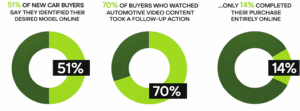
This means buyers are arriving at Google with a clearer shortlist and stronger preferences.
The role of search shifts from discovery to validation.
For suppliers, this reduces the volume of exploratory traffic and increases the importance of high-intent capture.
We need to prioritise visibility on model-level, pricing, and comparison queries where decisions are being finalised.
Google still captures demand, but it no longer creates it
The EV search landscape shows over 2.4 million monthly searches across generic terms alone.
This confirms that Google remains the dominant demand capture channel.
The shift is happening earlier in the journey.
AI is influencing which brands, models, and considerations make it into the search phase.
For automotive businesses, this creates a blind spot.
We are optimising for where demand is captured, not where it is shaped.
We need to expand measurement beyond search volumes and start analysing how AI-generated recommendations are influencing brand visibility and consideration.
Brand visibility is being filtered through AI systems
Search data shows that a small number of brands dominate attention, with Tesla alone attracting over 3.2 million monthly searches.
This concentration reflects how strongly certain brands shape the EV narrative.
AI models are trained on this same ecosystem of content, media coverage, and search behaviour.
This means they are likely to reinforce existing visibility patterns unless new signals break through.
For suppliers, this creates a structural disadvantage in early-stage discovery.
We need to increase our presence across authoritative content, reviews, and structured data sources that feed AI systems.
Mid-funnel compression will increase competition on price and availability
Search behaviour already shows strong clustering around deals, pricing, and comparisons.
AI accelerates this by narrowing options before users reach marketplaces or search engines.
This increases competition at the point of conversion.
For suppliers, this means more buyers arriving with fixed expectations on monthly price, model choice, and specification.
We need to ensure pricing strategy, stock visibility, and offer clarity are aligned with this more informed customer.
What automotive brands should do next
AI is reshaping how demand is formed, even if it is not yet fully visible in search data.
This requires a shift in how we approach digital strategy.
We should expand content strategies beyond ranking to ensure inclusion in AI-generated answers, structure data to improve machine readability, and strengthen brand signals across trusted sources.
At the same time, search remains critical for capturing high-intent demand, so performance in Google should be maintained while adapting to earlier-stage influence.
If this shift is already visible in user behaviour, it is worth reviewing how much of your demand is being shaped before it reaches your channels.
Want to see all insights on current automotive search trends?
👇
Talk To Our Experts
Please submit your details and as much information as you can on what you would like to discuss:
required information