

- 72 car brands now compete in the UK, up from 45 in 2019.
- Automotive search clicks are up 10% year-on-year, despite longer buying journeys.
- 70% of motorists now switch brands when buying their next vehicle.
- Chinese OEMs have seen a 63% rise in ad opportunities, while legacy brands are falling behind.
The UK automotive digital marketing landscape is experiencing a significant shift in consumer behaviour. While lead volumes may appear to fluctuate, analysis suggests that consumer demand remains stable; however, the path from initial search to dealership enquiry has become increasingly non-linear.
The traditional focus on bottom-of-funnel keywords, such as “car lease deals” or finance offers, is no longer sufficient to capture the full breadth of the modern buyer’s journey. Success now requires a more comprehensive approach that accounts for the extensive research phase preceding the final conversion.
Fragmented Demand and the Rise of Comparison
Consumer intent within the auto category remains positive. Automotive search clicks increased by 10% year-on-year when comparing January to August 2025 against the same period in 2024. This data indicates that interest in vehicle purchases is growing, but consumers are exercising greater caution and conducting more thorough research before submitting enquiries.
The market has become more crowded and complex, leading buyers to take additional steps to evaluate value and understand the available options. Relying solely on capturing the final, high-intent click ignores the critical mid-funnel interactions that influence the eventual purchase decision.
The Friction of Choice
The UK automotive market is now more crowded than at any point in modern history. 72 car brands are competing for attention, up from 45 in 2019. This complexity is compounded by the rapid electrification of the market; EVs now command 40% of all new car models, and the number of available Battery Electric Vehicle (BEV) options has surged from roughly 130 to over 165 in just a few months.
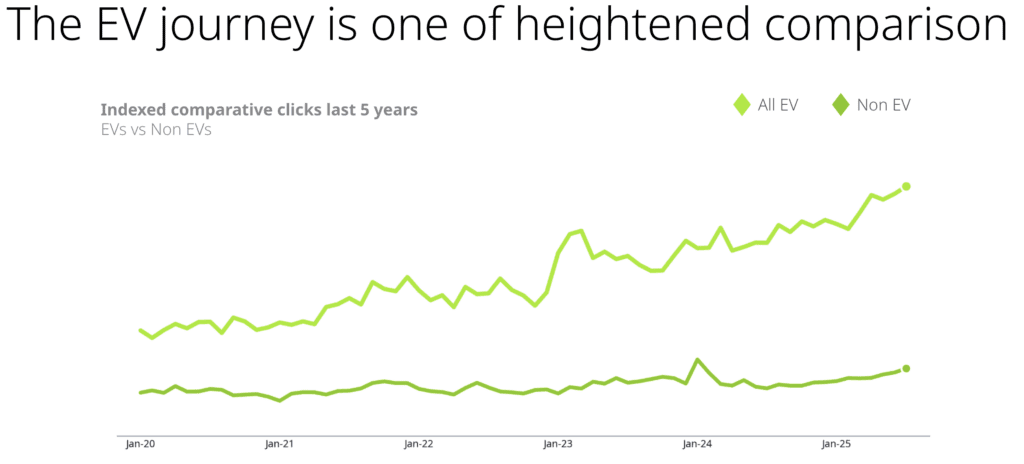
This abundance of choice presents a distinct paradox. While having more options allows for greater customisation, it introduces significant friction into the decision-making process. Traditional PPC structures often assume a straightforward path to purchase, yet many prospects enter the market without a clear preference. This necessitates a mid-funnel comparison phase that models built for immediate demand harvesting fail to address effectively.
The EV journey is a primary driver of this heightened comparison phase. A buyer doesn’t just jump from “best electric SUV” to an enquiry form. They query running costs, contrast petrol vs. EV depreciation, and pit specific models against each other. This investigative process involves research-heavy touchpoints that are essential precursors to the high-intent brand searches that lead to conversions.
Beyond Choice: Economic Pressures and Financial Due Diligence
Choice alone does not explain the full extent of this shift. The prevailing economic climate and the rising cost of living have fundamentally altered buyer psychology. Consumers are no longer just comparing features; they are conducting rigorous financial due diligence before committing to a purchase. Data indicates a tough economic environment for UK consumers, with 31% struggling to pay bills and 23% making real changes to their spending habits, such as delaying major purchases or switching to lower value tiers.
This cautious mindset is reflected in search behaviour. Buyers are increasingly investigating the granular financial implications of vehicle ownership, firing off hyper-specific, anxious questions regarding total cost of ownership over several years. There is significant search interest for long-tail queries such as “why is inflation so high” and “why are interest rates increasing,” showing a clear desire to understand the broader macro-environment before acting. In the automotive space, this translates to intensified research into running costs, depreciation contrasts between petrol and electric vehicles, and specific finance options.
The research phase now encompasses extensive exploration of finance offers, including searches for “0% apr car deals,” “no deposit car finance,” and “pcp deals”. Before ever visiting a website or dealership, a modern buyer has likely already explored these finance options alongside watching reviews and reading owner testimonials. Consequently, when a customer finally searches for a specific lease or finance offer, they arrive with far more information and higher expectations than in previous years.
New Entrants Are Owning the Mid-Funnel
This rise in comparison behaviour is not happening in a vacuum. It is being fuelled and captured by aggressive new market entrants who are capitalising on legacy brand complacency. While established manufacturers often remain focused on bottom-funnel brand terms, these challengers are successfully capturing mid-funnel demand by addressing this comparison behaviour, investing heavily in visibility during the earlier stages of the buyer journey.
Data from Google paints a stark picture of who is winning the digital battlefield:
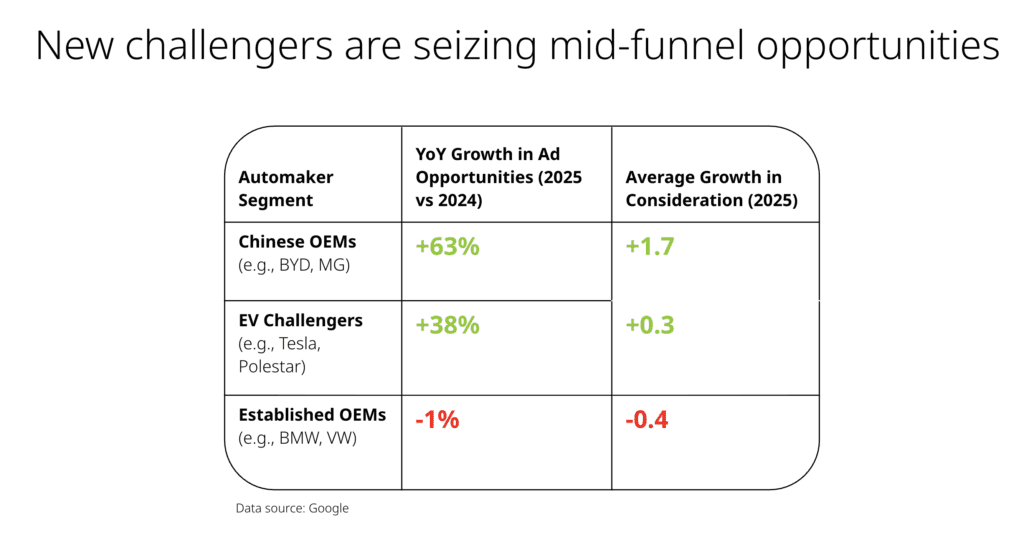
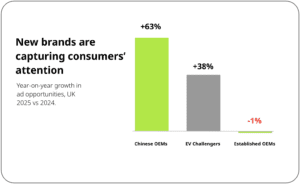
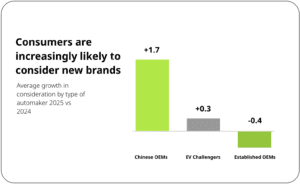
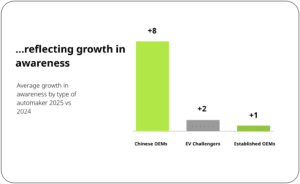
Brand retention is dead. If you aren’t showing up prominently during the messy, investigative comparison phase, you’re entering the conversation far too late. By the time a user types a model-specific leasing query, their shortlists have already been aggressively curated by your competitors.
The Pivot: Re-imagining Your Automotive PPC Strategy
To capitalise on the rising consumer consideration and successfully compete with market challengers, your PPC strategy must pivot from demand harvesting to demand creation.
To win the comparison stage, automotive brands must move away from a purely defensive, bottom-funnel focus and execute a multi-layered search strategy. This isn’t a licence to waste budget on loose traffic; it requires a structured framework designed to capture consideration intent while protecting your cost-per-lead.
1. Own Your “High-Volume Battlegrounds”
The Business Case: A leasing company or dealership group isn’t trying to compete across all 72 brands. Your profitability is tied to moving specific, high-volume inventory. If you aren’t visible when a buyer is weighing your core model against its rival, you’re letting a competitor steal a warm prospect at the 11th hour.
- Under the Hood (For Your PPC Team): Don’t dump broad comparison phrases into core campaigns. Create dedicated ad groups for your top two or three vehicle head-to-heads (e.g., “Kia EV3 vs”). Pair these with specific, hardcoded RSAs to guarantee ad relevance, maximise Quality Score, and keep your CPC as low as possible.
2. Match Landing Page Content to the Buyer’s Mindset
The Business Case: If a prospect is searching for “best family electric SUV,” they’re looking for information, not a salesperson. Sending them directly to a sterile stock-list page with an aggressive form is a conversion killer. You’re paying for a premium click but providing a poor experience.
- Under the Hood (For Your PPC Team): Deploy dedicated mid-funnel landing pages that prioritise utility and feature comparison grids, lease cost calculators, and range explainers. Build a two-step conversion path: capture soft data first (like saving a configuration) to pull them into your email ecosystem before pushing for the formal application.
3. Use Video to Intercept Competitor Shortlists
The Business Case: Car buying is deeply visual and emotional. Video shouldn’t be treated as an expensive luxury; it’s a targeted performance tool. By placing visual walkarounds directly in front of buyers who’re actively shopping your competitors, you can shift their preference before they ever approach a dealership.
- Under the Hood (For Your PPC Team): Stop running broad YouTube campaigns. Deploy Demand Gen campaigns targeted exclusively via Custom Intent Audiences. Build segments of users who’ve searched for direct competitors within the last 14 days, placing high-quality video reviews into their YouTube Shorts, Discover, and Gmail feeds.
4. Move Beyond Volume: Optimising for True Value
The Business Case: Relying on last-click measurement is an outdated constraint that ignores the research journey, artificially defunding the mid-funnel campaigns that drive your long-term pipeline. If you’re optimising solely for the final click, you are blind to the touchpoints that actually built the prospect’s intent.
- Under the Hood (For Your PPC Team): Since Data-Driven Attribution (DDA) is the established standard for Google Ads, stop treating it as a setting to “upgrade” to and start treating it as the baseline for your bidding strategy. The real opportunity for maturity lies in Value-Based Bidding (VBB). Move away from generic lead-volume goals and assign relative, tiered values to your micro-conversions (e.g., £15 for a vehicle configurator save, £50 for a brochure download, £200 for a test drive booking). This feeds higher-fidelity signals into Smart Bidding, allowing the algorithm to prioritise the prospects who are actually signalling high intent rather than just those who click the final ad.
5. Steer AI Search Automations to Resolve Buyer Anxiety
The Business Case: Today’s buyers are firing off hyper-specific, anxious questions (e.g., “how does the total cost of ownership compare over three years?”). Capturing these long-tail queries is incredibly cheap because your competitors aren’t bidding on them, but manually writing ads for hundreds of unique questions is an operational nightmare.
- Under the Hood (For Your PPC Team): Don’t let Google’s AI blindly crawl your entire domain. Construct a strict Page Feed containing only your high-value FAQs and comparison blogs. Pair this with tight URL exclusions to force the AI Max engine to match long-tail queries to the exact resources that resolve consumer doubt.
The Bottom Line
The brands that’ll dominate the automotive space over the next few years won’t be the ones that outspend everyone else on the final click. They’ll be the ones who show up when the buyer is confused.
By guiding them through an oversaturated market and building confidence long before the enquiry form is ever filled out, you’ll win the conversion before your competitors even know they’re in the race.
In a market defined by hyper-comparison, paid search can’t just sit at the end of the funnel to harvest demand; it has to actively help create it.
Talk To Our Experts
Please submit your details and as much information as you can on what you would like to discuss:
required information