

Search demand shows where attention starts, not where conversion happens
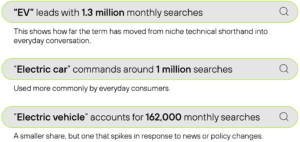
Across the UK, there are over 2.4 million EV-related searches every month, spanning everything from “EV” to “electric car” and model-specific queries
This level of demand tells us the market is active, but it also shows how fragmented intent has become.
Generic search terms like “electric car” signal early-stage exploration focused on price and lifestyle. Model-level searches signal consideration and intent. Brand searches signal trust and preference.
This split matters commercially because performance channels largely operate in the first category.
Most paid strategies are built to capture generic demand at scale. That demand is high volume and low trust. It produces clicks easily and leads cheaply.
We should treat generic demand as a discovery layer, not a conversion layer.
Automotive businesses need to separate how they capture attention from how they convert it. Budget should reflect that distinction.
Cheap leads are concentrated in low-trust search environments
Search cluster analysis shows that generic EV queries are dominated by price, deals, and affordability language
Queries like “cheapest electric car”, “electric car deals”, and “best EV under £X” sit at the centre of this demand.

This creates a predictable outcome.
Users entering through these queries are optimising for price. They compare aggressively, switch brands easily and convert poorly.
Performance channels can generate volume here, but the quality is structurally weak.
We see this in lead-to-sale rates across leasing brokers and dealerships. High volumes of low-intent enquiries inflate CPL efficiency while reducing commercial output.
We should expect cheap leads to underperform because they are driven by price-first behaviour.
Automotive businesses should audit lead quality by query type, not just by channel. Generic demand needs tighter qualification and controlled spend.
Brand-led search sits closer to purchase and carries higher intent
Model-level and brand-specific searches tell a different story.
The Tesla Model 3 generates around 250,000 monthly searches, while rising models like the BYD Seal and Volvo EX30 are growing rapidly.
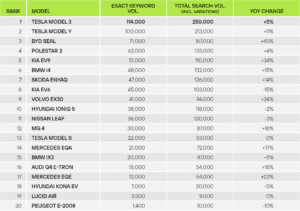
These queries include modifiers like price, range, lease deals, and reviews.
This is where intent becomes structured.
Users are no longer asking what to buy but they are evaluating a defined option.
Brand visibility plays a direct role here. For example, Tesla captures over 3.2 million monthly searches across brand-related terms in the UK
That volume is driven by brand familiarity, cultural relevance, and perceived credibility – not by performance activity
This all translates directly into lead quality.
Users who search for a specific brand or model convert at a higher rate because the decision is already partially made.
We should treat brand search as a demand capture layer with materially higher commercial value.
Automotive businesses should prioritise owning brand and model-level search coverage before scaling generic acquisition.
New entrants are winning attention by shaping perception, not lowering price
BYD’s growth in UK search demand has been driven by visibility, pricing narratives, and constant model launches, reaching around 882,000 monthly searches within two years.
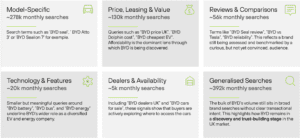
A large share of this demand is still top-of-funnel and curiosity-led.
Search queries focus on validation:
• “Is BYD reliable”
• “BYD vs Tesla”
• “Why is BYD so cheap”
This is where trust is built or lost.
BYD’s pricing plays a clear role in driving attention, with strong perceived value relative to competitors, but search behaviour shows users are still trying to understand whether that value is credible.
Even with aggressive pricing, conversion depends on credibility signals.
Polestar provides a useful contrast. It generates around 547,000 monthly searches with a stronger mid-funnel profile and higher consideration intent.
The difference comes from positioning clarity.
Polestar leans on design, Volvo heritage, and premium cues. Users arrive with clearer expectations and fewer objections.
We see the same pattern consistently.
Price can accelerate attention, but perception determines whether that attention converts.
Automotive businesses entering competitive segments need to invest in positioning before scaling acquisition.
Trust signals determine whether performance spend converts
Search behaviour shows that EV buyers actively look for reassurance.
High-volume query clusters include:
- Charging infrastructure
• Running costs
• Battery life
• Reviews and comparisons
These are not edge cases. They sit at the centre of the journey.
Users are trying to reduce risk.
Performance campaigns that drive traffic without resolving these concerns create friction at the point of conversion.
This shows up as:
- High bounce rates
• Low form completion
• Poor lead quality
Trust signals need to be visible at the point of entry.
This includes:
- Clear pricing and finance structures
• Transparent ownership costs
• Credible reviews and comparisons
• Strong brand identity
We should align landing page strategy with the dominant search concerns, not just the keyword.
Automotive businesses should map trust gaps across their funnel and prioritise content that removes friction.
Performance efficiency declines when brand demand is weak
Search data shows that some brands generate disproportionate visibility relative to their sales.
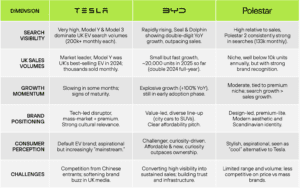
Tesla aligns visibility and sales.
BYD generates high visibility with lower conversion.
Polestar sits between awareness and consideration.
This creates a clear commercial pattern.
When brand demand is strong, performance channels capture existing intent efficiently.
When brand demand is weak, performance channels are forced to manufacture demand through generic queries.
This increases cost and reduces quality.
We see this in rising CPAs despite stable or growing traffic volumes.
Performance efficiency is a downstream effect of brand strength.
Automotive businesses should track brand search volume as a leading indicator of paid channel performance.
The market is shifting from product comparison to brand preference
Early EV adoption was driven by functional comparison.
Search data now shows a shift toward brand-led evaluation.
Consumers are no longer searching for “an EV”. They are searching for a specific EV that fits their perception of value, design, and trust
This is visible in:
- Growth in model-level searches
• Increased review and comparison queries
• Rising interest in newer brands
The implication is clear.
Product specs alone do not win demand.
Perception defines the shortlist.
Automotive businesses should invest in distinct positioning that can be recognised and searched for directly.
What automotive businesses should do next
Rebalance budget toward demand creation
Allocate budget to channels that build brand search demand:
- Organic search
• Digital PR
• Content
• High-impact paid media
This supports performance efficiency over time.
Separate acquisition strategy by intent layer
Structure activity across three layers:
- Generic discovery
• Model consideration
• Brand capture
Each layer should have different messaging, budgets, and KPIs.
Qualify performance traffic more aggressively
Reduce exposure to low-intent queries that drive price-led behaviour.
Focus on:
- Model-specific terms
• Lease and finance modifiers
• Comparison queries
This improves lead quality without increasing spend.
Build trust into every landing experience
Align landing pages with real user concerns:
- Cost clarity
• Charging practicality
• Ownership reassurance
This increases conversion from existing traffic.
Cheap leads are easy to generate because price creates clicks.
Sustainable growth comes from building demand that already trusts you before it lands.
Want to see all insights on current automotive search trends in more detail?
👇
Talk To Our Experts
Please submit your details and as much information as you can on what you would like to discuss:
required information