

For most of the last decade, competitive advantage in paid search has come from better campaign management.
Smarter bidding strategies, stronger creative and larger budgets have often been enough to outperform competitors. Even where websites had limitations or data quality wasn’t perfect, experienced PPC teams could usually compensate through optimisation and manual intervention.
We believe the next era will be defined by something different.
As advertising platforms become increasingly automated, competitive advantage will shift away from campaign optimisation alone and towards organisational design. The businesses that outperform won’t necessarily be those with the best PPC managers. They’ll be the ones with the cleanest data, the strongest operational alignment and the most connected technology infrastructure.
Google Vehicle Ads are one of the first advertising products to make that shift visible.
While they appear to be another extension of Google Ads, they’re exposing something much deeper: how connected, consistent and commercially meaningful an organisation’s data really is.
We call this the Transparency Tax.
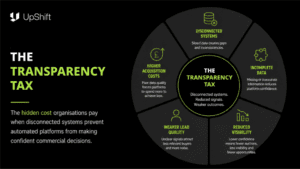
The Transparency Tax is the hidden cost organisations pay when disconnected systems prevent automated platforms from making confident commercial decisions.
Every organisation pays in one way or another. Some pay through duplicated processes or operational inefficiencies. Increasingly, automotive retailers are paying it through reduced visibility, weaker lead quality and higher acquisition costs because fragmented systems make it harder for Google’s algorithms to understand inventory and match it with buyer intent.
Google Vehicle Ads haven’t created the Transparency Tax.
They’ve simply made it impossible to ignore.
The Transparency Tax
Vehicle Ads demand a level of operational hygiene that many businesses simply haven’t needed to achieve until now.
The friction isn’t the platform; it’s the internal silo.
When the marketing team doesn’t own the inventory, the pricing logic or the vehicle detail page (VDP) experience, organisational readiness becomes a theoretical concept rather than an operational reality. Google’s algorithms don’t understand departmental structures or supplier relationships; they simply interpret the information they’re given.
If pricing differs between systems, specifications are incomplete, imagery is inconsistent, or landing pages fail to reflect the vehicles being advertised, Google’s confidence in that inventory declines. Visibility suffers not because the media strategy is flawed, but because the underlying business infrastructure isn’t providing reliable signals.
For years, those weaknesses could be hidden. Better ad copy, manual optimisation and increased budgets often compensated for fragmented processes and disconnected systems.
Automation fundamentally changes that equation.
As Google’s machine learning assumes greater responsibility for campaign optimisation, the quality of the underlying data becomes increasingly important. Businesses can no longer outbid poor infrastructure.
A practical example
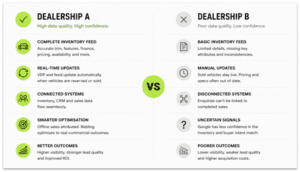
Imagine two dealerships advertising the same vehicle.
Both are running similar budgets through Google Vehicle Ads. Both have experienced paid media teams managing their campaigns.
The difference lies in the quality of their data.
The first dealership’s inventory feed includes the correct trim level, monthly payment, battery range, optional features, finance information, availability status and a vehicle detail page that updates automatically when the car is reserved or sold. Offline sales are attributed back to Google Ads, allowing the platform to optimise towards genuine commercial outcomes.
The second dealership’s feed contains only basic vehicle information, inconsistent specifications and pricing that occasionally differs from the website. Sold vehicles remain visible in advertising until the next manual update, while enquiries cannot be linked back to completed sales.
The media strategy may be identical, but Google’s understanding of each business is not.
One provides rich, consistent signals that enable automation to optimise with confidence. The other introduces uncertainty at almost every stage of the customer journey.
The difference isn’t campaign management, it’s data quality.
And that’s the Transparency Tax in action.
What we’re beginning to see is a clear divide between organisations that view Google Vehicle Ads as another marketing channel and those that recognise them as a business capability.
The strongest performers are not necessarily those with the largest media budgets. They’re the organisations that have effectively dissolved the barrier between the showroom floor and the digital advertising account, allowing inventory, pricing, customer data and commercial outcomes to flow seamlessly between systems. By giving Google’s algorithms richer and more consistent signals, they enable automation to make better decisions and achieve better commercial results.
In many respects, Google Vehicle Ads aren’t exposing weaknesses in paid media strategy, they’re exposing weaknesses in organisational design.
Why Google Vehicle Ads are different
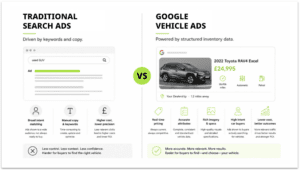
Unlike traditional search campaigns, Google Vehicle Ads rely far less on persuasive copy and far more on structured inventory data.
When a customer searches for a specific make, model or vehicle type, Google analyses the information contained within a dealership’s feed, including pricing, mileage, specifications, imagery and landing page content, to determine which vehicles should appear.
For consumers, this creates a more transparent buying experience. Buyers can compare real vehicles before clicking and arrive on site with a much clearer understanding of what they’re interested in.
For dealerships, however, the implications are far more significant.
Success is increasingly determined not by how well a campaign is managed, but by how well the organisation manages its data.
Your inventory feed is becoming a strategic asset
Many dealerships still treat their inventory feed as a technical requirement.
It’s generated by the dealer management system, uploaded into Google Merchant Center and largely forgotten about.
This perspective is becoming increasingly outdated.
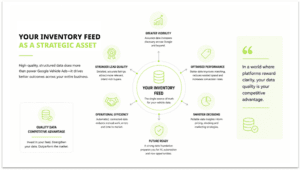
The inventory feed is evolving into one of the most valuable marketing assets within the business because it forms the foundation of how Google’s systems understand inventory.
Every additional attribute, complete specification, finance detail and accurately categorised feature provides Google with greater confidence when matching vehicles to relevant searches. Conversely, every missing field or inconsistency creates ambiguity that reduces visibility.
As search becomes increasingly automated and AI-driven, structured data will become a competitive advantage in its own right.
The next evolution won't be lower cost per lead
For years, automotive marketers have optimised around cost per lead.
Increasingly, that’s becoming the wrong conversation.
Generating more enquiries means little if they don’t translate into profitable sales or if campaigns prioritise low-margin stock over vehicles that contribute most to the business.
The next stage of paid media maturity lies in connecting advertising platforms with genuine commercial outcomes.
Google’s Value-Based Bidding capabilities already allow organisations to optimise towards revenue, profit or customer value rather than enquiry volume alone. However, that can only happen when CRM platforms, sales systems and marketing data are connected and able to share meaningful information.
Once again, the limiting factor is organisational alignment, not technology.
The future belongs to businesses that machines can understand
Much of the conversation around AI focuses on automation or content generation.
The bigger shift may be how machines understand products.
Consumers are already moving beyond simple searches such as “used BMW X3 near me”. Increasingly, they’re asking nuanced questions like “What’s the safest electric SUV for a family?” or “Which company car offers the lowest Benefit-in-Kind tax under £500 per month?”
Answering those questions requires context, structure and high-quality data.
Google Vehicle Ads are effectively preparing businesses for that future by rewarding complete specifications, accurate pricing, rich imagery and relevant landing pages. These are the same signals that will underpin conversational search, AI-generated recommendations and predictive buying journeys over the coming years.
The next competitive advantage in paid media may have very little to do with campaign management itself. As AI assumes greater responsibility for optimisation, success will increasingly depend on the quality of the information feeding those systems. Organisations that invest in connected, commercially meaningful data will provide Google’s algorithms with greater confidence in understanding their inventory, matching it with buyer intent and delivering stronger business outcomes.
In other words, the organisations that outperform will be those that are easiest for machines to understand.
Building the infrastructure for AI-driven marketing
Where dealerships should start
For many UK dealer groups, the prospect of connecting inventory systems, websites, CRMs and advertising platforms can feel overwhelming. The instinct is often to treat Google Vehicle Ads as another marketing initiative and hand responsibility entirely to the paid media team.
This would miss the bigger opportunity.
The first step should be to audit the flow of data through the organisation rather than the performance of the campaigns themselves. Is pricing consistent across systems? Do vehicle detail pages accurately reflect live stock? Can enquiries be tracked beyond initial web forms to showroom appointments, vehicle sales and ultimately profitability? Can those commercial outcomes be fed back into Google Ads to improve automated bidding?
Once those operational questions have been answered, selecting the right technology stack and integration strategy becomes significantly more straightforward.
There is no single blueprint for success. Some dealer groups choose modern, cloud-based dealer management systems with integrated CRM functionality that create a single source of truth for inventory, customer and sales data. Platforms such as Pinewood.AI demonstrate the advantages of this approach by bringing stock management, customer records and sales processes together within a unified environment.
Others adopt a best-of-breed approach, integrating established CRM platforms such as HubSpot or Salesforce with their existing dealer management systems and marketing technology stack. Increasingly, larger dealer groups are also investing in bespoke internal CRM platforms, designed around their own customer journeys, operational workflows and reporting requirements. Although these custom-built solutions require greater investment, they can provide complete control over how data is captured, shared and activated across the business.
The competitive advantage, however, doesn’t come from choosing one platform over another. It comes from ensuring that whichever solution is adopted becomes a trusted source of truth, connecting inventory, customer behaviour and commercial outcomes into a single, coherent data ecosystem.
From a digital marketing perspective, the benefits are substantial. When inventory, customer data and sales activity are managed within a connected architecture, there is far less scope for discrepancies between systems.
Live inventory feeds submitted to Google Merchant Centre remain more accurate, reducing the risk of advertising vehicles that have already been reserved or sold. If a vehicle is marked as sold or removed from available stock, those changes can flow through to advertising platforms automatically, helping to minimise wasted spend while improving the customer experience.
It’s equally important to connect offline sales outcomes back to digital marketing activity. Modern CRM and dealer management platforms increasingly support the capture and attribution of offline conversions, allowing dealerships to link physical sales back to the original Google Click ID. This provides Google’s machine learning with richer commercial signals and creates the foundation for more sophisticated value-based bidding strategies that optimise towards genuine business outcomes rather than enquiry volume alone.
For dealer groups operating on legacy systems or open-platform architectures such as Keyloop, the journey may require a different approach. Integration platforms such as Zapier or Make, alongside dedicated automotive Customer Data Platforms (CDPs), well-structured APIs, Google Tag Manager and enhanced conversion tracking, can bridge the gap between disparate systems without requiring a complete replacement of existing infrastructure. The objective is not to eliminate every legacy platform, but to ensure they communicate effectively and provide Google with consistent, high-quality data.
Most importantly, don’t wait for perfection.
Many of the most successful transformations begin with a single dealership, a subset of used stock or a focused integration project that demonstrates the commercial value of cleaner data before improvements are rolled out across the wider group.
The broader transformation is that paid media is becoming increasingly dependent on the quality of the operational data behind it. As AI reshapes search and digital buying journeys, the organisations that thrive won’t necessarily be those spending the most on advertising. They will be those who have eliminated the Transparency Tax by connecting their systems, breaking down organisational silos and treating structured data as a strategic business asset.
The next generation of paid media won’t be won solely through better campaigns. It will be won by organisations whose data is accurate, connected and trusted enough for AI and automated platforms to make confident commercial decisions.
Whether Google Vehicle Ads become a defining advertising format is almost beside the point. They shine a light on a broader shift: as advertising becomes increasingly automated, the quality of the data behind it is becoming just as important as the campaigns themselves.
The dealerships that recognise that shift today will be better prepared for whatever comes next.
Talk To Our Experts
Please submit your details and as much information as you can on what you would like to discuss:
required information