

The pandemic permanently changed how people buy cars.
Not because forecourts disappeared, but because the decision-making process moved online long before the dealership visit. Today, search behaviour reveals a buyer journey that is more digital, more fragmented, and more financially driven than the pre-2020 market.
Search activity now acts as a mirror for the modern buyer. It tracks product interest, but it also highlights anxieties around affordability, new financing models, and the jump to EVs. For car brands, this data is now the most reliable way to see where demand is growing before it ever shows up in sales figures.
Online Research Now Owns the Journey
Search used to be a way to start the process. Since 2020, it has become the entire process. Buyers use search to gut-check financing, verify delivery dates, compare trim levels, and value their trade-ins. By the time they visit a showroom, most of the hard decisions are already made.
The numbers back this up. More than 50% of new car buyers pick their specific model online before they ever talk to a dealer. Video reviews often act as the final “push” that leads to a purchase action. While few people finish the entire transaction online, the physical dealership is no longer the place where the choice begins. It’s where the choice is finalized.
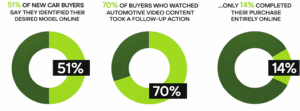
For brands, the lesson is clear: if you aren’t visible during the early research phase, you aren’t even on the shortlist. Trying to win a customer with late-stage ads is a losing game if their mind was made up three weeks ago on a search engine.
More Demand, More Crowded Room
Interest in cars is still high. In the UK, automotive search volume rose by about 11% year-on-year. This proves that even with a tough economy, people are still looking to upgrade.
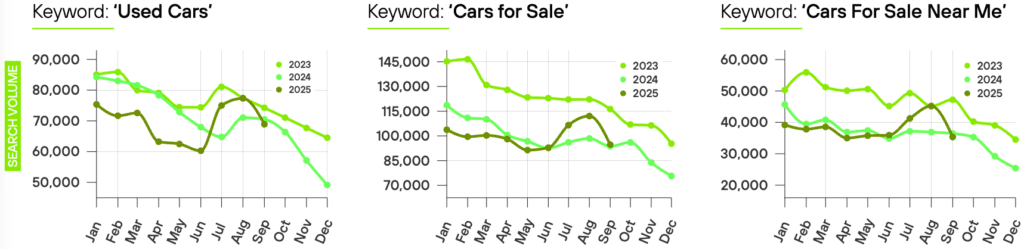
The catch is that this demand is being split between more players than ever. A typical search journey now touches around seven different brands or platforms. That is nearly double what we saw just a few years ago.
Between marketplaces, leasing sites, review blogs, and finance providers, the manufacturer’s own website is often buried. These third-party sites often become the first point of contact, setting the buyer’s expectations on price and value. Relying solely on paid ads isn’t enough anymore. Brands need to treat search visibility and high-quality content as essential infrastructure, not just a line item in a marketing budget.
Leasing: The New Way In
Since the pandemic, leasing has moved from a niche option to a core market driver. As people prioritize monthly flexibility over owning an asset outright, search behavior has shifted to follow the money.
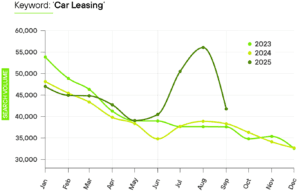
Leasing demand is highly sensitive to the economy. When interest rates climbed in 2023, monthly searches for “car leasing” dropped from over 53,000 to around 34,000. However, as rates began to settle in mid-2025, that interest bounced back fast, surging past the 50,000 mark.
Leasing is also the primary “test drive” for electric vehicles. By late 2024, nearly half of all new leased vehicles were fully electric. For many, leasing is the low-risk way to try out new tech. For marketers, this means the battle is won on queries about monthly costs and salary sacrifice schemes rather than just brand names.
A Fragmented Path to Purchase
The modern car buyer doesn’t follow a straight line. They bounce between Google, comparison tools, YouTube, and AI assistants. Brand loyalty is often formed in these “neutral” spaces before the buyer ever hits an official manufacturer page.
Marketplaces and aggregators have set the bar for how easy it should be to find information. Their filters and review systems are now the gold standard for user experience. This makes “attribution” figuring out exactly which ad led to a sale, incredibly difficult. Between AI summaries and cross-device browsing, the path to a sale is often hidden.
The Bottom Line
The post-2020 world didn’t just speed up online shopping; it changed the DNA of car buying. Search data proves that buyers are doing the heavy lifting themselves, long before they meet a salesperson.
Growth now depends on being helpful and visible during the “discovery” phase. If your search data shows people are looking for answers you aren’t providing, it might be time to rethink where your brand actually lives in the mind of the consumer.
Want the full breakdown of trends?
👇
Talk To Our Experts
Please submit your details and as much information as you can on what you would like to discuss:
required information