

Market intelligence · November 2025
2025 Automotive Marketing Survey
A benchmark for in-house teams as we fast approach 2026
This isn’t a sector that lacks drive; it lacks direction.
About UpShift
Introduction
Introduction
03About UpShift
Part of the wider Evolved group, UpShift is a specialised search agency that focuses on building long-term partnerships with businesses in the automotive sector.
With a proven track record of success, UpShift has helped a variety of companies across many sub-sectors in the automotive industry, and has built long-term partnerships with specialist and global brands.
Capabilities
- SEO
- Strategy development
- Paid search
- Digital PR & outreach
- Customer insights & CRO
- AI strategy
- Brand consultancy
Who we work with
BYD, Stellantis, Select Car Leasing, Gridserve, Vanarama, Leasing Options, Nextbase, Peter Vardy, loveelectric, ClickMechanic and motoreasy.
About UpShift · page 3
Challenges we solve and opportunities we realise
Challenges we solve
- Reducing reliance on marketing cost by offsetting pain channels and security commercial sustainability
- Recovering stagnant and/or eroding performance
- Provide expert consultancy, insight, and reporting to assist with board and key investor decisions
- Navigating changing industry / market economics by streamlining marketing strategies
- Challenging industry competitors
- Website migration management / recovery
Opportunities we realise
- Developing and executing brand propositions and market positioning that underpin performance
- Data transformation to understand a true ROI, reduce waste, and maximise investment
- Developing, executing, and managing marketing strategies that align with key commercial business objectives
- Increasing ecommerce sales or generating new leads through marketing optimisation
- Launching a new brand, product or service online
- Upskilling and training inhouse teams to realise marketing potential
Introduction
The automotive sector is at a crossroads.
Introduction · page 4
The automotive sector is at a crossroads.
Consumer behaviour is shifting faster than ever, shaped by the rapid shift to online car buying, the acceleration of electric vehicle adoption, and the growing dominance of aggregator platforms. At the same time, brands are under increasing pressure to deliver measurable results, often while navigating tighter budgets and more complex internal demands.
Yet while the industry has no shortage of reports on consumer attitudes and vehicle sales trends, there has been little focus on the marketers themselves, the people inside automotive brands tasked with driving digital growth in such a competitive, fast-changing landscape.
That’s why UpShift set out to capture their perspective. We surveyed 50 in-house automotive marketers, spanning a mix of roles and seniorities, to uncover the real challenges they face, the opportunities they see, and where they believe the industry is heading.
Our Process
A simple but comprehensive research process
Our Process · page 5
A simple but comprehensive research process
To ensure this whitepaper reflects the realities of automotive marketing today, we designed a simple but comprehensive research process:
1. An online survey
We created an online survey (accessible here) to capture insights directly.
2. Shared across the sector
The survey was shared widely with our contacts in the sector and amplified across social media channels.
3. AI-assisted analysis
To analyse the results, we leveraged AI to provide objective and data-driven analysis.
Who Took Part
50 professionals from across the automotive industry
Who Took Part · page 6
A broad cross-section of roles, company sizes and subsectors
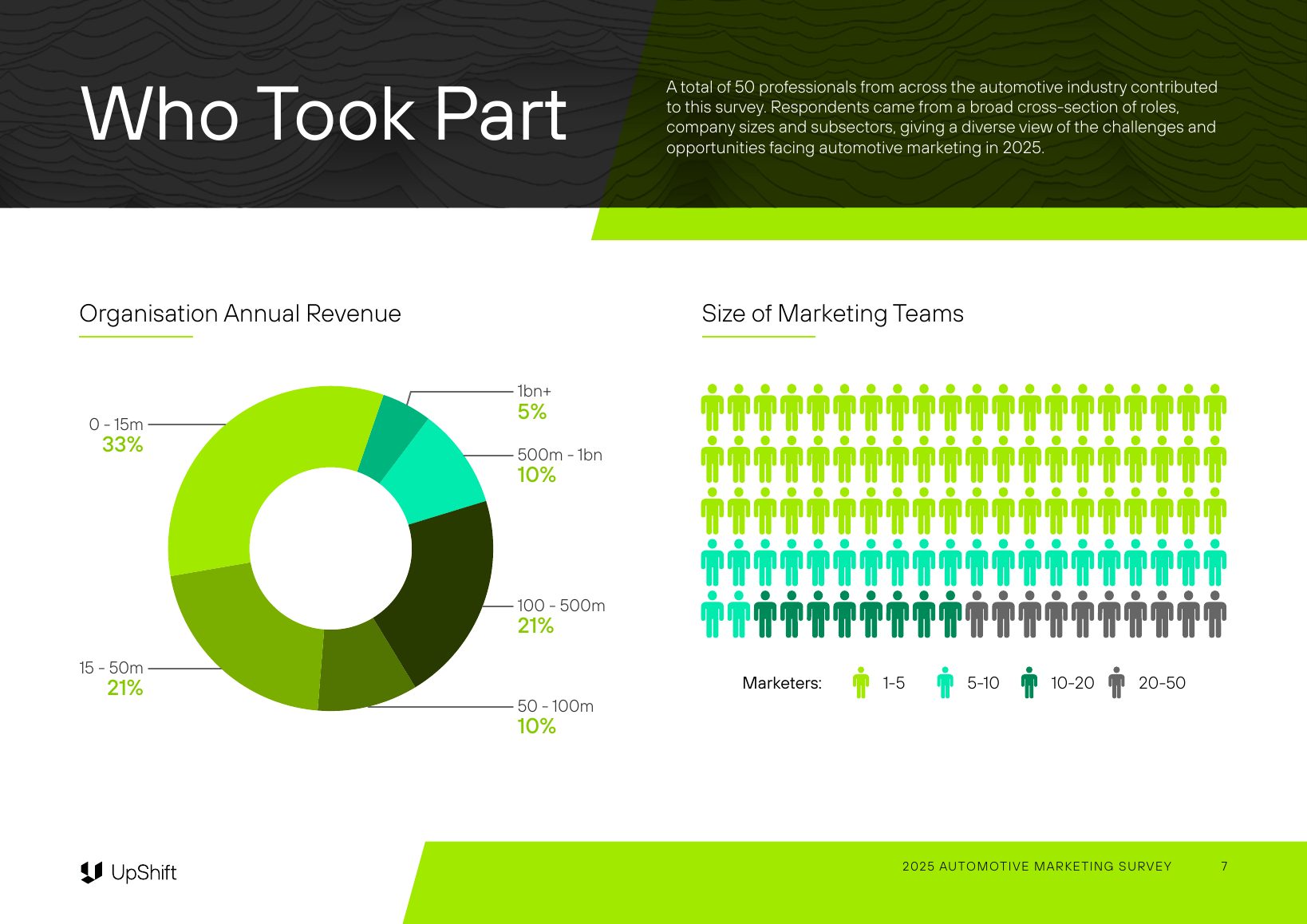
A total of 50 professionals from across the automotive industry contributed to this survey. Respondents came from a broad cross-section of roles, company sizes and subsectors, giving a diverse view of the challenges and opportunities facing automotive marketing in 2025.
Professionals from across the automotive industry contributed to this survey
Who Took Part · pages 6-7Managers - the largest seniority group among respondents
Seniority of Participants · Base: 50 respondentsSales and Distribution - the largest sub-sector represented
Sectors of Participants · Base: 50 respondentsAuthoritative source visual · page 7
Size of Marketing Teams
Executive Summary
A sector under pressure but also full of opportunity
Executive Summary · page 8
A sector under pressure but also full of opportunity
The results of our 2025 Automotive Marketing Survey highlights a sector under pressure but also full of opportunity.
Across those surveyed, a consistent picture emerges: marketing teams are lean, budgets are tight, and expectations are high.
TLDR
The executive summary in four themes
- 01Measurement and data sit at the core of the industry’s challenges.
Proving ROI, fixing attribution, and turning data into action are the top pain points, heightened by limited resources and gaps in strategy.
- 02Spend is digital first.
Most investment goes into Paid Search, Social, Email and SEO; while brand building is undervalued, with cuts this year coming from activities such as TV and display.
- 03Goals are growth led.
Marketers need more leads and sales, stronger brands and better conversions through improved onsite experience - a shift from pure acquisition to full funnel performance.
- 04AI is the defining trend shaping the year.
Both machine learning and generative AI were widely cited as trending topics, alongside growing interest in video content and marketing automation.
Those who act decisively and embrace change will be best placed to turn today’s challenges into tomorrow’s competitive advantage.
Introduction to Results
The survey findings are presented in four sections
Introduction to Results
Four sections
The survey findings are presented in four sections, each designed to build a complete picture of how automotive businesses are approaching their marketing.
Marketing Strategies
This section covers how teams are currently planning, where confidence in strategies sits, and why ROI/attribution remains the number-one blocker.
Marketing Investment
Here we look at where budgets are allocated now and moving forward, and what marketers expect from agencies.
Trends & Expertise
Next, we look at how AI, automation and video are being applied in practice, and why industry expertise is non-negotiable.
Future Objectives
Finally we look at future priorities for teams, the obstacles in the way, and how to close the gap.
Marketing Strategies
Strategy & Measurement Are Still Holding Marketers Back
Top challenge: “Accurately measuring and maintaining ROI” - cited most frequently by respondents.
Top Marketing Challenges · Base: 50 respondentsAvg. confidence rating in marketing strategy & ROI measurement
Confidence in Your Org’s ROI Quantification · Base: 50 respondentsRespondents scoring their confidence 7 out of 10 - the most common rating
Confidence in Your Org’s ROI Quantification · Base: 50 respondents70% said they are not overly reliant on a single channel, but 30% admitted they are, with Paid Search (Google Ads) being the most common: Paid Search 14%, Google 8%, Email Marketing 8%. Base: 50 respondents. Page 12.
Marketing Strategies
13What This Tells Us
Many automotive marketers are still struggling to tie performance back to business outcomes. With an average confidence score of just 6 out of 10, it’s clear that attribution, clarity, and strategic alignment remain unattainable.
The fact that ROI measurement is the number one pain point reinforces this, marketers are making decisions without all the facts.
While 70% say they’re not overly reliant on a single channel, this figure should be taken with caution. It is likely that many brands are reliant without knowing it, particularly on paid search and branded search, due to weak attribution and a lack of channel diversification. During the survey we asked where marketers are most likely to invest budgets over the next 12 months, and unsurprisingly, Google Ads (paid search) was the overwhelming response.
Implication for In-House Marketers
Without a robust measurement protocol, in-house marketers are limited in their ability to make confident decisions around budget allocation, prove ROI, or scale their campaigns sustainably.
The risk isn’t just inefficiency, it’s stagnation. Channel overreliance also leaves brands vulnerable to platform shifts, cost inflation, or algorithm changes
Insight · page 14
ROI isn’t just about reporting; it’s about direction.
Without a shared definition of success and how it’s measured, even well-executed campaigns drift off course.
We believe the cause of the attribution issue can be split into 3:
Technical setup
Ability to collect and attribute.
Data accuracy
Quality and completeness.
KPI alignment
Are we optimising to the right outcomes? On (3), how KPIs are defined and used can distract from real performance. Teams end up optimising to the metric rather than the outcome, creating noise and misalignment.
TLDR
Key takeaways: Marketing Strategies
- 01
If you do not invest in your ability to track and measure your business performance and marketing activity, you are most likely wasting your budget.
- 02
Your impact can compound when you understand how different data sets influence and correlate with one another.
- 03
With too many KPIs, significant resources can be misallocated to goals that are only loosely linked to core business metrics.
- 04
Similarly, focusing too heavily on specific KPIs and performance metrics can distract from the real customer pain points or growth areas that will make the most significant difference.
Key takeaways · page 15
For business owners and senior management
Avoiding change is costly.
Sticking with legacy systems and thinking will cost you more each year.
Own your data.
How it’s collected, attributed, and analysed must be understood by all stakeholders internally - failure to do so impedes necessary change and can result in less effective decision making.
Marketing Investment
Investment Priorities Signal Performance Bias
Paid advertising leads with 22% of total investment share
Key Points · page 17Social media follows, then email (15%) and SEO (14%)
Key Points · page 17Of marketers currently work with agencies
Key Points · page 17Marketing Investment
Top agency traits ranked by marketers
Transparency & communication
Expertise & specialisation
Understanding of your business & industry
Marketing Investment
18What This Tells Us
Investment is heavily weighted toward performance based, conversion channels. While these deliver immediate returns, upper-funnel, brand-building activities remain undervalued and underinvested in. That will limit long-term visibility, trust, and growth.
Agency usage is high, yet basic issues persist. The recurring theme is a lack of trust driven by poor communication and delayed, misaligned deliverables.
As one Head of Marketing put it:
‘If something isn’t working, we want to know. We don’t just want to know the good stuff. In a way, that’s actually less important.’
Implication for In-House Marketers · page 18
Relying too heavily on paid search may achieve short-term wins at the expense of sustainable growth
Relying too heavily on paid search may achieve short-term wins at the expense of sustainable growth and will cause a strain on budgets, especially with rising CPCs and tightening ROI. With competition focused on a fixed pool of demand, brands risk higher costs, lower efficiency, and limited growth unless they invest in upper-funnel activity to build awareness and affinity.
And if you’re outsourcing, choosing a partner without transparency, focus, or the ability to execute fast and well will only increase those risks.
Insight · page 19
Sustainable growth comes from balance
Of course, sales-driven (bottom-funnel) activity is non-negotiable; however, the urgent need for revenue and tighter budgets is pulling attention away from other priorities. We’re increasingly seeing that brand building and awareness (top-of-funnel) directly affect bottom-funnel performance.
Sustainable growth comes from balance: elevating upper-funnel activity not only for awareness, but because brand strength compounds over time and cushions volatility in paid channels.
Focusing too heavily on bottom-funnel conversion channels can lead businesses to over-optimise around short-term sales metrics while overlooking the wider influences that drive purchase decisions.
Most brands are under-investing in what actually builds resilience, differentiation, and long-term demand.
Marketing Investment
The Evidence is Overwhelming
Google Automotive Insights
“Brand differentiation is more important than ever”
Rand Fishkin, SparkToro
“Brand matters more than anything else... Build a notable, popular, well-recognised brand in your space.”
Jason Barnard, Search Engine Land
“Modern SEO is about developing a cohesive brand identity and implementing a content strategy that genuinely serves your target audience across the web.”
Mark Ritson, Think with Google
“To connect with potential customers who aren’t in the market yet, you need to play the long game. Build brand awareness. Create positive associations. Predispose them to choose you when they are ready to buy.”
Brand awareness content and platforms · page 20
Social media and video were seen as the most transformative for awareness
Among respondents investing in brand, social media and video were seen as the most transformative for awareness, with 27 and 25 mentions respectively. Facebook was cited as the single most effective platform for marketing impact.
When asked what competitors do better, social media topped the list, followed by content creation and video, closely related capabilities that reinforce each other.
100% of marketers said industry expertise matters in agency selection - 60% called it imperative. Page 21.
Marketing Investment
And when it comes to working with an agency, what should you look for?
A specialist
Pick a partner with genuine automotive expertise - one that understands your brand and speaks your language, both in terms of automotive and commercially. You care about pounds and pence, so should your agency.
They come highly recommended
Ask peers in the industry who they work with and request references you can speak to from the agency.
An experienced delivery team
During the pitch, meet the people who will actually run your account and clarify their roles and experience. It can be hard at that stage to judge how well they’ll communicate and deliver, but this helps avoid the classic “seniors sell; juniors deliver” scenario and gives confidence that you’ll have a capable team with a track record.
Trends & Expertise
The Smart Tech Surge & the Specialism Gap
Yes - AI is used in the current marketing strategy
AI Use in Current Marketing Strategy · Base: 50 respondentsNo - AI is not used in the current marketing strategy
AI Use in Current Marketing Strategy · Base: 50 respondentsDon’t know
AI Use in Current Marketing Strategy · Base: 50 respondentsTrends & Expertise · page 23
AI is no longer experimental
What This Tells Us
AI is no longer experimental; it’s actively being integrated into marketing workflows. But it’s not the only priority: automation, predictive analytics, and chat-based tools are gaining traction too.
Implication for In-House Marketers
The rise of smarter tools offers huge efficiency gains, but only if used strategically. In-house teams need to understand what’s worth adopting and how to implement it effectively.
The challenge isn’t adoption; it’s application.
Insight · page 24
The advantage won’t just go to the first movers, but to those who use them well
As new tools flood the market, the advantage won’t just go to the first movers, but to those who use them well.
AI is the hot topic with machine learning being the most interesting trend to be explored, followed by generative AI, yet only 48% of in-house marketing strategies currently include the use of AI.
At UpShift, we’re helping clients get ahead of generative search in particular. A recent stat suggests only 14% of Google users currently turn to ChatGPT for answers (Search Engine Land), yet usage of AI-powered, generative search is growing as behaviours shift away from traditional search.
We’re preparing clients for that shift and ensuring their brands are discoverable and compelling - wherever the journey begins.
A recent stat cited from Search Engine Land. Usage of AI-powered, generative search is growing as behaviours shift away from traditional search. Page 24.
Insight
How do we do this?
Transition to an “answer-ready” state. Maximise coverage by aligning with how LLMs consume and reason. Remove obstacles to accurate information, prepare to measure impact, and support practical LLM use.
Implement/upgrade schema
A well-implemented schema is one of the best ways to ensure high coverage and high quality in LLM answers, AIOs, and organic results.
Reduce LLM hallucinations
Earn citations with accurately formatted and markup data.
Content coverage
Ensure each priority topic is comprehensively covered and accessible to AI across your site. If you’re not talking about it, you won’t be part of the conversation. Brands should engage customers at every stage of the buying process. Deep research into behaviours and intent across the funnel should inform your content.
Optimise feed quality
Across Merchant Centre, Vehicle Ads and Inventory to ensure real stock and prices pull into AI answers.
Measure what matters
Build dashboards for AIO citations, AI-surface impressions, AI referral traffic quality, and down-funnel outcomes.
Helping to discern when to use AI
Assist and not to replace to ensure high quality as well as efficiency.
Future Objectives
Ambition Without Alignment
Implication for In-House Marketers · page 26
Big goals need bold actions.
Without a clear roadmap, robust KPIs, and a measured appetite for risk, even strong objectives can fall flat. Whether in-house or via external partners, strategy and execution should embrace experimentation. Marketers must test and learn, make time to think beyond the status quo, and iterate based on evidence to achieve brand ambitions.
Future Objectives
27Insight
Ambition isn’t the problem, alignment is. Marketers know what they want: more leads, stronger brands, better conversions. But they’re expected to deliver within constrained budgets and a narrow set of channels and tactics.
As noted earlier, pushing bottom-funnel activity only gets you so far.
Doing what you’ve always done stalls progress. and eventually leaves you behind.
New entrants to the market have an edge: no legacy systems, no sacred processes. They face today’s market with a ‘day-one’ mentality, pro-risk and quick to act on priorities.
To move the needle, break the pattern and experiment: new technologies, creative campaigns, fresh channels, and reallocated budgets.
Take measured risks, and give your agencies licence to do the same.
Recommendations
Three strategic moves
Recommendations
Three strategic moves
The survey results reveal a sector that is ambitious - but constrained, clear on its goals - but hindered by resources, measurement, and confidence. To bridge this gap, automotive marketers should focus on three strategic moves.
Rebuild Measurement and ROI Frameworks
If ROI, attribution, and actionable insight are the number one pain points, they must also be the starting point for progress.
Establish a consistent measurement framework that ties spend directly to business outcomes, not just clicks or impressions.
Invest in attribution modelling and campaign dashboards that show the full customer journey, from awareness to conversion.
Use data not only to report past performance but to proactively inform decisions about budget allocation and channel strategy.
Rebalance the Channel Mix
The data shows over-reliance on Paid Search and short-term tactics. To reduce risk and unlock growth, marketers need a more balanced portfolio.
Diversify spend beyond the bottom of the funnel by investing in awareness-building content, including video, social, and case studies.
Strengthen organic levers such as SEO and content to reduce dependency on paid traffic and auction dynamics.
Build in regular channel reviews to ensure spend reflects both performance today and long-term demand creation.
Raise the Bar for Partnerships
With two-thirds of respondents already using agencies, and many voicing frustrations, the role of partners must evolve.
Prioritise agencies with deep automotive expertise, not just generic digital capability.
Demand outcome-focused delivery: reporting that links activity to tangible results like leads, conversions, or sales.
Set expectations around speed, responsiveness, and brand understanding, ensuring partners act as an extension of the in-house team, not a detached supplier.
Conclusion
A sector caught in a strategic stalemate
Conclusion · page 29
A sector caught in a strategic stalemate
The picture that emerges from this survey is one of a sector caught in a strategic stalemate, driven by high ambition, but often constrained by resources.
Marketers know where they want to go: more leads, stronger brands, smarter data use. But the tools, clarity, and confidence to get there are still catching up.
Throughout this whitepaper, the same themes resurface: confidence in strategy is middling, performance channels dominate, and while AI is being explored widely, it’s rarely integrated with precision. Meanwhile, measurement remains the most pressing challenge, and expectations of external partners are increasing.
Key Takeaways
Key Takeaways from the Survey
TLDR
Key Takeaways from the Survey
- 01
Measurement and attribution remain the #1 barrier to effective marketing
- 02
Paid media and social dominate budgets, while brand-building channels are underused
- 03
AI is being adopted, but often without strategic depth or clear use cases
- 04
30% report single-channel reliance; diversify to reduce risk
- 05
Marketers want partners who are transparent, specialised, and communicative, not just “experts”
Key Takeaways · page 30
The next phase of growth will be led by clarity
We believe the next phase of growth in automotive marketing won’t be led by bigger budgets or louder messaging; it will be led by clarity. Clarity in strategy. Clarity in measurement. Clarity in what partnerships are truly delivering.
This whitepaper isn’t the final word. It’s a benchmark. A snapshot of where the industry stands now, and a signal for what comes next.
If you need help increasing revenue, achieving clarity in attribution and ROI, or rebalancing your channel mix, then let’s talk. At UpShift, we turn these challenges into opportunities.
We’re ready to turn a 6/10 strategy into confident growth.
If any of the above resonates with you,
speak to one of the team to see how we can help.
enquiries@upshift.co.uk