

Market intelligence · September 2026
Why Tyre Retailers Risk Disappearing From Search
How AI is concentrating visibility among fewer businesses, and why tyre retailers without a clear reason to be chosen risk being left out entirely.
This sector has only three AI winners, and they’re consistently named together.
Introduction
About UpShift
Introduction · Page 04
About UpShift
Part of the wider Evolved group, UpShift is a specialised search agency that focuses on building long-term partnerships with businesses in the automotive sector.
With a proven track record of success, UpShift has helped a variety of companies across many sub-sectors in the automotive industry, and has built long-term partnerships with specialist and global brands.
About UpShift
04Capabilities
- AI Strategy
- Brand Consultancy
- SEO
- Strategy Development
- Paid Search
- Digital PR & Outreach
- Customer Insights & CRO
Who we work with
BYD, Toyota, Stellantis, Select Car Leasing, Vanarama, Peter Vardy, Leasing.com, Nextbase, loveelectric, ClickMechanic and Lexus.
Page 04 · About UpShift
Challenges we solve, opportunities we realise
| Challenges we solve | Opportunities we realise |
|---|---|
| Looking, sounding and pricing the same as every competitor | Developing a distinct brand value proposition, and the messaging to carry it |
| Reducing reliance on marketing cost by offsetting pain channels and security commercial sustainability | Developing and executing brand propositions and market positioning that underpin performance |
| Recovering stagnant and/or eroding performance | Data transformation to understand a true ROI, reduce waste, and maximise investment |
| Navigating changing industry / market economics by streamlining marketing strategies | Increasing ecommerce sales or generating new leads through marketing optimisation |
| Poor or non-existent AI visibility, with no clear reason why | A clear diagnosis of what’s driving it, and a proposition that fixes it |
At a Glance
What AI Search Means for the Tyres industry
Look at the businesses competing for anyone who needs new tyres, and the same pattern repeats almost everywhere.
At a Glance · Page 05
Why AI is Impacting Tyre Retailers Specifically
Similar websites. Similar promises – fully fitted pricing, fast turnaround, a straightforward booking flow. Similar messaging, often word for word. Across the national chains, the competition has narrowed down to just two things: price, and convenience.
That’s not a failure of any one business – it’s what happens when an entire category converges on the same playbook at the same time. Yesterday’s differentiator becomes today’s baseline, and once everyone offers next-day fitting and competitive pricing, none of it separates anyone anymore.
It was a survivable problem when the customer was the one doing the comparing – a person can still scroll past ten near-identical options and pick one anyway. AI doesn’t scroll. It picks one, and it can only justify picking a business it can actually tell apart from the rest. A retailer whose site, promise and pricing are indistinguishable from its closest competitor gives AI nothing to choose it for – so increasingly, it doesn’t.
At a Glance
06What to Expect
What follows is an honest account of what’s actually happening in search, its impact on tyre retailers and what brands can do about it – not a doom-and-gloom warning with nothing behind it. Just what the data shows, and what it means for how a business moves forward from here.
TLDR
Our visibility analysis covers
- 01
How each brand performs, brand by brand, across every retailer in this sector
- 02
How AI visibility compares with Google Search – two different platforms and, in most cases, two entirely different sets of winners
- 03
What AI actually says about each brand – whether it actively recommends the brand or simply names it
- 04
Where retailers appear across the AI buying journey – and why AI offers them fewer opportunities for visibility than Google Search
TLDR
We’ll also give you an honest account of
- 01
How the search landscape has changed – why AI answers questions instead of listing options, and what that means for who gets found
- 02
How AI is making the tyre buying journey disappear – where customers once compared ten options, they may now be shown only one
- 03
Why addressing this problem cannot wait – standing still does not preserve your position; it hands it to whoever moves first
- 04
Why a real reason to choose your brand is protection, not just growth
Where AI sees tyre retailers
Where AI Sees Tyre Retailers Today
prompts used
Persona-based queries run across the full buyer journey, from awareness to transaction.prompt runs
Prompts are run multiple times to ensure the data used is strong enough to analyse.researched
Focus on national chains and online retailers.Page 08 · Industry-Wide Visibility
Industry-Wide Visibility
| # | Brand | Type | Visibility score |
|---|---|---|---|
| 1 | BLACKCIRCLES | Online Fitting Retailer | 37.78% |
| 2 | HALFORDS | National Chain | 35.92% |
| 3 | KWIK FIT | National Chain | 12.79% |
| 4 | ASDA TYRES | Online Fitting Retailer | 5.15% |
| 5 | NATIONAL TYRES AND AUTOCARE | National Chain | 4.82% |
| 6 | ETYRES | Online Fitting Retailer | 1.74% |
| 7 | TYRE SHOPPER | Online Fitting Retailer | 1.03% |
| 8 | MYTYRES | Online Fitting Retailer | 0.22% |
| 9 | CAMSKILL | Online Fitting Retailer | 0.15% |
| 10 | PROTYRE | National Chain | 0.13% |
| 11 | OPONEO | Online Fitting Retailer | 0.12% |
| 12 | COSTCO TYRES | National Chain | 0.11% |
| 13 | TYRELEADER | Online Fitting Retailer | 0.09% |
| 14 | TYRES.NET | Online Fitting Retailer | 0.08% |
| 15 | FORMULA ONE AUTOCENTRES | National Chain | 0.07% |
| 16 | HIQ TYRES & AUTOCARE | National Chain | 0.01% |
| 17 | STS TYRE PROS | National Chain | 0.00% |
Three businesses – Blackcircles, Halfords, and Kwik Fit – own nearly nine-tenths of everything AI volunteers unprompted, out of 17 retailer businesses tracked.
Page 08Blackcircles’ share of the entire Online Retailer tier. The other eight retailers combined share just 18% between them.
Page 08Average visibility for a Online Retailer that isn’t Blackcircles. This is the real starting point for almost every business in this tier.
Page 08Industry-Wide Visibility · Page 08
This sector has only three AI winners, and they’re consistently named together.
This table shows exactly how AI visibility is distributed across all retailers we have analysed in this sector – who holds it, and by how much.
Ask AI about tyres and it names the same three brands back, together, in the same answer: Blackcircles, Halfords and Kwik Fit. Almost nobody else makes it into the conversation at all.
Blackcircles leads with the strongest language (“safest choice,” “best overall”), Halfords follows as the recognisable brand, and Kwik Fit closes the trio specifically because of its nationwide physical coverage – a reason AI states directly, not just infers.
Between them, they are the default answer to “where do I buy tyres” in this sector. Not necessarily because they’re different from the other retailers in this industry – they’re just larger, more household names with a bigger brand.
Everyone else is competing for what’s left over, with nothing to separate them – it’s a lottery. AI has nothing to base a recommendation on beyond price or whatever’s said loudest.
Ranking well on Google and being visible within AI are not the same.
Google visibility vs AI visibility
Google Visibility vs. AI Visibility
Some businesses have built real SEO presence and get almost nothing for it in AI. Others barely register on Google and dominate AI conversations instead. This chart shows exactly where every brand in this sector actually sits – not which channel matters more, but how differently they’re being won.
Page 10 · Google visibility vs AI visibility
Google Visibility vs. AI Visibility: The Smaller Retailers
This chart shows the same data as the full chart as previous, cropped on both axis so that brands below the visible range are legible.
Page 11
AI Concentrates Visibility More Than Google – And Around Different Winners
Google still spreads a meaningful share of visibility across a real number of businesses.
AI hands almost nine-tenths of everything to just three – and they’re not even the same three businesses Google favours.
The top three brands on Google are Asda Tyres, Kwik Fit and MyTyres.
The top three brands in AI are Blackcircles, Halfords and Kwik Fit.
Page 11 · AI-favoured
AI-favoured – 3 out of 17 brands
| Brand | AI | Gap | |
|---|---|---|---|
| HALFORDS | 7.58% | 35.92% | +28.34% |
| BLACKCIRCLES | 9.74% | 37.78% | +28.04% |
| TYRES.NET | 0.04% | 0.08% | +0.04% |
Page 11 · Google-favoured
Google-favoured – 14 out of 17 brands
| Brand | AI | Gap | |
|---|---|---|---|
| TYRE SHOPPER | 1.06% | 1.03% | -0.03% |
| COSTCO TYRES | 0.26% | 0.11% | -0.15% |
| STS TYRE PROS | 0.26% | 0.00% | -0.26% |
| NATIONAL TYRES AND AUTOCARE | 5.17% | 4.82% | -0.35% |
| HIQ TYRES & AUTOCARE | 0.76% | 0.01% | -0.75% |
| ETYRES | 2.65% | 1.74% | -0.91% |
| FORMULA ONE AUTOCENTRES | 1.06% | 0.07% | -0.99% |
| OPONEO | 1.59% | 0.12% | -1.47% |
| TYRELEADER | 3.52% | 0.09% | -3.43% |
| PROTYRE | 4.81% | 0.13% | -4.68% |
| CAMSKILL | 5.06% | 0.15% | -4.91% |
| KWIK FIT | 20.16% | 12.79% | -7.37% |
| MYTYRES | 11.90% | 0.22% | -11.68% |
| ASDA TYRES | 24.38% | 5.15% | -19.23% |
Page 12 · How are brands framed within AI responses?
National Chains
Every business in this analysis, broken down the same way – what AI recommends them for, what it cautions against, and what’s left over. Green shows the most dominant owned theme, red shows a caution AI attaches to the brand, and grey is everything else.
Page 13 · How are brands framed within AI responses?
Online Fitting Retailers
What stood out wasn’t the individual themes, it was the collective similarity across national chains and online retailers. National chains are basically all ‘convenient’ – but that’s the business model talking, not anything they’ve built – and almost every one carries the same risk: upselling, which is close to a contradiction of their own pros and cons. Online retailers compete on price, with fitting as the caution attached to nearly all of them. There are only really a handful of genuinely different things happening across this whole analysis – and that’s exactly what explains the problem. — Jack Nesbitt, UpShift Head of SEO.
Page 14
The Opportunity for Retailers to be Visible Has Reduced
Compared with traditional Google Search, AI gives tyre retailers fewer opportunities to be visible across the buying journey.
In Google, retailers can appear while customers research their options, compare manufacturers and decide where to buy. Within AI, retailer visibility is concentrated much later.
A retailer can rank in Google for searches such as “best Michelin tyres” or “Pirelli vs Continental”, putting its guides, category pages and products in front of customers while they are still deciding what to choose.
In AI responses, that influence shifts towards manufacturers. When a question relates to a particular manufacturer, its products or their features, AI is more likely to treat the manufacturer’s own website as the primary source of truth than rely on information provided by a retailer. This is reflected in our analysis: manufacturers account for 71% of visibility at the Consideration stage, compared with just 24% for retailers.
Retailers only become dominant once the product choice has largely been made. Their visibility rises to 98% at Decision and 79% at Transaction, as the customer moves from deciding what to buy to deciding where to buy it.
Page 14 · AI buying journey
Where retailers appear across the AI buying journey
Share of visibility at each stage of the AI buying journey, as printed on page 14.
-
100%No brand mentioned
-
71%Manufacturer24%Retailer
-
98%Retailer
-
79%Retailer21%No brand mentioned
Methodology
Our Research Methodology
Methodology · Page 16
Why We Built UnderAi
We set out to use an AI visibility platform, not build one. But the tools we tested often reduced complex customer journeys to a single score, with little clarity around how it was calculated or what businesses should do next.
Page 16 · Why we built UnderAi
What most AI tools do versus what UnderAi does
| Principle | What most AI tools do | What UnderAi does |
|---|---|---|
| Persona-based | One generic answer from “the average customer” who does not exist | Uses real persona and real buyer information to understand how visible you are to your ‘actual’ audience |
| Release-timed | Daily tracking dashboards, AKA daily noise | Updated when new AI models are released, as this is actually when most of your visibility changes – not daily |
| Prominence-weighted | Build on simple-mention counting. A brand buried in a footnote counts the same as one leading the entire answer. That’s not measurement, it’s a headcount. | Visibility is weighted by what is actually seen, not just if you show up. |
| Demand-grounded | Rare prompts are treated as common ones. | Anchored in real search demand data – so you know actually what to prioritise over others. |
We built Under Ai because we needed something we could trust with our own clients’ money, and nothing on the market met that bar.
Our Research Process · The Persona Behind This Data
The Uncertain Novice
A driver with low confidence around tyres, triggered by an MOT failure, visible wear, or a puncture – reactive, not planned. What they care about most: not being taken advantage of – plain, honest explanation and one clear recommendation, not upselling or jargon. They drive a 6-year-old Corsa, bought used, mainly for work and seeing family, not for fun.
YouGov Profiles
“55% of GB respondents change their tyres only when absolutely necessary or in case of damage; price is the biggest purchase concern for 57% of GB consumers.”
National Highways | TyreSafe
“Over 17% of tyres are already illegal at the point of replacement, with a further 40% borderline.”
Fixter via The Car Expert
“56% of British drivers – potentially 28 million people – believe they have been scammed or overcharged after taking their car to a mechanic, and 40 million admit to being fearful of the possibility.”
Fixter via The Car Expert
“70% of 25–35 year-olds were the most sceptical of garages, compared with 52% of 50–64s and 43% of over-65s.”
Fixter via The Car Expert
“27% of UK motorists would rather drive their car in poor condition than risk being scammed at the garage.”
Page 17 · Our Research Process
Data Sources
AI Visibility
186 real prompts, run 931 times, across defined buyer personas built from genuine UK tyre-buying research. No hypothetical questions, no single “average customer.”
Google Visibility
160 real search keywords pulled from Ahrefs, reflecting genuine search demand across the sector.
Same standard, two data sources
Both grounded in what people actually search for and ask.
real prompts, across defined buyer personas built from genuine UK tyre-buying research
AI Visibility · page 17times the prompts were run
AI Visibility · page 17real search keywords pulled from Ahrefs, reflecting genuine search demand across the sector
Google Visibility · page 17The Market Shift
The Market Shift
The Market Shift · Page 19
The Search Landscape Has Changed
For the past two decades, ranking well on Google meant customers found you, clicked through, and you had the chance to win their business.
That relationship is breaking down.
Google is increasingly designed to keep people on Google. AI Overviews now answer many buyer questions on the results page – the customer gets what they need without ever visiting a website.
At the same time, buyers are starting their research somewhere else entirely. A growing share of product and brand research now happens inside AI tools – before a customer ever reaches a traditional search results page, if they reach one at all.
Page 19 · The Search Landscape Has Changed
This changes what it takes to be found – and, more importantly, it changes who gets found.
Search engines used to rank pages. AI tools recommend brands.
Under that old system, ten businesses could all win from the same Google search – position one converted more often than position ten, but position ten still got found, still got clicked, still had a real shot.
AI doesn’t return a list. It synthesises a single answer, usually naming one or two businesses, based on who has a clear, defensible reason to be chosen. A business is either in that answer, or it doesn’t exist for that customer at all.
Google Search
10 Results. 10 Real chances to be found. Business A through Business J are all listed – every business on this page can still win the customer.
AI Assistant
One answer. One or Two real chances. “Hello, I’d recommend Business A or Business B.” Everyone else doesn’t exist for this customer.
AI is giving fewer businesses a chance to be seen at all – and if you’re not one of them, you don’t exist to that customer.
Page 20
Why Tyre Retailers Are Especially Exposed
Fewer chances to be seen, and a category where every business looks the same – that’s a worse combination for tyre retailers than for most sectors.
A business that resells the same products as competitors, at similar prices, with no clear point of view – or with a point of view nobody has aimed at a specific customer, in language that customer actually understands – gives an AI system nothing to recommend it for. It doesn’t matter how well-optimised the website is – if there’s no real, specific answer to ‘why this one, not the others, for someone like me,’ AI has no reason to choose them either.
This is why the businesses most exposed right now aren’t the ones doing SEO badly. They’re the ones who never needed a genuine point of differentiation in the first place – because until now, ranking well was enough. It isn’t anymore.
Page 20
Yesterday… and Today
Yesterday… How to win Google
- Target the right keywords
- Build backlinks
- Publish content
- Optimise technical SEO
- Improve page speed
- Rank number 1
Today: How to win AI
- Be genuinely different
- Solve a customer problem
- Build authority
- Earn trust
- Demonstrate expertise
- Become the obvious recommendation
The Market Shift · Page 21
How AI is Collapsing the Tyre-Buying Journey
It’s not just that AI recommends brands instead of ranking pages. For a growing number of buyers, AI is replacing the research journey itself.
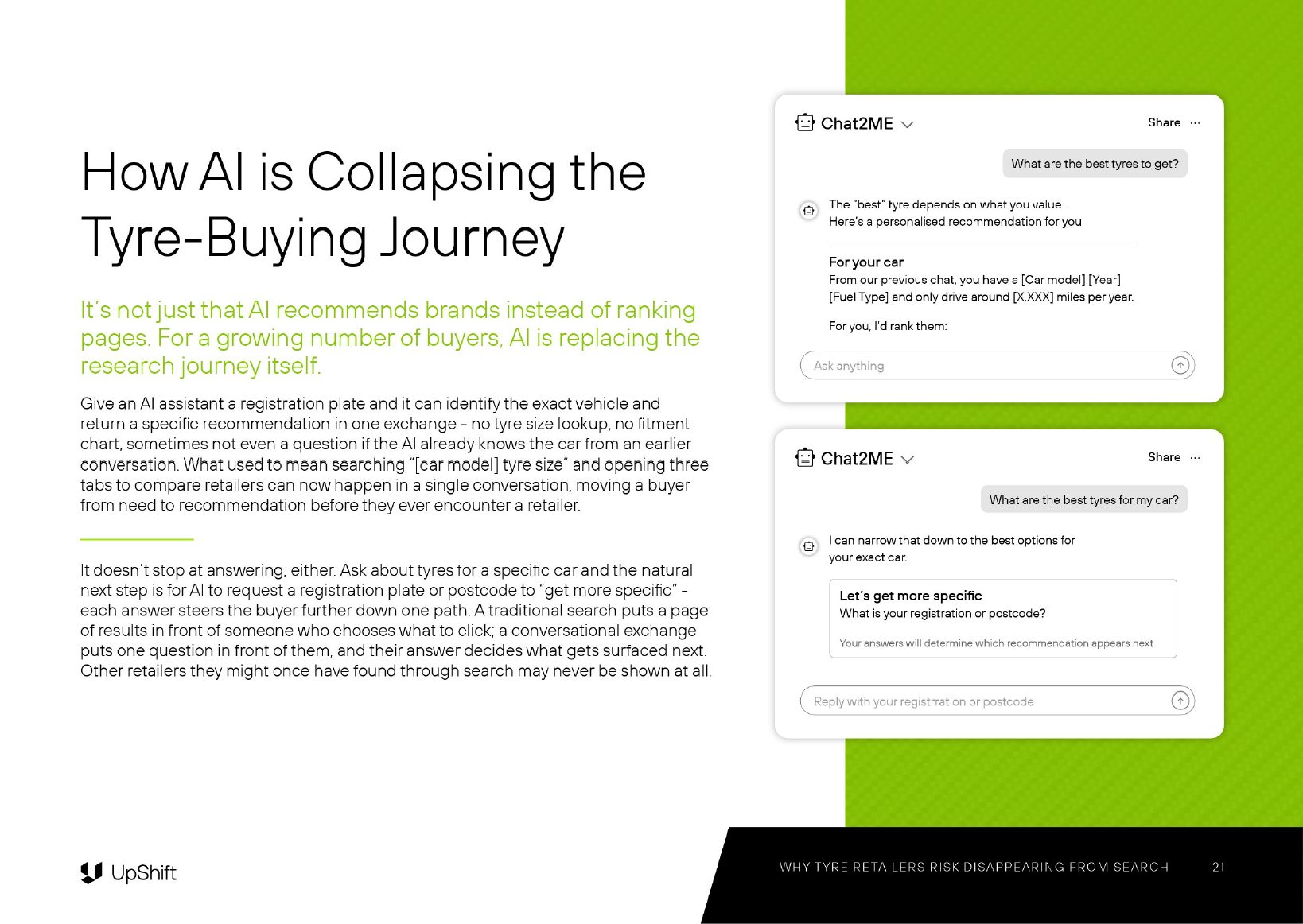
Give an AI assistant a registration plate and it can identify the exact vehicle and return a specific recommendation in one exchange – no tyre size lookup, no fitment chart, sometimes not even a question if the AI already knows the car from an earlier conversation. What used to mean searching “[car model] tyre size” and opening three tabs to compare retailers can now happen in a single conversation, moving a buyer from need to recommendation before they ever encounter a retailer.
It doesn’t stop at answering, either. Ask about tyres for a specific car and the natural next step is for AI to request a registration plate or postcode to “get more specific” – each answer steers the buyer further down one path. A traditional search puts a page of results in front of someone who chooses what to click; a conversational exchange puts one question in front of them, and their answer decides what gets surfaced next. Other retailers they might once have found through search may never be shown at all.
Authoritative source visual · page 21
How AI is Collapsing the Tyre-Buying Journey
Why it can’t wait
Why Addressing This Problem Can’t Wait
Why it can’t wait · Page 23
The Marketing Reality
When price is the only thing left to compete on, the result is a race to the bottom.
Every discount gets matched, every competitor bids the same keywords, and the business that lasts longest isn’t the best one, it’s whoever can survive on the thinnest margin.
Page 23 · The Marketing Reality
None of these fix the actual problem
They can help a business be found. None of them give AI – or a customer – a reason to choose it.
None of these
- Keyword improvements
- More backlinks
- More content
- More ads
- A faster website
- More PPC spend
A genuine reason to be chosen
The only thing that actually changes who gets picked. By the right audience, with the right messaging.
The Marketing Reality
23Many of the businesses that succeeded in ecommerce started with something genuinely distinctive.
In tyre retail, ordering online, comparing prices, booking local fitting or having tyres fitted at home once represented meaningful points of difference.
But successful ideas get copied. Over time, yesterday’s advantage becomes today’s minimum expectation. Next-day appointments, nationwide fitting, large product ranges and competitive prices now appear across the sector. Look at the market with fresh eyes and many retailers largely look, sound and promise the same things.
That doesn’t mean their original propositions were weak. It means the market caught up. What used to be a reason to choose them is now just the price of entry.
Page 24
The Opportunity Is Real – But It Won’t Wait
In a category everyone needs and nobody thinks about, the business that becomes the obvious answer to “who do I use for this” gets asked the question for years.
That’s what makes the position worth more than the sale it wins today. A competitor can match the price, copy the messaging, even build a better website – and it won’t matter, because the customer was never comparing in the first place. Being the obvious answer removes a business from the competition altogether. It’s no longer one option being weighed against others. It’s just what someone does, the same way they’d always done it.
There aren’t countless ways to be that answer, either. In a category this narrow, the genuine positions to hold are few. Every one already claimed is one fewer left for whoever comes next.
of UK adults use AI tools, rising to 79% of 16-24 year olds and 74% of 25-34 year olds
Ofcom, 2026year-on-year growth in UK consumers who have used AI.
Deloitte UK, 2026UK consumers have asked AI for product recommendations, while 15% would assume a brand was not right for them if AI failed to suggest it.
Kantar AI Barometer, 2026The Upside
A Real Reason to Choose You is Protection, Not Just Growth
The Upside · Page 26
The Real Way to Future-Proof Your Marketing
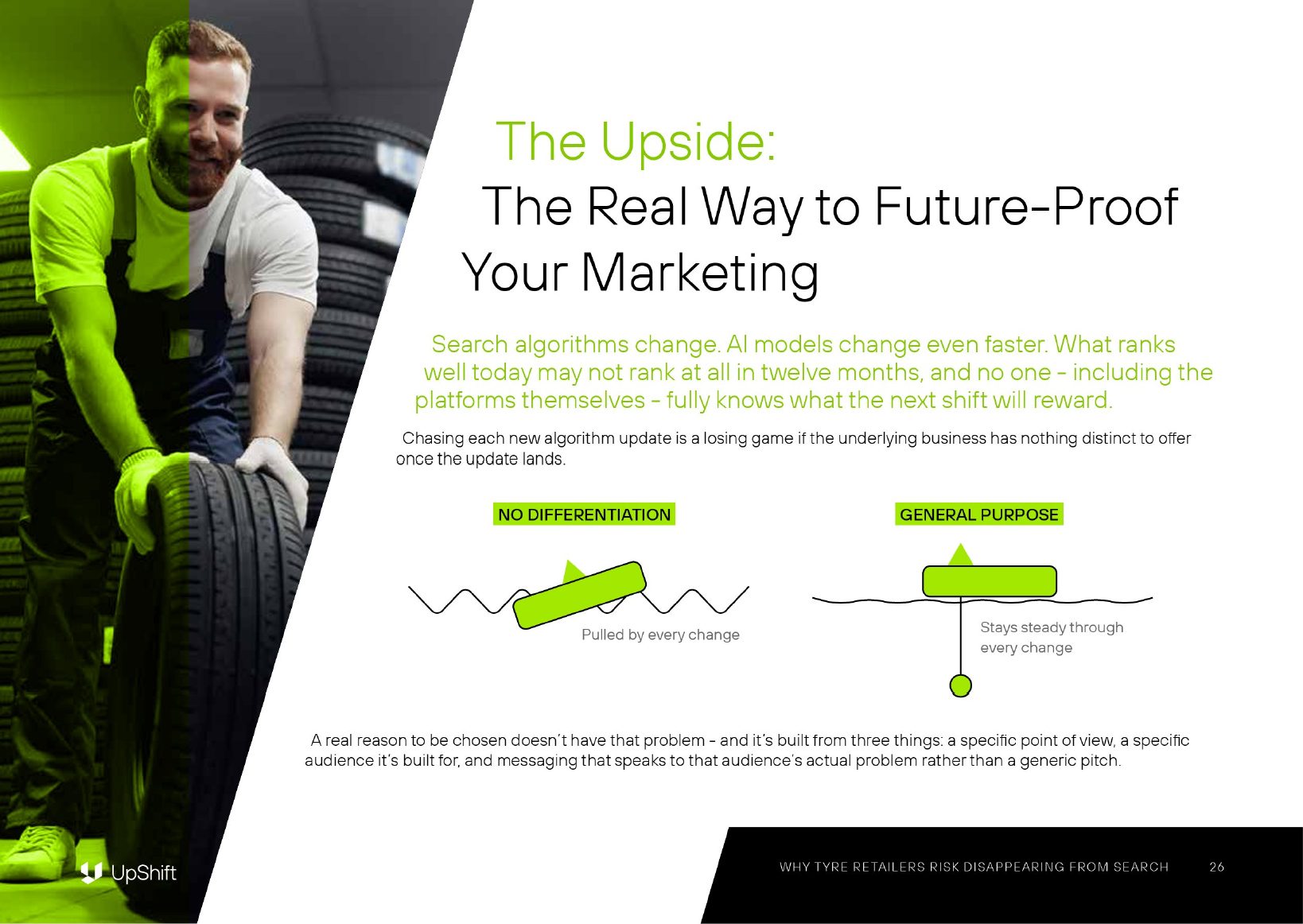
Search algorithms change. AI models change even faster. What ranks well today may not rank at all in twelve months, and no one – including the platforms themselves – fully knows what the next shift will reward.
Chasing each new algorithm update is a losing game if the underlying business has nothing distinct to offer once the update lands.
Authoritative source visual · page 26
No differentiation versus general purpose
The Upside · Page 27
In other words: visibility is rented, differentiation is owned.
If a brand is trusted for a specific type of expertise, service, or a specific point of view – and says so in words that customer recognises as being about them – that advantage doesn’t depend on any one platform’s rules.
It shows up in reviews, in word of mouth, in repeat business, and – increasingly – in whether AI tools have a genuine reason to recommend that brand by name, to the right person, rather than defaulting to whichever generic result is easiest to summarise.
This plays out commercially, not just strategically:
Page 27 · This plays out commercially, not just strategically
No differentiation versus genuine differentiation
| No differentiation | Genuine differentiation |
|---|---|
| Higher CPAs: Every competitor bids on the same keywords for the same customer – there’s no cheaper, owned channel to fall back on | Lower CPAs: Branded search and direct demand reduce reliance on paid acquisition for every single customer |
| Margin erosion: Price is the only lever left, so discounting becomes routine rather than occasional | Pricing power: A specific value customers can’t get elsewhere supports a price beyond the cheapest option |
| Low repeat rate: No reason to come back beyond price – the next search starts the acquisition cost all over again | Higher repeat and referral rate: Trust and reputation compound – each satisfied customer lowers the cost of the next one |
| Exposed to platform risk: Visibility is rented from Google and AI platforms – one algorithm change can remove it overnight | Resilient to platform risk: Reputation and demand exist independently of any one algorithm or platform’s rules |
The Upside · Page 28
Differentiation Creates Another Route into the Answer
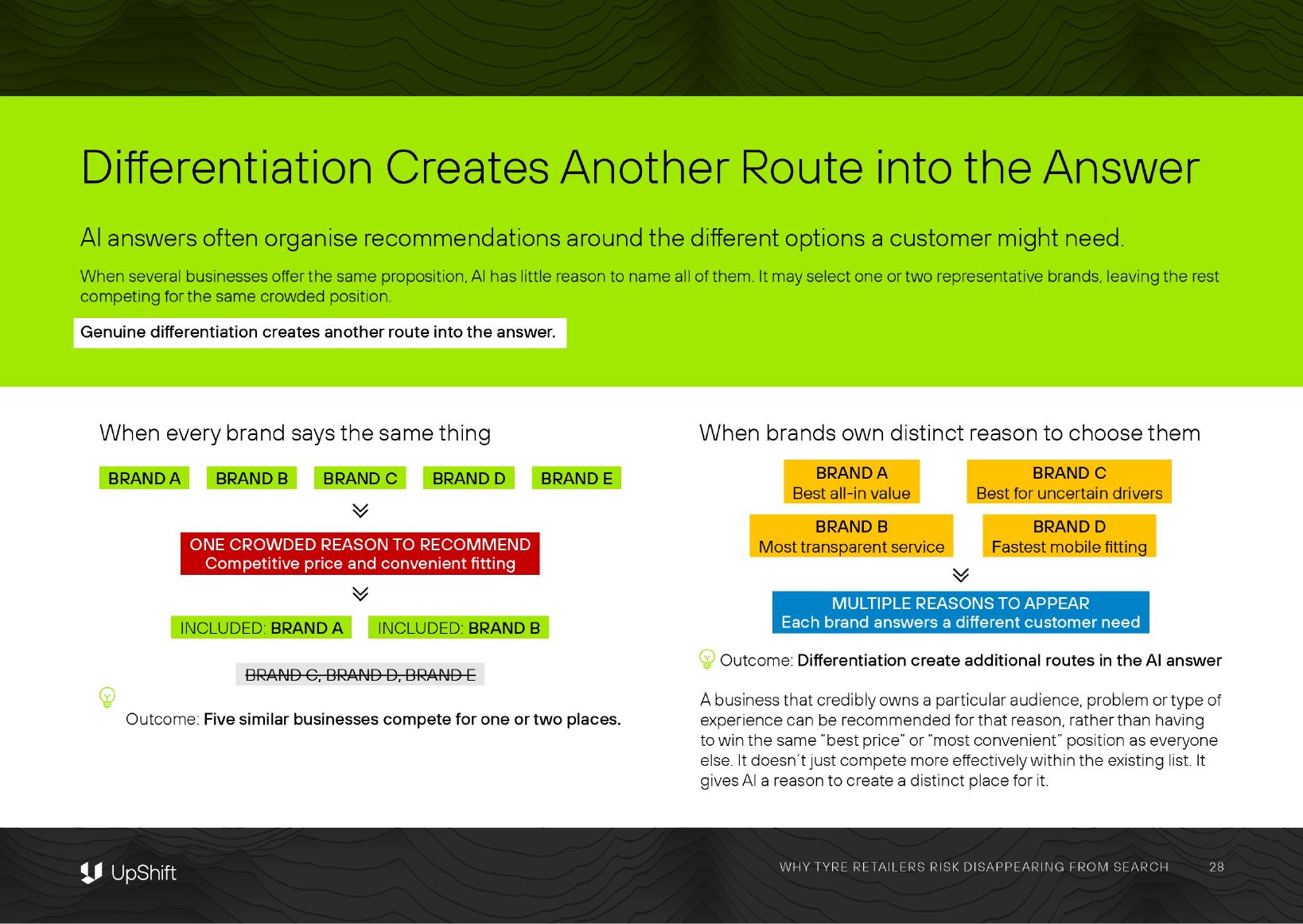
AI answers often organise recommendations around the different options a customer might need.
When several businesses offer the same proposition, AI has little reason to name all of them. It may select one or two representative brands, leaving the rest competing for the same crowded position.
Genuine differentiation creates another route into the answer.
Authoritative source visual · page 28
When every brand says the same thing versus when brands own distinct reasons to choose them
Page 28 · Differentiation Creates Another Route into the Answer
Two ways into the answer
A business that credibly owns a particular audience, problem or type of experience can be recommended for that reason, rather than having to win the same “best price” or “most convenient” position as everyone else. It doesn’t just compete more effectively within the existing list. It gives AI a reason to create a distinct place for it.
When every brand says the same thing
- Brand A, Brand B, Brand C, Brand D, Brand E
- One crowded reason to recommend: competitive price and convenient fitting
- Included: Brand A. Included: Brand B. Brand C, Brand D, Brand E left out
- Outcome: Five similar businesses compete for one or two places.
When brands own distinct reason to choose them
- Brand A – Best all-in value
- Brand B – Most transparent service
- Brand C – Best for uncertain drivers
- Brand D – Fastest mobile fitting
- Multiple reasons to appear: each brand answers a different customer need
- Outcome: Differentiation create additional routes in the AI answer
Who We Are
Who We Are
Who We Are · Page 29
Who We Are
Most agencies sell more of what already isn’t working – more content, more digital pr campaigns, more spend on the same channels everyone else is bidding on.
We do the opposite. We find the specific reason a business deserves to be chosen, build it, and make sure it’s the thing AI and Google actually see.
Rankings fade. A genuine reason to be chosen doesn’t.
Who We Are
29Some of the brands we’ve worked with
BYD, Select Car Leasing, DS Automobiles, Vanarama, Peugeot, Gridserve, Vauxhall, Peter Vardy, Leasing Options, EZOO, Vertu, Nextbase, GoodByeCar, motoreasy, Wessex Fleet, Xcite Car Leasing, loveelectric, ClickMechanic, WhoCanFixMyCar.com, moneyshake, National Tyres and Autocare and CarMoney.
About UnderAi · Page 30
About UnderAi
UnderAi is the research platform behind this report. It was built to answer a simple question: when real customers ask AI for advice, which brands are actually visible – and why?
It doesn’t track rankings or generic visibility scores. It measures what real personas actually get told – which brands come up, how prominently, and in what context – using real buyer questions, not hypothetical ones.
Next Steps
This report is a starting point.
Next Steps · Page 31
Next Steps
This report is a starting point.
The next step is a call to run through the full report together – what we found, what it means for you specifically, and what a genuine, defensible point of differentiation could look like from here.
TLDR
Next steps
- 01
Request more AI visibility data through our own tool built in house (UnderAi)
- 02
AI analysis into your brands own personas (via UnderAi)
- 03
A deeper-dive into your brands own AI visibility
Next Steps
31Your contacts at UpShift
Ben Gibson, UpShift Business Dev. Manager – bengibson@evolvedsearch.com – (0191) 375 9170
Jack Nesbitt, UpShift Head of SEO – jack@evolvedsearch.com – (0191) 375 9170
Book a call to run through this report.
This report is a starting point.
The next step is a call to run through the full report together – what we found, what it means for you specifically, and what a genuine, defensible point of differentiation could look like from here.
enquiries@upshift.co.uk