

In a space defined by transformation, it’s easy to get distracted by sales targets, production delays or shifting regulations. But if you really want to understand where the UK EV market is going, you need to pay attention to search.
Each month, UK consumers make over 2.4 million EV-related searches — not just for specific models, but for affordability, policy changes, infrastructure, and brand perception. That’s a live, unfiltered look at real-world interest and intent. And it’s not always what brands expect.
EV is Now Mainstream, But It’s Fragmented
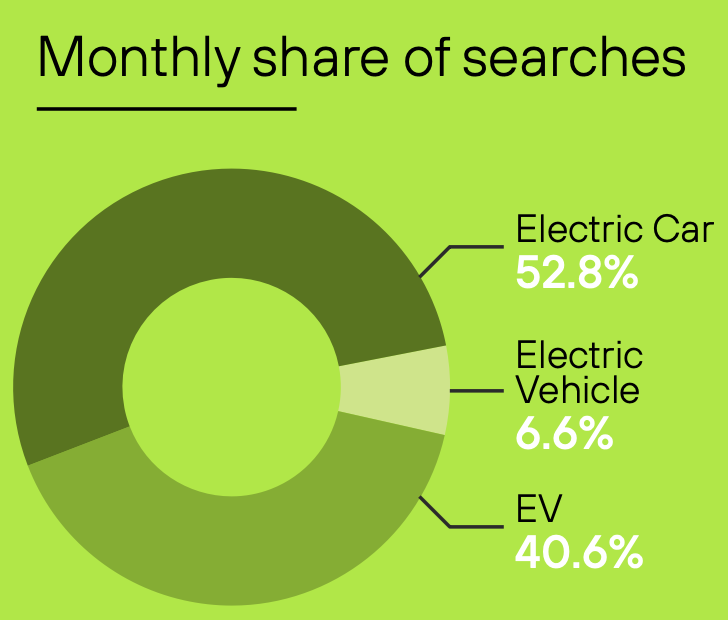
The term “EV” has now fully overtaken both “electric car” and “electric vehicle” in raw search volume. It’s become the consumer default, with 1.3 million monthly searches, compared to 1 million for “electric car” and just 162,000 for “electric vehicle.”
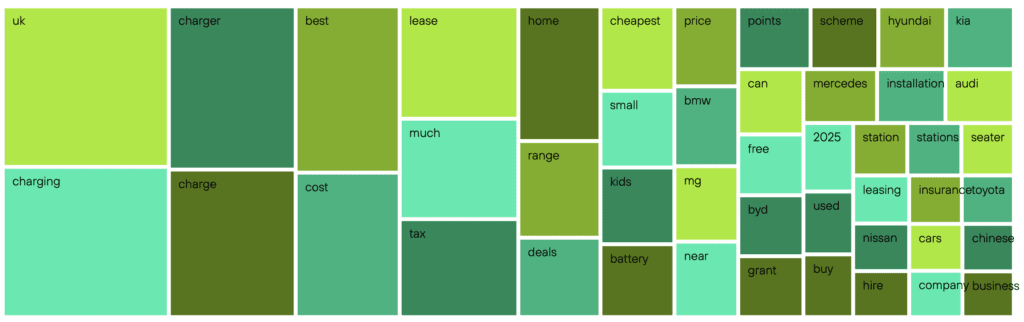
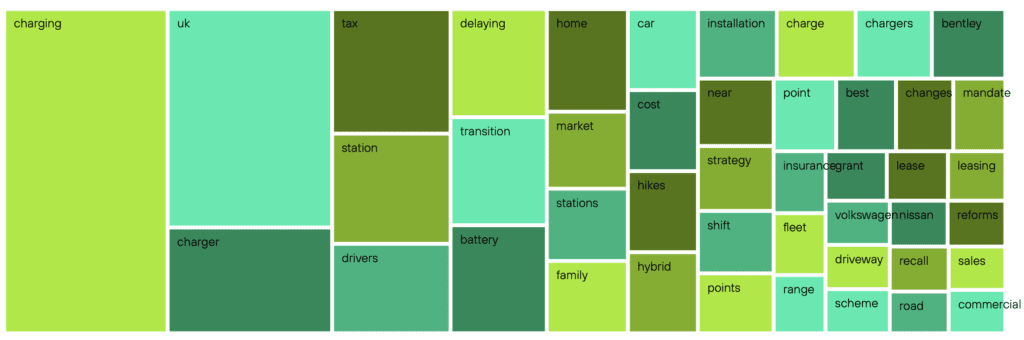
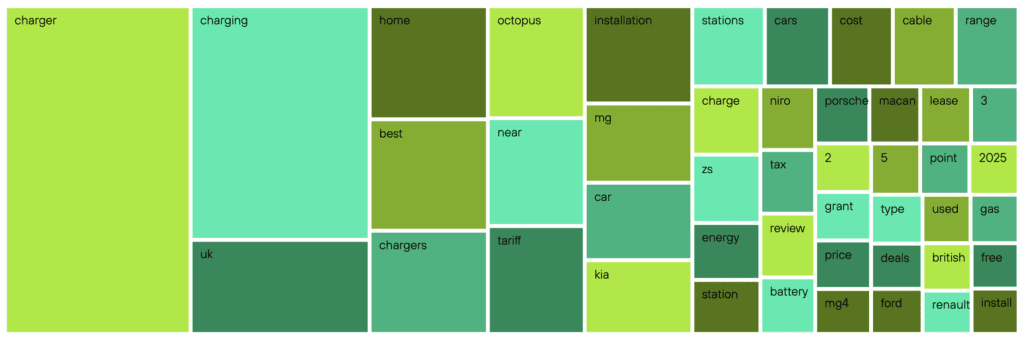
But that linguistic difference reveals something deeper. The images below show the keyword cluster breakdown, with each block representing total search volume within that keyword cluster.
- “Electric car” (1 million monthly searches) is where consumers talk affordability, family suitability, and comparison shopping.
- “Electric vehicle” (162,000 monthly searches) shows up around tax, mandates, policy and legislation, especially during policy announcements.
- “EV” (1.3m monthly searches) captures infrastructure queries, tariffs, charging, range, as well as high-level interest.
These aren’t just synonyms. They’re signals of intent — and knowing which one dominates your brand’s visibility matters more than ever.
Search Growth Is Explosive, But Volatile
Search demand for EV-related keywords has more than doubled since 2022, with peak interest landing in mid-2024.
But the trend isn’t linear. Interest spikes around key moments — from tax policy announcements to new model launches — and softens during periods of uncertainty or lack of media noise. That volatility reflects a category still maturing: people are interested, but not yet consistent.
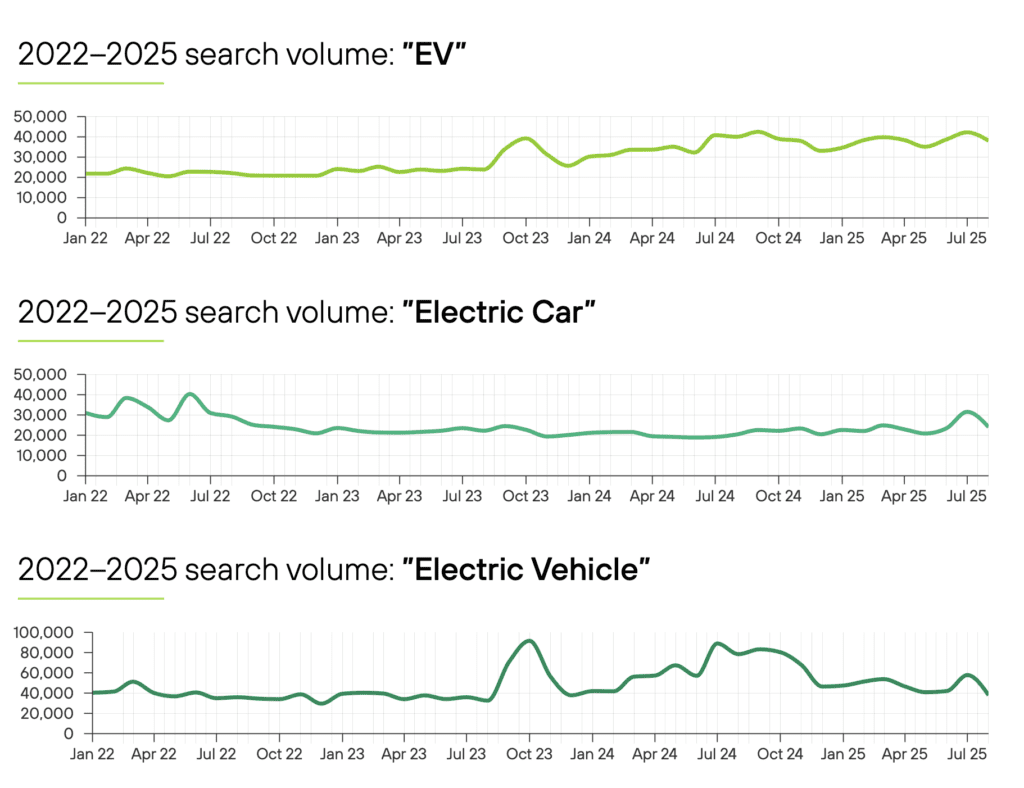
This is especially important for brands banking on long-tail search visibility to signal purchase intent. EV searches today are driven by reaction, not routine.
For brands, this means timing and language matter. If your site content on charging, incentives, or ownership doesn’t match the phrases people are actually searching — like “EV charging cost” or “electric vehicle tax 2025” — it’s easy to miss the moment. Being visible when interest peaks is a competitive edge.
Model Searches Still Trail the Conversation
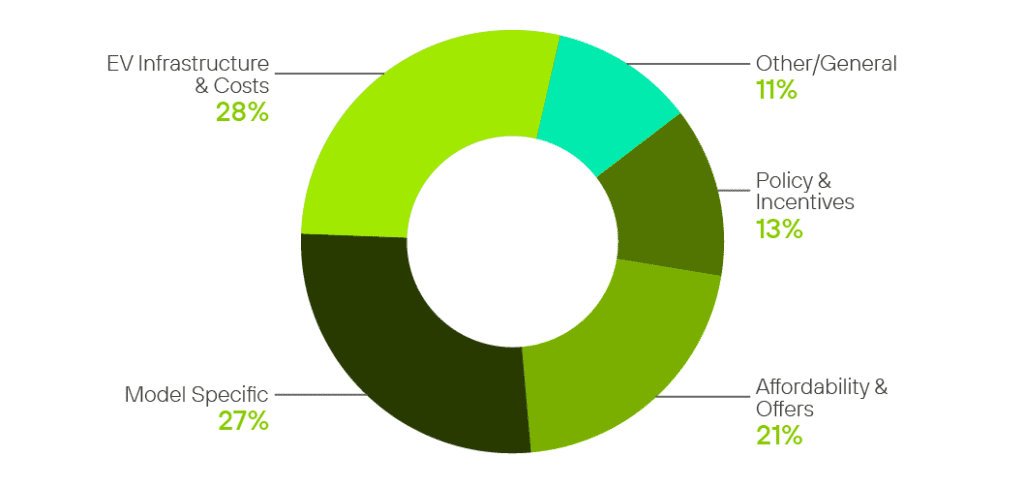
Despite the overall volume, many consumers are still not searching for specific EV models. In fact, even the most searched models — Tesla Model 3, BYD Seal, Polestar 2 — are dwarfed by general queries about cost, charging, and incentives.
This puts pressure on brands to go beyond traditional awareness campaigns. If your model isn’t appearing in searches like “best electric car 2025,” there’s a real risk it’s being overlooked at the point of consideration.
Distribution of total search volume by category
Search is a Mirror and a Forecast
Search doesn’t just reflect what consumers already know. It shows what they’re curious about next. That makes it a leading indicator, and a competitive advantage for brands that treat it seriously.
Want to see where your brand sits in the EV conversation? We can help.
enquiries@upshift.co.uk
Talk To Our Experts
Please submit your details and as much information as you can on what you would like to discuss:
required information