

Have you been on social media recently and noticed how similar AI-generated content looks? The same polished visuals. The same cinematic edits. The same robotic voiceovers attempting to make everyday products sound revolutionary. Different brands are now producing content that feels almost interchangeable.
Now, AI itself is not the issue here. In many ways, it is one of the most important developments in marketing in years. Smaller businesses suddenly have access to tools that previously required large production budgets or specialist creative support. Campaign production has become quicker, creative testing has become easier, and marketers can now execute ideas at a pace that would have been difficult only a few years ago.
That shift is genuinely positive.
The concern is what happens when accessibility turns into uniformity.
AI Has Changed Marketing Forever
There is no denying the impact AI is already having across the marketing industry.
Creative workflows are moving faster. Brands can produce campaign assets without lengthy turnaround times, and smaller businesses can compete visually in ways that were previously unrealistic. AI has lowered the barrier to entry in creative production, opening opportunities for brands that may never have had the budget to compete at scale before.
This shift is already reflected across the industry. According to HubSpot’s State of Marketing 2026 report, 78% of marketers now use AI in their daily workflows, highlighting just how quickly the technology has moved from experimental to mainstream in a relatively short space of time.
This matters because marketing has become increasingly expensive. Paid media costs continue to rise across multiple platforms, while attention spans continue to shrink. AI enables businesses to react faster and produce content more efficiently in an increasingly competitive environment.
The problem is not the technology itself.
When businesses rely on the same tools, prompts, and creative shortcuts, the outputs inevitably start to converge. Different products, different industries, and different audiences are increasingly being marketed through the same visual language.
The result is not necessarily lower-quality content. The challenge is that it becomes harder for consumers to remember who created it, as with the same visual style, differentiation naturally starts to disappear.

Consumers Are Already Spotting Generic AI Content
Audiences are becoming far more aware of AI-generated content than many businesses realise.
At first, the cinematic edits and hyper-polished visuals felt fresh because they were new. Now the same AI aesthetic is appearing everywhere. Finance brands, automotive companies, and fitness businesses use it. The industries are different, but the creative language is becoming identical. Eventually, the content itself becomes more recognisable than the brand behind it.
This isn’t confined to a single industry. Across luxury fashion, retail, and beyond, a clear pattern is emerging. Creative output is starting to converge on a shared visual language. Composition, lighting and finishing all feel increasingly standardised, shaped less by brand identity and more by shared tools and trend-driven templates. This doesn’t lead to identical campaigns, but it does narrow the range of how brands appear visually.
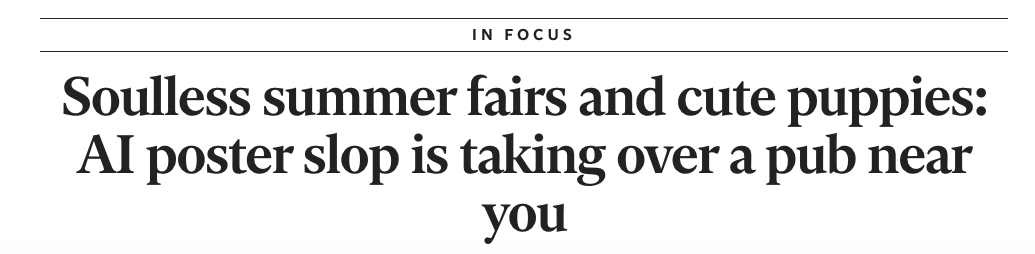
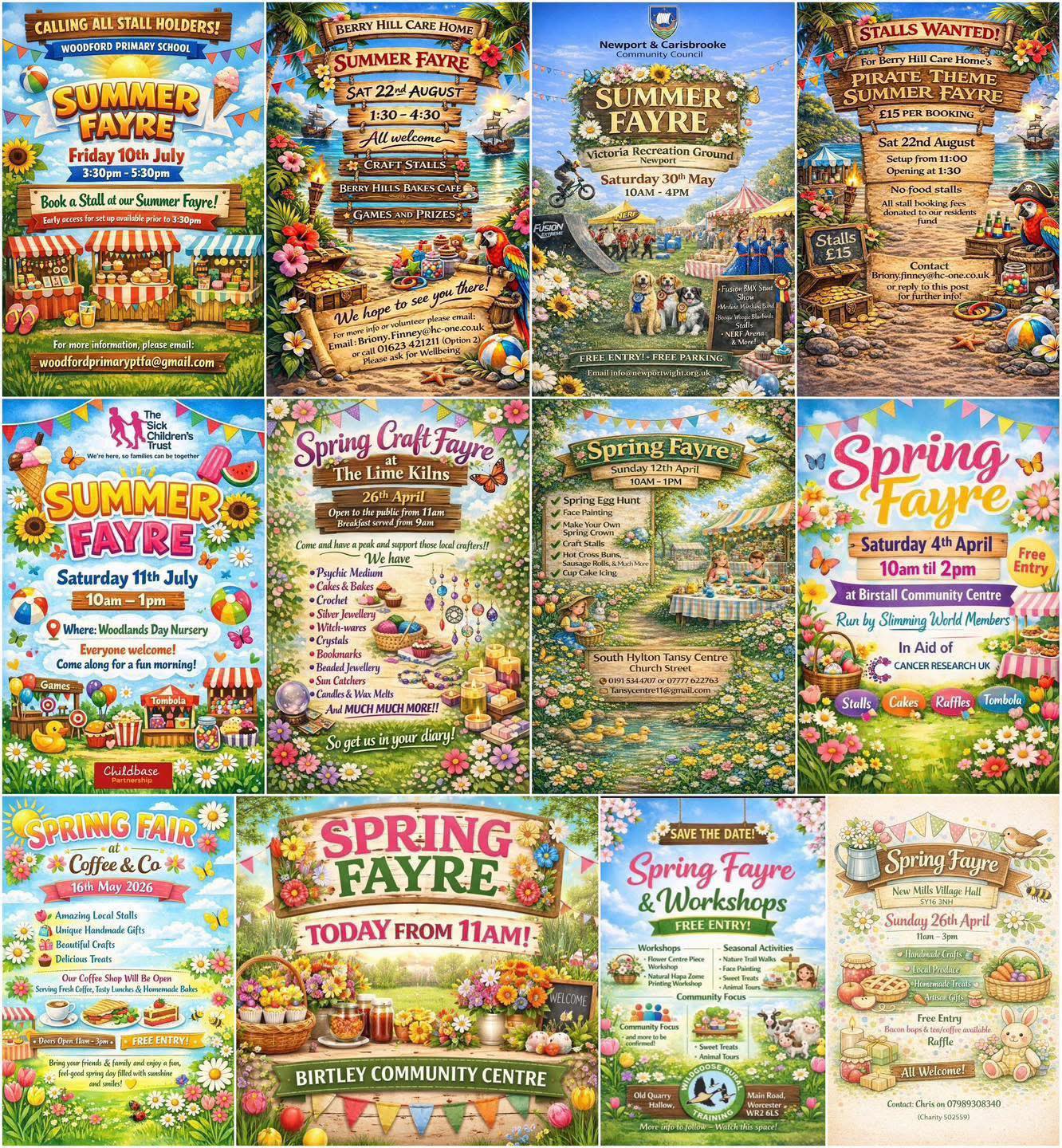
There’s been an influx of AI-generated flyers across social media for local events, and even news outlets are beginning to highlight how similar they all look.
Even in luxury fashion, where differentiation should be strongest, this shift is visible. Both Gucci and Valentino have faced criticism for leaning into AI-influenced or AI-adjacent aesthetics. Gucci was called out for using an AI-generated figure instead of a real model, while Valentino received backlash for visuals that felt overly artificial and engineered for social engagement.

Gucci, PRIMAVERA at Milan Fashion Week 2026 – Before PRIMAVERA at Milan Fashion Week 2026, Gucci released fully AI-generated imagery featuring models. It divided opinion, with critics
Valentino’s AI-generated DeVain Campaign – Valentino faced criticism after posting an AI-generated campaign for its DeVain handbag, with some fans calling the surreal visuals “sloppy” and “sad.”
The point isn’t that the campaigns look the same. It’s that very different brands are arriving at the same aesthetic conclusion. Hyper-polished, algorithm-friendly creative that prioritises attention over distinctiveness.
This creates a problem.
Brand recognition is built through familiarity and distinction. If consumers cannot creatively distinguish one brand from another, it becomes harder to hold attention and build trust.
The irony is that AI is often being used to increase content volume, yet the more uniform the content becomes, the less memorable it feels. Gartner predicts that by 2027, 90% of online content will either be generated or assisted by AI. If that prediction proves accurate, originality may become one of the few remaining advantages that cannot be automated.
Visibility alone does not guarantee effectiveness. In crowded digital spaces, distinctiveness still matters. And as content production becomes increasingly accessible, distinctiveness becomes increasingly valuable.
The Difference Between Using AI and Depending on It
There is a clear difference between using AI strategically and depending on it entirely.
The strongest marketers are using AI to support execution. It helps speed up research, streamline production, and remove repetitive tasks that slow teams down. Used properly, it creates more space for creative thinking rather than less.
This operational value is one of the main reasons for the rapid acceleration in adoption. Research from Deloitte found that 83% of marketers believe AI helps them achieve more with tighter budgets, particularly as businesses face increasing pressure to produce more content without significantly increasing internal resources.
The issue starts when businesses stop contributing their own perspective.
Too much AI-generated content now feels like it was created from the same playbook. The visuals are similar, the messaging follows the same tone, and brands start sounding less like businesses with identity and more like algorithms trying to imitate personality.
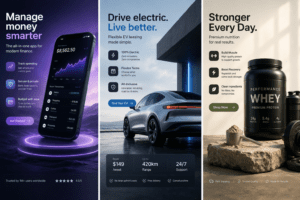
An example of a finance, automotive and fitness ad created by OpenAI.
This becomes risky from a branding perspective because differentiation is one of the few remaining advantages in highly saturated markets.
The brands performing best today simply combine AI with stronger creative direction and clearer brand positioning, rather than avoiding it.
AI can support the execution. It should not replace the thinking behind it.
AI Should Enhance Brand Identity, Not Replace It
Strong branding has always been about more than producing polished content.
A recognisable brand comes from consistency, personality, and having a point of view that feels distinct from competitors. Those qualities become even more important in digital environments where consumers are exposed to thousands of pieces of content every day.
AI should help brands strengthen those qualities rather than flatten them into generic outputs.
Right now, many businesses are prioritising speed so heavily that they are unintentionally weakening their own identity. The result is content that may look visually impressive but lacks anything truly memorable.
This creates a long-term issue because memorable brands tend to outperform generic ones over time. Familiarity increases trust, improves recall, and often strengthens overall campaign performance. When branding is diluted, businesses risk competing solely on price or visibility.
Technology can increase output, but it cannot define what a brand should stand for.
The Future Belongs to Brands That Combine AI With Original Thinking
Businesses should absolutely embrace AI. Ignoring it completely would be a mistake.
The brands likely to succeed over the next few years will not be those rejecting AI, nor those automating every part of their marketing without direction. The advantage will come from balance.
AI is incredibly valuable when paired with original thinking and strong creative judgment. It allows brands to move faster, test ideas more quickly, and compete more effectively in increasingly crowded markets.
This balance is already becoming more important at an industry level. According to research compiled from reports by Gartner, McKinsey, and Salesforce, the strongest performance gains are increasingly coming from businesses that combine AI efficiency with human creativity and strategic oversight rather than relying on full automation alone.
But speed alone has never built a memorable brand.
Consumers still connect with businesses that feel human. They remember brands with personality. They notice companies that communicate differently from everyone else and fight for attention online.
AI is not killing creativity. In many ways, it is creating more opportunities for brands willing to use it properly.
The challenge is making sure efficiency does not come at the expense of identity.
The brands that will benefit most from AI will be the ones using it to strengthen what already makes them different.